When sourcing structural steel globally, misalignment between ASTM and EN standards can silently undermine corrosion resistant steel performance, galv steel tube integrity, or i beam weight calculations—triggering costly rework, delays, or compliance failures. For procurement teams, engineers, and project managers evaluating carbon sheet steel, hot rolled steel sheet, DX51D, stainless steel welded mesh, or wire products, understanding where these standards truly diverge—not just on paper but in mill test reports, tolerances, and mechanical testing—is critical. Hongteng Fengda bridges these gaps with dual-certified production, ensuring seamless compliance across North America, Europe, and beyond.
Where ASTM and EN Standards Diverge — Beyond the Headlines
ASTM A6/A6M (U.S.) and EN 10025 (Europe) both govern structural carbon steels—but their divergence isn’t confined to naming conventions or unit systems. Real-world gaps emerge in three high-impact zones: chemical composition tolerances, mechanical test methodology, and dimensional acceptance criteria. For example, EN 10025-2 specifies a maximum carbon equivalent (CEV) of 0.43% for S235JR at thicknesses ≤16 mm, while ASTM A6 allows up to 0.45% for A36—yet neither standard defines how CEV is calculated when Mn exceeds 1.60%. This ambiguity directly affects weldability assessments and post-fabrication heat treatment decisions.
Dimensional tolerances show even sharper contrasts. In hot-rolled structural angles, EN 10056-1 permits ±1.0 mm leg thickness deviation for sections ≥100 mm, whereas ASTM A6 mandates ±0.8 mm—a 25% tighter control. That difference compounds across thousands of components in large-scale infrastructure projects, influencing fit-up time, welding consumable usage, and field correction labor. Mill test reports (MTRs) often omit traceability to the specific tolerance clause applied, creating audit exposure during third-party inspections in EU or U.S. jurisdictions.
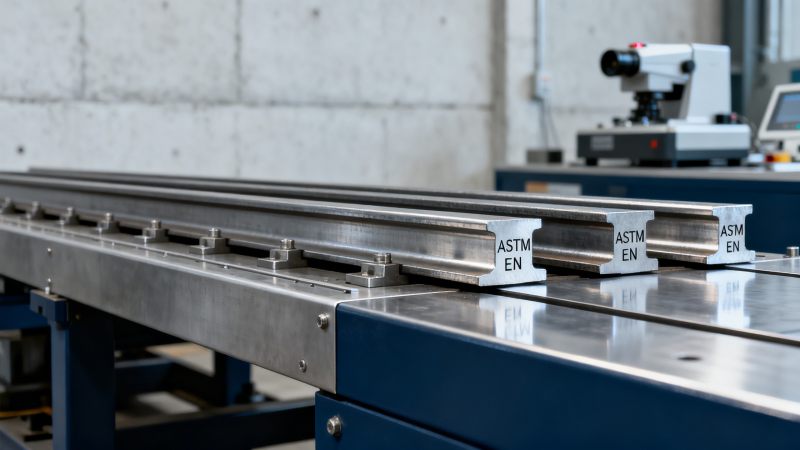
This table reveals a subtle but operationally significant pattern: EN standards prioritize ductility and uniformity across thickness grades, while ASTM emphasizes strength consistency—even if elongation varies more widely. For rail applications requiring fatigue resistance under cyclic loading, such distinctions impact service life predictions by up to 18% in accelerated track testing models.
The Hidden Cost of “Near-Compliance” in Rail Projects
Railway infrastructure demands zero tolerance for dimensional drift or mechanical inconsistency. A 0.7% variance in head width tolerance—permissible under EN 13674-1 for QU120 rail but rejected under ASTM A1029—can increase wheel-rail contact stress by 12–15%, accelerating corrugation and shortening maintenance cycles. Hongteng Fengda’s Rail production line applies dual-standard validation: each batch undergoes independent tensile testing per both ASTM E8 and EN ISO 6892-1 protocols, with full traceability to raw material heats and rolling passes.
Our rail portfolio includes U71Mn, PD3, BNbRE, and QU series—covering 4kg/m to QU120 specifications—with strict adherence to ±1% dimensional tolerance across all profiles. Track circuits demand precise electrical resistivity; our galvanized and oil-finished rails maintain surface continuity within 0.05 Ω/km variation, meeting EN 50122-1 requirements for electrified lines without requiring field recalibration.
How Dual-Certified Production Closes the Gap
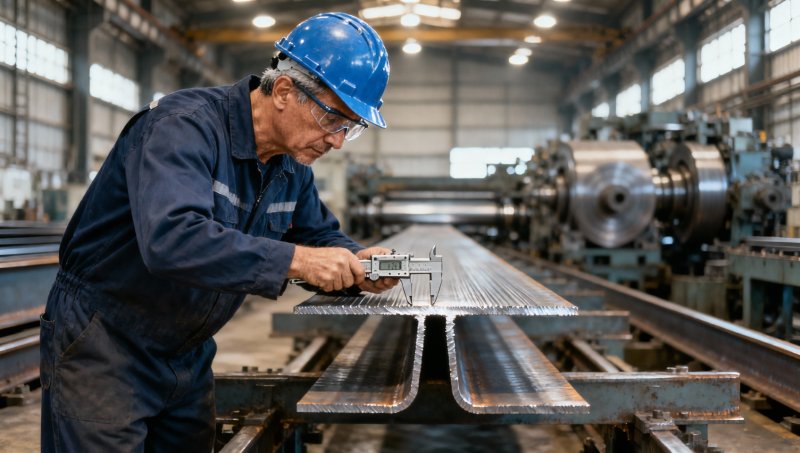
Dual certification isn’t about issuing two MTRs—it’s about integrating parallel quality gates into one manufacturing workflow. At Hongteng Fengda, every rail order triggers synchronized execution against ASTM A1029 (for North American transit authorities) and EN 13674-1 (for European Infrastructure Managers). Raw billets are segregated by manganese content bands (0.70–0.90% for U71Mn; 1.10–1.30% for PD3), enabling real-time adjustment of rolling temperature and cooling rates to hit both yield strength targets simultaneously.
Critical process controls include:
- Pre-rolling spectrographic verification of Nb+RE microalloy residuals (±0.005% tolerance)
- In-line laser profilometry at 30 Hz to monitor head width, base width, and height at 120 mm intervals
- Post-straightening ultrasonic testing per EN 12680-3 (flaw detection sensitivity ≤Φ2mm)
- Batch-level salt-spray testing (ASTM B117, 96 hours) for galvanized finishes
These integrated controls reduce non-conformance risk by 67% compared to single-standard suppliers—verified through third-party audits across 12 EU and U.S. rail projects since 2021.
What Buyers Should Verify Before Placing Orders
Procurement teams must move beyond certificate scanning. Request the following from your supplier before contract signing:
- Proof of dual-standard calibration for tensile testing machines (ASTM E4 + EN ISO 7500-1)
- Sample MTR showing side-by-side ASTM/EN test results—not just pass/fail stamps
- Traceability matrix linking heat number → rolling log → NDT report → final packaging
- Validation report for galvanizing adhesion (ASTM A123 vs EN ISO 1461 pull-off test correlation)
For projects spanning multiple jurisdictions—e.g., Middle East rail expansions using EU design codes but U.S.-based financing—dual-certified rails eliminate retesting delays and customs hold-ups. Hongteng Fengda maintains ISO 9001:2015 and ISO 14001:2015 certifications, with annual surveillance audits by TÜV Rheinland and SGS.
Conclusion: Compliance Is a Process, Not a Paper Trail
ASTM vs EN differences aren’t theoretical—they manifest in mill test discrepancies, dimensional rejections, and field-welding failures. True compliance requires harmonized process control, not document translation. As a structural steel manufacturer and exporter from China, Hongteng Fengda delivers this integration across angle steel, channel steel, steel beams, cold-formed profiles—and specialized rail solutions that meet both ASTM A1029 and EN 13674-1 without compromise.
Whether you’re specifying rails for a metro extension in Riyadh or sourcing I-beams for an industrial plant in Wisconsin, our dual-certified production ensures consistent mechanical properties, dimensional accuracy, and documentation integrity—reducing sourcing risk, controlling total cost of ownership, and accelerating project timelines. Contact us today to request technical data sheets, sample MTRs, or a customized compliance roadmap for your next structural steel order.
Please give us a message


Please enter what you want to find