Choosing the right ASTM standard steel plate affects compliance, fabrication, safety, and total project cost.
Many errors happen when grade names are treated as interchangeable without checking chemistry, toughness, welding behavior, or delivery condition.
This guide explains common ASTM standard steel plate grades, where they fit, and which sourcing mistakes create avoidable technical risk.
What does ASTM standard steel plate actually mean?
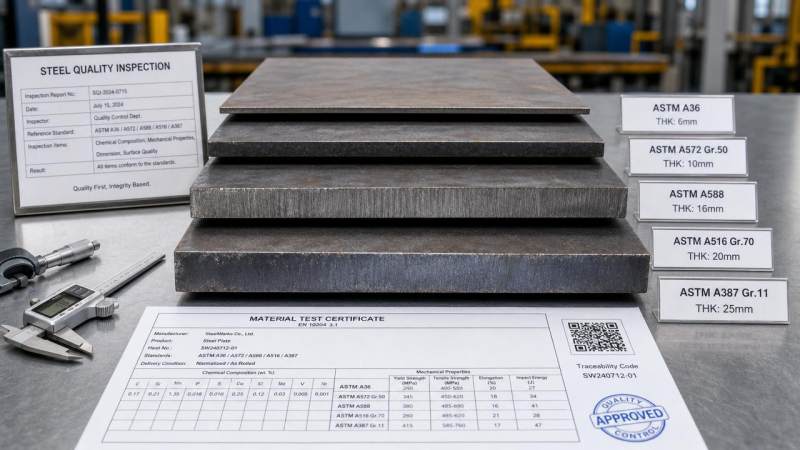
ASTM standard steel plate refers to plate produced and tested under specific ASTM material specifications.
The standard defines chemical composition, mechanical properties, testing requirements, and sometimes heat treatment or impact testing conditions.
It does not mean every ASTM plate has the same strength or use.
For example, ASTM A36, A572, A516, and A514 all belong to the broad ASTM family, but they serve very different applications.
Confusion starts when people compare only yield strength and ignore service environment, formability, weldability, or pressure vessel requirements.
A correct evaluation begins with the code requirement, then moves to design load, operating temperature, fabrication method, and inspection level.
Which ASTM standard steel plate grades are most commonly used?
Several grades appear repeatedly in structural, industrial, and fabrication work.
ASTM A36
A36 is a common carbon structural plate with good weldability and broad availability.
It is often selected for general supports, base plates, brackets, frames, and non-critical structural components.
Its advantage is simplicity, but it may not satisfy higher strength or low-temperature toughness demands.
ASTM A572
A572, especially Grade 50, is a high-strength low-alloy structural plate.
It helps reduce section weight while maintaining structural capacity.
This ASTM standard steel plate is common in buildings, bridges, heavy equipment, and fabricated steel structures.
ASTM A588
A588 is a weathering steel grade developed for improved atmospheric corrosion resistance.
It performs well in suitable exposure conditions, but not every climate supports stable protective patina formation.
ASTM A516
A516 is widely used for pressure vessel plate, especially in moderate and lower temperature service.
Grade 60, 65, and 70 are common options.
This grade is not a direct substitute for ordinary structural plate, even if dimensions look similar.
ASTM A514
A514 is a quenched and tempered high-strength alloy plate.
It is selected for demanding equipment, cranes, and wear-resistant structural parts requiring very high strength.
However, fabrication control becomes more critical because welding and heat input must be managed carefully.
How do common selection mistakes happen?
The most frequent errors are not caused by missing data.
They happen because data is read out of context.
- Choosing by price alone, without checking required standard and supplementary tests.
- Assuming higher strength always means better project value.
- Ignoring thickness effects on toughness, bending, or weld procedures.
- Treating mill certificates as complete without reviewing heat number traceability.
- Confusing plate standards with coil or sheet standards used in other steel products.
This last mistake appears often in mixed sourcing projects.
For example, support structures may use ASTM standard steel plate, while cladding or formed components use galvanized material.
In those cases, a separate product such as Galvanized Steel Coil Sheet may be more suitable.
Typical grades include DX51D+Z, SGCC, and S350GD+Z, with thickness from 0.12mm to 3.5mm and zinc coatings from Z80 to Z275.
That product fits corrosion protection and forming needs, but it should not be mistaken for pressure vessel or heavy structural plate.
How should ASTM standard steel plate be matched to application?
Application matching works best when technical requirements are listed in sequence.
- Confirm the governing design code or customer specification.
- Define whether the part is structural, pressure-retaining, wear-exposed, or corrosion-exposed.
- Check required minimum yield, tensile range, and impact testing temperature.
- Review welding process, preheat needs, and post-fabrication treatment.
- Verify plate thickness, rolling direction, tolerances, and certification documents.
A36 or A572 may work well for general structures.
A516 is usually preferred when pressure vessel code compliance is required.
A588 can support exposed architectural or bridge use where atmospheric corrosion resistance matters.
A514 is better reserved for cases needing very high strength with controlled fabrication.
The right ASTM standard steel plate is the one that satisfies the real service condition, not the broadest marketing claim.
What differences should be checked beyond grade name?
A grade name alone never tells the full story.
Several details can change performance significantly.
These checks help avoid the false assumption that any ASTM standard steel plate with a similar strength number is an acceptable replacement.
How can sourcing risk, cost, and lead time be controlled?
Risk control starts before the order is placed.
A clear inquiry package shortens quotation time and reduces revision cycles.
- State exact ASTM grade, thickness, width, length, and quantity.
- Add supplementary requirements for impact testing, ultrasonic testing, or normalization if needed.
- Specify end use when substitution is not allowed.
- Request MTC review before shipment for critical projects.
- Confirm export packing, marking, and traceability method.
Cost can rise when the wrong grade is ordered and later upgraded through rework, retesting, or delayed approval.
Lead time also increases when uncommon dimensions or special test requirements are added after production begins.
A reliable steel supplier should align available mill sources with ASTM, EN, JIS, or GB requirements while keeping documentation consistent.
For global structural supply, stable production capacity and strict quality control remain as important as the quoted price.
Quick FAQ: what should be remembered before ordering?
Selecting ASTM standard steel plate should never rely on grade familiarity alone.
The best choice comes from matching standard, mechanical properties, fabrication needs, and service conditions.
When specifications are reviewed carefully, common mistakes become avoidable, sourcing becomes faster, and technical approval becomes smoother.
If a project includes structural members, plate components, and corrosion-protected formed steel, coordinated sourcing can reduce risk and improve delivery consistency.
Hongteng Fengda supports international steel supply with reliable manufacturing, customized solutions, and compliance across major global standards.
Please give us a message


Please enter what you want to find