Many buyers focus on price and thickness but miss critical ASTM Steel Coil details that affect compliance, performance, and total procurement cost. For sourcing teams in construction and manufacturing, understanding the overlooked parts of ASTM standards can reduce quality risks, avoid project delays, and support better supplier decisions when buying from global structural steel manufacturers.
In steel procurement, ASTM Steel Coil is rarely judged by one factor alone. Coil grade, base standard, mechanical property tolerances, coating condition, edge condition, test documentation, and dimensional consistency all influence whether the material will perform as expected after forming, welding, slitting, or structural fabrication.
For procurement teams sourcing from overseas mills or structural steel suppliers in China, the cost difference between a well-specified order and an incomplete order can appear small at quotation stage, yet expand by 5%–15% once claims, rework, delayed site installation, or secondary inspection are added.
Why ASTM Steel Coil Specifications Are Often Misread in Purchasing
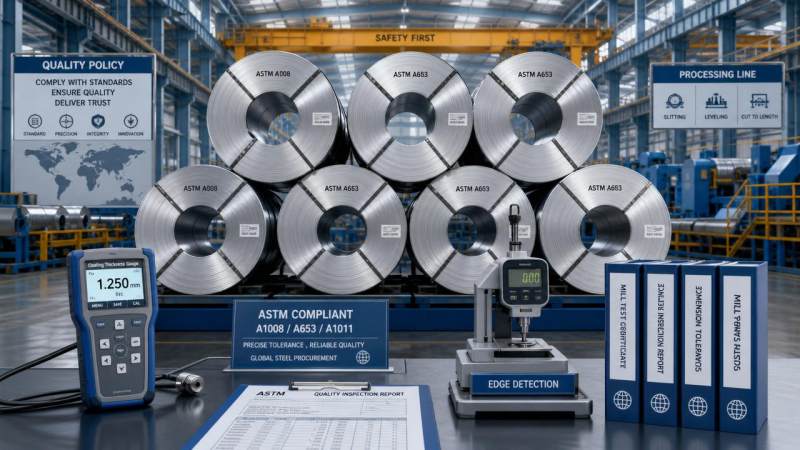
ASTM standards are designed to define material chemistry, mechanical performance, dimensional acceptance, and sometimes coating or testing rules. The problem is that many purchase orders mention only “ASTM Steel Coil” plus thickness and width. That is not enough for reliable supply control.
The difference between standard name and complete material requirement
A buyer may request ASTM A36 coil, ASTM A572 coil, or another ASTM grade, but still omit key details such as yield strength range, tensile strength, surface finish, tolerance class, or whether the material will be used for bending, punching, or galvanizing. In practice, 4 to 6 missing items can create major downstream disagreement.
What purchasing teams usually include
- Thickness, such as 2.0 mm, 3.5 mm, or 6.0 mm
- Width, such as 1,250 mm or 1,500 mm
- Quantity in tons, often 25–200 tons per order
- Basic grade reference, such as A36 or A572
What they often leave out
- Required mechanical properties after forming or welding
- Permitted thickness tolerance, flatness tolerance, and camber
- Heat number traceability and mill test certificate format
- Whether the steel is intended for structural conversion into sections or fabricated parts
This gap matters because ASTM Steel Coil may pass a basic grade test but still fail a buyer’s actual processing conditions. For example, a coil within nominal chemistry range can still cause cracking during cold forming if bendability and elongation expectations were never aligned before production.
The table below shows several commonly overlooked purchasing points and how they affect total sourcing results.
The main takeaway is simple: ASTM naming identifies a framework, not a complete procurement instruction. A stronger order sheet reduces ambiguity, especially when multiple countries, mills, and fabrication stages are involved.
Overlooked ASTM Steel Coil Factors That Affect Compliance and Performance
Buyers evaluating ASTM Steel Coil for construction, industrial equipment, and manufacturing should check at least 6 technical points before confirming an order. These points influence whether the steel can move smoothly from mill production to final installation.
1. Grade substitution is not always risk-free
International sourcing often involves comparison between ASTM, EN, JIS, and GB grades. While cross-reference tables are useful, they do not guarantee identical performance. Yield strength may look close, yet carbon equivalent, impact behavior, or weldability may differ enough to matter in structural or fabricated applications.
This is especially important when coil is later converted into channels, beams, brackets, or cold formed profiles. A supplier that understands both coil standards and structural fabrication can better advise whether a proposed substitute is commercially acceptable or technically risky.
2. Mechanical properties should match the final use, not only the standard
Procurement teams sometimes focus on minimum yield strength but ignore elongation, tensile range, or forming behavior. For parts requiring punching, roll forming, or repeated welding, a balanced property profile is often more useful than simply chasing the highest strength number.
If the application includes heavy forming, request confirmation of tensile strength, elongation, and process suitability. If the material is for load-bearing structures, ask whether the coil will maintain required properties after cutting and fabrication. These checks can prevent rejection after only 1 or 2 production batches.
3. Coil tolerances influence waste rate and downstream efficiency
A steel coil that complies generally with ASTM grade chemistry may still create problems if thickness variation, width deviation, or flatness are too loose for the buyer’s processing line. In many manufacturing environments, small dimensional variation increases scrap, slows machine setup, and affects assembly consistency.
For example, slit coils feeding automated lines may require tighter width control, while structural fabricators may prioritize flatness and edge condition. If a buyer handles 100 tons per month, even a 2% increase in scrap can become a meaningful cost issue over a 6- to 12-month contract.
4. Coating and corrosion expectations must be defined early
If ASTM Steel Coil will be used in outdoor fabrication, coastal installations, or chemically aggressive environments, coating expectations should be aligned before production. “Galvanized” alone may not be enough. Buyers should clarify whether they need hot-dip performance, paint-ready surface, or a specific post-processing route.
This procurement logic also applies to section steel products used in the same project. For example, some buyers source coil together with fabricated profiles or channels and expect similar corrosion behavior across components. In that case, coating specification should be coordinated across all steel items.
A good example is Structural Steel Channel, which is widely used in building structure, curtain wall engineering, mechanical equipment, vehicle manufacturing, ship beams, and industrial furnaces. Common material options include A36, A572 GR50, Q235B, Q345B, S235JR, and S355JR, with sizes ranging from 50*37*4.5 to 400*104*14.5 and standard lengths of 6 m, 9 m, or 12 m. For corrosive environments, galvanized or painted finishes can materially improve service life.
When coil is the starting material for structural sections, procurement teams should also review final-product requirements such as tensile strength, section consistency, and certification compatibility. In some channel applications, tensile strength expectations may reach ≥520 MPa depending on design and material route, so early coordination between coil supply and fabrication requirements is essential.
How Procurement Teams Can Build a Better ASTM Steel Coil RFQ
A practical request for quotation should do more than ask for price per ton. It should reduce interpretation risk and shorten the back-and-forth between buyer, exporter, mill, and inspection party. In most B2B steel transactions, a stronger RFQ can save 3–5 working days during technical clarification.
The 8-point RFQ checklist
- ASTM standard and exact grade
- Nominal thickness, width, and coil weight range
- Tolerance expectations for thickness and width
- Surface condition and edge type
- Mechanical property requirements
- End-use description, such as forming, welding, or structural conversion
- Documentation package, including MTC and inspection request
- Packing, marking, and shipment terms
The next table can help buyers decide which items should be mandatory in the RFQ and which can remain negotiable depending on the project.
The key conclusion from the table is that technical clarity and document clarity are equally important. A low-price offer becomes less attractive if it leaves major questions unresolved until after production starts.
Lead time planning for imported coil
For international purchases, buyers should separate mill production time from logistics time. Depending on grade, size, and order volume, production may take 2–4 weeks, while export booking, port handling, and sea transit may add another 2–6 weeks. If third-party inspection is required, allow an extra 3–5 working days.
This timeline matters for project-based procurement because ASTM Steel Coil may be only one input among plates, beams, channels, and fabricated parts. If coil arrival slips by even 7 days, linked fabrication schedules can also move, especially when materials are planned as one integrated package.
Common Buyer Mistakes When Comparing Global Suppliers
Global steel sourcing is not only about comparing three quotations and choosing the lowest number. Buyers need to compare commercial terms and technical execution side by side. In ASTM Steel Coil procurement, the cheapest quote may exclude tests, tighter tolerances, rust-prevention packing, or traceable marking.
Mistake 1: Comparing offers with different technical bases
One supplier may quote based on standard tolerances, another on stricter tolerances, and a third on an equivalent non-ASTM grade. If the RFQ is not precise, buyers end up comparing 3 different products as though they were identical. That creates avoidable risk at contract review stage.
Mistake 2: Treating documentation as secondary
In many projects, customs, engineering approval, or contractor acceptance depend on the right paperwork. A missing heat number link or incomplete mill certificate can delay unloading or site acceptance. Documentation should be reviewed before shipment, not after the vessel arrives.
Mistake 3: Ignoring supplier experience beyond the coil itself
A supplier serving structural steel buyers often understands how coil interacts with section steel, fabricated components, and project delivery schedules. That broader view helps procurement teams avoid isolated decisions. It is especially valuable when the same project includes channels, beams, cold formed profiles, and custom steel parts.
What to verify in 3 steps
- Ask which international standards the supplier routinely handles, such as ASTM, EN, JIS, and GB
- Confirm whether inspection, traceability, and export packing are handled in-house or coordinated externally
- Check whether the supplier can support both standard specifications and OEM structural steel requirements
For buyers working with global construction and manufacturing projects, this integrated capability can reduce sourcing risk. A manufacturer and exporter familiar with structural steel applications is better positioned to coordinate material consistency, lead time, and quality documentation across multiple steel categories.
Practical Sourcing Advice for ASTM Steel Coil Buyers
The most effective procurement strategy is to turn technical assumptions into written order conditions. That approach protects both buyer and supplier. It also improves quotation accuracy, production planning, and claim handling if problems arise.
A balanced decision model
Instead of awarding business on unit price alone, use a 4-factor review: technical compliance, production stability, document readiness, and delivery predictability. If one offer is 2% cheaper but carries higher uncertainty on tolerance or certificates, the total procurement outcome may still be worse.
Questions worth asking before order confirmation
- Is the quoted ASTM Steel Coil based on the exact requested grade or a proposed equivalent?
- What tolerance range will be applied for thickness and width?
- Can the supplier provide MTC and third-party inspection support before loading?
- What is the realistic production lead time for 25 tons, 100 tons, or larger monthly demand?
- Will packing and rust prevention match the shipping route and storage period?
For buyers sourcing from China, working with an experienced structural steel manufacturer and exporter can create additional value. Companies serving North America, Europe, the Middle East, and Southeast Asia are often familiar with international standard matching, export documentation, and project-oriented supply coordination.
Hongteng Fengda focuses on structural steel manufacturing and export, supplying angle steel, channel steel, steel beams, cold formed profiles, and customized structural steel components under major international standards including ASTM, EN, JIS, and GB. For procurement teams that need stable production capacity, quality control, and dependable lead times, this kind of supplier profile is often more useful than a trader offering limited technical support.
ASTM Steel Coil procurement becomes safer when buyers define the full technical requirement, not only the visible commercial terms. Grade matching, mechanical properties, tolerances, coating expectations, certificates, and delivery planning all affect project cost and schedule. If you need support with ASTM-based steel sourcing, structural components, or a coordinated material solution for construction and manufacturing projects, contact us now to get a tailored quotation, discuss product details, and explore the right supply plan for your next order.
Please give us a message


Please enter what you want to find