ASTM Standard Steel Pipe: Decoding A53, A106 & A333 Grades for Oil & Gas, Power and Infrastructure Projects
ASTM standard steel pipe selection is not a matter of specification matching alone—it’s a technical evaluation anchored in service environment, failure mode prevention, and long-term system integrity. For engineers assessing piping systems in oil & gas transmission, power plant steam circuits, or cryogenic infrastructure, choosing between ASTM A53, A106, and A333 is not about interchangeability but about aligning metallurgical behavior with operational boundaries. Each grade carries distinct chemical, thermal, and mechanical constraints that govern its safe envelope—not just at design temperature, but across fabrication, hydrotesting, commissioning, and decades of cyclic service.
A53 is the baseline structural pipe specification—welded or seamless—intended for low-pressure, ambient-temperature applications such as water distribution, structural supports, and non-critical utility lines. Its carbon content is capped at 0.25%, with manganese up to 1.20%, and no mandatory impact testing. While Grade B (the most commonly used) offers minimum tensile strength of 415 MPa and yield of 240 MPa, those values degrade rapidly above 350°C. More critically, A53 does not require Charpy V-notch testing, nor does it mandate grain size control or fine austenite conditioning—making it unsuitable where thermal shock, fatigue loading, or brittle fracture risk exists. It is often misapplied in boiler feedwater lines or flare headers simply because it is widely stocked and cost-advantaged; however, its lack of notch toughness verification renders it non-compliant under ASME B31.4 or B31.8 for many pressurized hydrocarbon services.
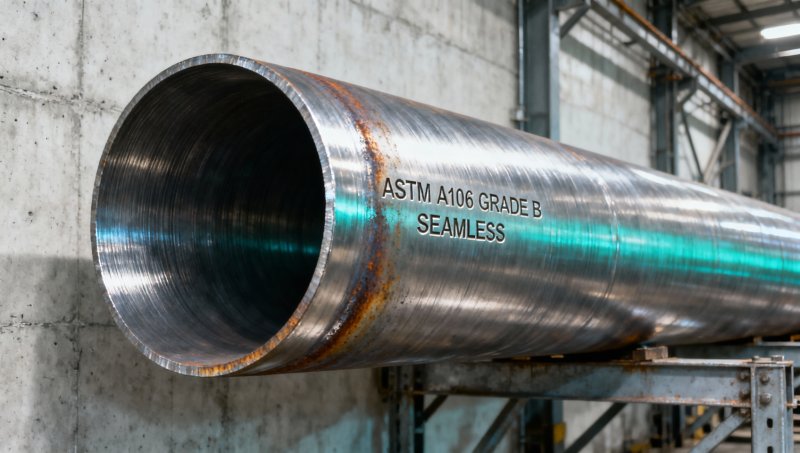
A106, by contrast, is engineered for high-temperature, high-pressure service—particularly in refinery process piping, superheater tubes, and main steam lines. All three grades (A, B, C) are seamless only, with tighter chemical controls: phosphorus and sulfur limited to 0.035% max, and silicon added intentionally (0.10–0.60%) to improve oxidation resistance. A106 Grade B—the workhorse variant—requires minimum tensile strength of 415 MPa and yield of 240 MPa *at room temperature*, but crucially, its allowable stress values are defined across a full temperature range in ASME Section II Part D, validated by elevated-temperature tensile data. More importantly, A106 mandates heat treatment for all seamless pipe over NPS 4, ensuring uniform ferrite-pearlite microstructure and eliminating cold-work-induced anisotropy. That requirement directly affects weldability, post-weld heat treatment (PWHT) planning, and residual stress management—factors routinely overlooked during procurement but decisive during field welding qualification.
A333 is the low-temperature counterpart—designed explicitly for service down to –101°C. Unlike A53 or A106, A333 is not defined by strength alone; its core compliance hinges on impact performance. All eight grades (Grades 1 through 11, excluding 4 and 9) require Charpy V-notch testing at specified temperatures—Grade 6 (the most common), for example, must achieve minimum average energy of 20 J at –46°C. This is not a one-time lab check: ASTM A333 requires test specimens to be taken from the same heat and same reduction ratio as production pipe, and impact testing must be performed on both longitudinal and transverse orientations when wall thickness exceeds 12.5 mm. The specification also enforces strict limits on residual elements (e.g., copper ≤ 0.35%, nickel ≤ 0.40%) to prevent temper embrittlement during long-term operation in sour or cyclic environments. A333 pipe is frequently mis-specified in LNG transfer lines when Grade 6 is selected without verifying that the actual service temperature—accounting for transient cooldown during start-up or pressure drop—falls within its certified impact envelope.
Chemical composition differences are not academic—they drive real-world behavior. A106’s higher silicon improves scale adhesion above 450°C, reducing spalling-induced erosion in superheater bends. A333’s controlled aluminum addition (0.02–0.06%) promotes fine-grain ferrite formation, essential for consistent low-temperature toughness. A53’s broader tolerance on residual elements increases susceptibility to hydrogen-induced cracking in wet H₂S service—even if hardness is controlled—because trace arsenic or antimony segregate to grain boundaries under stress. These distinctions cannot be resolved by mill test reports alone; they require review of ladle analysis records, heat treatment charts, and independent verification of impact test methodology—including striker velocity, anvil radius, and specimen machining tolerances.
Testing protocols further separate these grades. A53 permits hydrostatic testing only—or non-destructive electric testing (ET) for welded pipe—but allows visual inspection as the sole method for surface defect detection. A106 requires hydrostatic testing for all sizes, and seamless pipe must undergo ultrasonic testing (UT) or radiography (RT) per ASTM E213/E273 if ordered for critical service. A333 mandates both hydrostatic and non-destructive testing, plus mandatory impact testing on each heat—and if multiple heats are blended into one order, impact tests must be repeated for each heat. That has direct implications for project QA/QC planning: a single A333 heat lot may require six to eight Charpy specimens across three temperatures, with full traceability back to the original ingot pour.
Application suitability cannot be inferred from nominal service temperature alone. A refinery crude preheat exchanger operating at 280°C may appear compatible with A53 on paper—but thermal cycling between shutdowns introduces fatigue stresses that A53’s uncontrolled grain structure cannot withstand reliably. Similarly, an offshore platform firewater line rated for –15°C ambient may require A333 Grade 6 not for fluid temperature, but because seawater spray combined with wind chill can locally depress metal temperature below –30°C during winter storms—triggering brittle fracture if toughness is unverified.
For technical evaluators sourcing from global suppliers, traceability is as critical as specification compliance. ASTM standards require mill test reports (MTRs) to include heat number, chemical analysis, mechanical test results, heat treatment details, and dimensional verification—but not all manufacturers maintain full batch-level traceability across rolling, heat treatment, and finishing. Reputable producers implement positive material identification (PMI) at multiple stages, retain raw material certificates, and archive test data for minimum 10 years—requirements aligned with ISO 9001:2015 and ASME QA-1. In practice, this means evaluating not just whether a supplier *claims* ASTM compliance, but whether their quality system enables reconstruction of every parameter influencing fracture mechanics, creep resistance, or corrosion initiation.
 Material substitution remains a persistent risk—not due to intentional noncompliance, but to ambiguous specification writing. Phrases like “ASTM-equivalent” or “A106-B grade” without referencing the full designation (e.g., ASTM A106/A106M-23, Grade B, Seamless) create gaps in enforcement. A pipe marked “A106 Gr.B” but produced to an older edition may omit required grain size reporting or omit post-weld heat treatment validation—both critical for high-cycle fatigue life. Technical evaluators must verify edition year, supplementary requirements (e.g., S1 for hydrotest, S5 for impact testing), and any purchaser-specific addenda before approving submittals.
In contexts where stainless alternatives are considered—for aggressive chemical exposure, chloride-rich environments, or extended service life—316 Stainless Steel Coil offers superior pitting resistance and elevated-temperature strength retention. However, its use introduces new variables: thermal expansion mismatch with carbon steel flanges, galvanic coupling risks in mixed-material systems, and higher fabrication costs due to work hardening during bending. It does not replace the need for correct carbon steel grade selection—it redefines the boundary conditions where carbon steel ceases to be technically viable.
Ultimately, ASTM standard steel pipe selection is a systems decision—not a materials checkbox. It demands cross-referencing design codes (ASME B31.4, B31.8, BPVC), environmental profiles (minimum/maximum service temperature, thermal cycling frequency, fluid aggressiveness), and fabrication constraints (welding procedure specifications, PWHT feasibility, NDE accessibility). When those parameters converge, A53, A106, and A333 are not interchangeable options. They are distinct engineering solutions—each validated for a specific failure mode envelope, and each carrying enforceable limits that must be respected at every stage from procurement to commissioning.
Material substitution remains a persistent risk—not due to intentional noncompliance, but to ambiguous specification writing. Phrases like “ASTM-equivalent” or “A106-B grade” without referencing the full designation (e.g., ASTM A106/A106M-23, Grade B, Seamless) create gaps in enforcement. A pipe marked “A106 Gr.B” but produced to an older edition may omit required grain size reporting or omit post-weld heat treatment validation—both critical for high-cycle fatigue life. Technical evaluators must verify edition year, supplementary requirements (e.g., S1 for hydrotest, S5 for impact testing), and any purchaser-specific addenda before approving submittals.
In contexts where stainless alternatives are considered—for aggressive chemical exposure, chloride-rich environments, or extended service life—316 Stainless Steel Coil offers superior pitting resistance and elevated-temperature strength retention. However, its use introduces new variables: thermal expansion mismatch with carbon steel flanges, galvanic coupling risks in mixed-material systems, and higher fabrication costs due to work hardening during bending. It does not replace the need for correct carbon steel grade selection—it redefines the boundary conditions where carbon steel ceases to be technically viable.
Ultimately, ASTM standard steel pipe selection is a systems decision—not a materials checkbox. It demands cross-referencing design codes (ASME B31.4, B31.8, BPVC), environmental profiles (minimum/maximum service temperature, thermal cycling frequency, fluid aggressiveness), and fabrication constraints (welding procedure specifications, PWHT feasibility, NDE accessibility). When those parameters converge, A53, A106, and A333 are not interchangeable options. They are distinct engineering solutions—each validated for a specific failure mode envelope, and each carrying enforceable limits that must be respected at every stage from procurement to commissioning.
Previous page: Already the first one
Next page: Already the last one
Please give us a message


Please enter what you want to find