Understanding ASTM A6 tolerances for high strength steel is essential for technical evaluators who need to verify dimensional accuracy, structural reliability, and compliance before procurement or fabrication.
These tolerances define acceptable variations in thickness, width, length, straightness, and shape for structural steel products, helping engineers and buyers reduce project risk.
For global construction and industrial applications, choosing a manufacturer that follows ASTM requirements ensures consistent quality, easier inspection, and better performance in demanding structural environments.
What Technical Evaluators Really Need to Know First
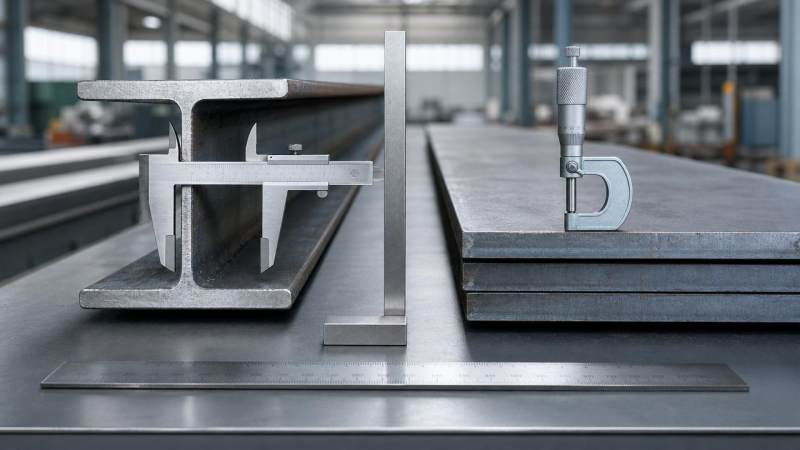
ASTM A6 is not a high strength steel grade by itself. It is a general specification covering dimensional, ordering, testing, and delivery requirements.
High strength grades such as ASTM A572, A588, A913, or A992 often reference ASTM A6 for product tolerances and general acceptance conditions.
For technical evaluators, the key question is not only whether the steel has sufficient yield strength, but whether it can be fabricated accurately.
Dimensional deviations affect connection fit-up, welding preparation, erection alignment, load transfer, and inspection acceptance during structural steel project execution.
Therefore, ASTM A6 tolerances for high strength steel should be reviewed together with project drawings, purchase orders, fabrication allowances, and inspection procedures.
What ASTM A6 Covers for Structural Steel Products
ASTM A6/A6M applies to rolled structural steel plates, shapes, sheet piling, and bars when referenced by the relevant material specification.
It provides common rules for dimensions, permissible variations, mass, testing frequency, certification, marking, and general delivery requirements.
For steel beams, channels, angles, and plates, ASTM A6 helps establish whether the delivered material falls within acceptable manufacturing variation.
This is especially important for high strength steel because designers often use tighter weight margins and more demanding performance assumptions.
ASTM A6 does not replace project-specific tolerances. Instead, it provides a baseline that engineers can use for procurement and inspection decisions.
Thickness Tolerance: Why It Matters More Than It Seems
Thickness tolerance is one of the first items evaluators check because it influences section capacity, weld design, bolt grip, and component weight.
In structural plates and rolled sections, small variations in thickness are normal, but they must remain within the relevant ASTM A6 table.
For high strength steel, under-thickness may reduce effective cross-sectional area, while over-thickness may create fit-up issues or unnecessary cost.
Technical evaluators should confirm whether thickness is measured at specified locations, especially for rolled shapes with flanges, webs, and tapered surfaces.
A proper mill certificate should identify the steel grade, heat number, product size, mechanical results, and applicable standard references.
Width, Length, and Cut Accuracy in Procurement Review
Width and length tolerances directly affect fabrication planning, nesting efficiency, shipping dimensions, and installation readiness at the construction site.
For plates, evaluators should verify ordered dimensions against actual measured dimensions, considering whether the material is mill edge or cut edge.
For beams, channels, and angles, length tolerance is critical when members are ordered near final fabrication size or used in modular assemblies.
If steel is supplied for CNC cutting, drilling, or welding, even acceptable ASTM variation may require allowance in the fabrication process.
Buyers should specify whether exact cut-to-length service, standard mill length, or fabrication-ready components are required before production begins.
Straightness, Camber, and Sweep: Fit-Up Risk Indicators
Straightness is often more important in practice than buyers expect because it affects erection alignment and connection hole matching.
ASTM A6 includes permissible variations for sweep, camber, and out-of-straightness depending on the product form and section type.
High strength beams used in long-span structures, crane supports, industrial platforms, and bridge-related components require careful straightness control.
Excessive sweep can cause field correction costs, delayed erection, or rejection if it prevents proper alignment within project tolerances.
Evaluators should ask suppliers how straightness is controlled, inspected, documented, and protected during loading, transportation, and unloading.
Shape Tolerances for Beams, Channels, Angles, and Plates
Shape tolerances cover the geometric features that determine whether a product can perform as intended after fabrication and installation.
For beams, evaluators often examine flange width, flange tilt, web position, web depth, and overall section geometry.
For channels and angles, leg length, squareness, twist, and local distortion can affect bolted connections and welded assemblies.
For plates, flatness can be critical when the material is used for base plates, gussets, stiffeners, or precision-fabricated components.
ASTM A6 provides acceptance limits, but project drawings may require tighter tolerances for critical structures or automated fabrication lines.
How ASTM A6 Connects With High Strength Steel Grades
High strength steel grades are usually controlled by their own material specifications for chemistry, tensile properties, yield strength, and impact requirements.
ASTM A572, for example, defines high strength low alloy structural steel requirements, while ASTM A6 provides general delivery and tolerance conditions.
ASTM A992 is widely used for structural shapes, particularly wide flange beams, and also relies on general specification requirements.
ASTM A588 covers weathering steel, where corrosion resistance matters, but dimensional acceptance still depends on applicable general requirements.
Evaluators should never assume that high yield strength automatically means better dimensional accuracy. Strength and tolerance compliance are separate acceptance categories.
Inspection Documents Evaluators Should Request
A reliable supplier should provide mill test certificates that match the purchase order, product marking, heat number, and delivered steel batch.
The certificate should list chemical composition, mechanical properties, applicable ASTM grade, heat treatment when relevant, and inspection status.
For dimensional verification, technical evaluators may also request inspection records showing thickness, length, straightness, and visual surface checks.
When dealing with large projects, incoming inspection plans should define sampling frequency, measurement tools, acceptance criteria, and nonconformity handling.
This approach helps prevent disputes because both buyer and manufacturer understand how ASTM A6 tolerances will be interpreted.
Common Misunderstandings About ASTM A6 Tolerances
One common mistake is treating ASTM A6 as a fabrication tolerance standard. It mainly addresses mill product tolerances, not assembled structure tolerances.
Another misunderstanding is believing every product has one universal tolerance. In reality, tolerances vary by product form, size, thickness, and dimension.
Some buyers also assume tighter tolerance is always better. Tighter requirements can increase production cost, inspection burden, and delivery time.
Technical evaluators should identify which dimensions are function-critical and which can follow standard mill tolerance without affecting final performance.
This balanced approach supports safe design, efficient procurement, and reasonable cost control across international structural steel sourcing projects.
Practical Evaluation Checklist Before Placing an Order
Before procurement, confirm the steel grade, product form, dimension unit, standard version, and whether ASTM A6/A6M is explicitly referenced.
Review drawings to identify critical dimensions, connection zones, welding areas, bolt-hole relationships, and members requiring tighter straightness control.
Check whether the supplier can manufacture angle steel, channel steel, beams, cold formed profiles, or customized components under controlled processes.
Ask how dimensional inspection is performed, which measuring tools are used, and whether inspection data can be shared before shipment.
For export projects, also confirm packing, corrosion protection, marking, container loading, and traceability documentation to reduce receiving risks.
Where Related Steel Products May Require Separate Standards
Not every steel product used in a structural or industrial project is governed by ASTM A6, even when supplied by the same manufacturer.
For example, lifting, mining, marine, elevator, crane, and cableway applications may require wire rope products under different technical standards.
A product such as Galvanized Steel Wire Rope may involve tensile strengths from 1470 MPa to 1960 MPa and zinc coating requirements.
Its specifications can include constructions such as 6X7+FC, 6X19+IWR, or 8x19S+FC, with diameters from 1.0 mm to 22 mm.
Technical evaluators should separate structural steel tolerance review from wire rope compliance, because standards, test methods, and safety factors differ.
How Manufacturer Capability Affects Tolerance Reliability
ASTM compliance depends not only on knowing the standard, but also on rolling control, equipment condition, inspection discipline, and production consistency.
A manufacturer with stable processes can reduce dimensional variation and provide more predictable results across repeat orders and large batches.
For international buyers, this reliability matters because rejected steel may cause expensive delays, replacement freight, and project schedule disruption.
Hongteng Fengda supports global projects with structural steel products including angles, channels, beams, cold formed profiles, and customized components.
Its production and quality control systems are designed to support ASTM, EN, JIS, and GB requirements for different market needs.
When Standard ASTM A6 Tolerances May Not Be Enough
Some projects require tolerances tighter than standard ASTM A6 limits because of automated welding, robotic assembly, or highly constrained installation conditions.
Examples include modular buildings, prefabricated industrial frames, equipment supports, bridge components, and structures with precision bolted connections.
In these cases, buyers should state special dimensional requirements clearly in the purchase order and technical drawings before production.
The supplier can then evaluate feasibility, inspection cost, production yield, packaging protection, and delivery schedule before confirming the order.
Unstated expectations often create disputes, while written tolerance agreements create a practical basis for manufacturing and acceptance.
How to Interpret Nonconforming Measurements
When a measurement appears outside tolerance, evaluators should first confirm the correct ASTM A6 table, measurement location, and instrument accuracy.
Environmental conditions, handling deformation, measuring technique, and product orientation can all influence apparent results during site inspection.
If nonconformity is confirmed, the next step is assessing whether it affects function, fabrication, safety, or contractual acceptance.
Some deviations may be corrected by straightening, trimming, machining, or controlled fabrication adjustment, depending on project requirements.
Critical deviations affecting load-bearing capacity, connection integrity, or code compliance should be reviewed by qualified engineers before acceptance.
Key Takeaways for Technical Evaluators
ASTM A6 tolerances for high strength steel provide a practical framework for judging whether structural steel products meet dimensional expectations.
They should be applied together with the specific steel grade standard, project drawings, purchase order requirements, and inspection procedures.
The most important areas to evaluate are thickness, length, width, straightness, camber, sweep, flatness, and section geometry.
Buyers should also verify supplier capability, documentation quality, traceability, and experience with international structural steel standards.
When requirements are critical, technical evaluators should define additional tolerances before production rather than relying on assumptions after delivery.
Conclusion: Turning ASTM A6 Into a Better Sourcing Decision
ASTM A6 is valuable because it turns dimensional variation into measurable acceptance criteria for structural steel procurement and inspection.
For high strength steel, this is especially important because projects often demand both mechanical performance and predictable fabrication behavior.
Technical evaluators should use ASTM A6 as a baseline, then add project-specific requirements where precision, safety, or schedule risk demands it.
Working with an experienced structural steel manufacturer helps ensure standards are understood, documented, and consistently applied from production to shipment.
By focusing on tolerances, inspection evidence, and supplier capability, buyers can reduce sourcing risk and improve project execution confidence.
Please give us a message


Please enter what you want to find