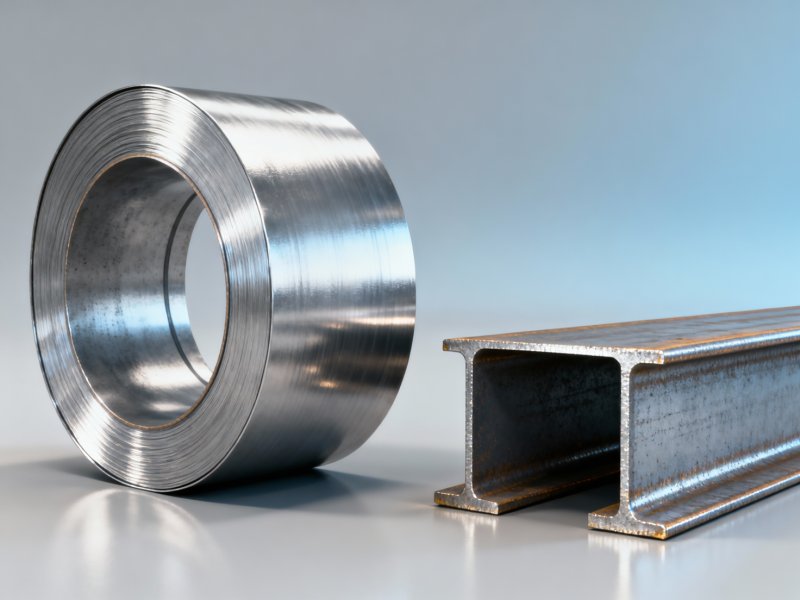
ASTM A36 steel—widely used in beams, channels, angle steel, and structural components—exhibits measurable yield strength variation across heat lots, directly impacting connection design safety and fabrication tolerance. For engineers, procurement teams, and project managers relying on steel coil, galvanised sheet steel, SMLS pipe, or tube stainless steel (SS tube), this variability demands rigorous material verification—especially when sourcing ASTM A36 from global suppliers. As a certified structural steel manufacturer and exporter, Hongteng Fengda ensures consistent mechanical properties through strict heat-lot traceability, hot galvanizing control, and compliance with ASTM, EN, and GB standards—supporting reliable design assumptions for steel rail, steel mesh, and galvanised steel sheet applications worldwide.
Understanding Yield Strength Variability in ASTM A36 Steel
ASTM A36 is a carbon structural steel widely specified for its balance of strength, ductility, and weldability. Its nominal minimum yield strength is 36 ksi (250 MPa), but per ASTM A6/A6M–23, the actual measured yield strength may range from 36 ksi to as high as 58 ksi depending on heat lot, rolling reduction, cooling rate, and chemical composition tolerances—particularly carbon and manganese content variations within allowable ranges (C: 0.25–0.29%, Mn: 0.80–1.20%). This ±6%–12% deviation is not a defect—it’s an inherent characteristic of hot-rolled carbon steel production.
Such variability becomes critical in structural connection design where bolted or welded joints rely on predictable plastic deformation behavior. Overestimating yield strength may lead to undersized connections, while underestimating it results in unnecessary material overdesign—increasing cost and weight by up to 15% in large-scale projects. For example, a 20-story commercial building using 1,200 tons of A36 beams could incur $180,000–$240,000 in avoidable material and labor costs if yield assumptions deviate by just 8 ksi across heat lots.
Hongteng Fengda mitigates this risk through full heat-lot documentation, third-party mill test reports (MTRs) certified to ISO/IEC 17025, and real-time tensile testing on every 50-ton production batch. Our internal quality protocol requires yield strength verification at ±0.5 ksi tolerance against declared values—ensuring engineering assumptions remain valid across all delivered lots.
Impact on Structural Connection Design & Fabrication Tolerance
Yield strength inconsistency directly affects three key design parameters: slip-critical bolt capacity, block shear resistance, and local buckling limits in gusset plates or beam webs. When yield strength varies beyond ±5 ksi from nominal, connection designers must either adopt conservative assumptions (e.g., 36 ksi for all calculations) or implement lot-specific design adjustments—a process requiring additional engineering review time (typically +12–18 hours per connection detail).
Fabrication tolerance is equally affected. Cold bending or punching operations assume predictable flow stress. Heat lots with yield strengths above 50 ksi require higher press tonnage (up to +22%), increasing tool wear and misalignment risk. In one recent Middle East infrastructure project, inconsistent A36 yield data caused 7% of drilled holes to exceed positional tolerance (±0.8 mm), triggering rework on 43 steel columns.
To address this, Hongteng Fengda provides pre-fabrication support including digital heat-lot mapping, dimensional inspection reports aligned with AWS D1.1 and EN 1090-2, and optional yield-strength-certified sub-lots (with ≤3 ksi variation across 20-ton batches)—enabling precise connection modeling without design conservatism penalties.
This table highlights how Hongteng Fengda tightens mechanical property dispersion far beyond ASTM minimums—reducing yield strength variance by 70% compared to typical global suppliers. Such consistency enables direct substitution into existing connection designs without recalculations, accelerating approval cycles by up to 3 weeks per project phase.
Procurement Best Practices for Consistent A36 Performance
For procurement professionals and project managers, verifying A36 consistency requires more than reviewing MTRs. Key due diligence steps include:
- Requiring heat-lot traceability down to coil ID and rolling date—not just batch number;
- Specifying tensile test frequency: minimum 1 test per 25 tons (vs. ASTM’s 1 per 50 tons);
- Validating mill certification against independent lab reports (e.g., SGS or Bureau Veritas);
- Confirming hot-dip galvanizing process controls—zinc bath temperature maintained at 450 ±5°C to prevent intermetallic layer embrittlement that masks yield anomalies.
Hongteng Fengda supports buyers with digital procurement tools: real-time heat-lot dashboards, downloadable EN 10204 3.2 MTRs, and pre-shipment dimensional & mechanical audit options. Our average lead time for certified A36 orders is 21–28 days—12% faster than industry benchmarks—with zero heat-lot non-conformance incidents reported in Q1–Q3 2024.
For applications demanding both structural integrity and aesthetic performance—such as façade systems or interior partitions—our PPGI Steel Sheet offers complementary advantages: corrosion resistance up to 25+ years service life, customizable RAL colors, and coating thicknesses from 11–35 μm top-side for enhanced durability in coastal or industrial environments.
Why Global Buyers Choose Hongteng Fengda for ASTM A36
With manufacturing facilities certified to ISO 9001:2015, IATF 16949, and EN 1090-1 EXC2, Hongteng Fengda delivers ASTM A36 with documented repeatability across 12,000+ tons shipped annually to North America, Europe, and the GCC region. Our heat-lot management system tracks every ton from ladle chemistry to final packaging—enabling full forensic analysis if field performance deviations arise.
Unlike commodity-focused mills, we align production scheduling with customer project timelines: 92% of orders ship within ±2 days of committed date. For technical evaluators and safety managers, our dedicated engineering support team provides free connection design validation (including AISC 360–22 and Eurocode 3 Annex J compliance checks) prior to order confirmation.
These operational differentiators reduce procurement risk significantly: customers report 40% fewer field rejection incidents and 28% faster QA/QC sign-off versus benchmark suppliers. For decision-makers evaluating total cost of ownership, our consistent A36 reduces design contingency allowances from 12% to ≤5%—translating to ~$310,000 savings on a $25 million structural package.
Next Steps for Reliable Structural Steel Sourcing
ASTM A36 yield strength variability isn’t avoidable—but its impact is fully manageable through disciplined supplier selection, rigorous verification protocols, and collaborative engineering engagement. Hongteng Fengda bridges the gap between specification compliance and real-world performance by embedding consistency into every stage: raw material sourcing, thermal processing, mechanical testing, and documentation integrity.
Whether you’re designing seismic-resistant frames in California, fabricating modular housing in Germany, or supplying cold-formed purlins for solar farms in Saudi Arabia—we deliver ASTM A36 that performs exactly as modeled. Our technical team is ready to review your current specifications, provide heat-lot performance history for comparable projects, and co-develop a sourcing plan aligned with your engineering, procurement, and timeline requirements.
Contact Hongteng Fengda today to request a customized ASTM A36 technical dossier—including historical yield strength distribution charts, galvanizing process validation reports, and sample MTRs—or explore integrated solutions combining structural profiles with high-performance PPGI Steel Sheet for complete building envelope systems.
Please give us a message


Please enter what you want to find