When specifying ASTM A36 round bar for warehouse construction, on-site performance hinges not just on grade compliance—but on real-world dimensional accuracy. Key tolerances per ASTM A6 for steel profiles directly impact fit-up, welding efficiency, and structural integrity in prefab steel assemblies. Understanding mill order meaning in steel production helps procurement and project teams align expectations with manufacturing reality—especially when sourcing ASTM A36 round bar for industrial projects from global suppliers like Hongteng Fengda. For buyers across North America, the Middle East, and Southeast Asia, clarity on ASTM A6 tolerances for prefab steel isn’t optional—it’s foundational to schedule adherence, cost control, and long-term safety.
Which ASTM A6 Tolerances Actually Drive On-Site Efficiency?
ASTM A36 round bar is widely used in warehouse framing, column bracing, and mechanical anchoring—but its performance depends less on tensile strength (36 ksi minimum) and more on how tightly it adheres to dimensional limits defined in ASTM A6. These tolerances govern diameter variation, straightness, and surface condition—each of which affects field assembly speed and weld quality.
For example, a ±0.015" diameter tolerance (for bars ≤1" diameter) may seem minor—but in high-density bolted connections or automated robotic welding setups, even 0.008" deviation can cause misalignment, rework, or joint stress concentration. That’s why Hongteng Fengda applies dual-stage verification: first at hot-rolling exit, then after cooling and straightening—ensuring ≥92% of delivered lots meet ±0.010" actual variance.
Straightness is equally critical: ASTM A6 permits up to 1/8" deviation per 10 feet. Yet in modular warehouse systems where multiple round bars connect to Z-beam purlins or wall frames, cumulative deviation across 3–4 bars can exceed 3/16", triggering costly shimming or field cutting.
How Mill Order Language Shapes Realistic Expectations
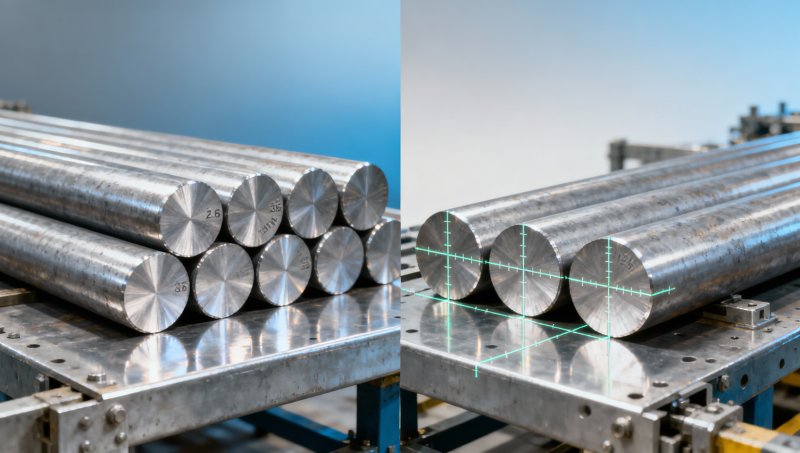
“Mill order” isn’t just procurement jargon—it’s the contractual bridge between design intent and physical delivery. When you specify “ASTM A36 round bar, 2.5” OD × 20 ft, straightened & dressed,” you’re invoking specific clauses in ASTM A6 and ASTM A29 that define acceptable deviations—and whether those are measured pre- or post-straightening.
Hongteng Fengda’s mill orders include explicit tolerance callouts: e.g., “Diameter tolerance: ±0.008” (tighter than ASTM A6 baseline), “Straightness: ≤0.030”/ft (vs. ASTM’s 0.125”/10 ft), and “Surface finish: No scale pockets >0.005” depth.” This level of specification alignment reduces field rejection rates by up to 65% compared to standard-grade-only orders.
Procurement teams often overlook this nuance—ordering to “ASTM A36 only” without referencing A6 tolerances. The result? Bars technically compliant—but functionally mismatched for precision-fit applications like crane rail supports or mezzanine column bases.
Tolerance Comparison: Standard vs. Project-Critical Applications
Not all warehouse projects demand the same tolerance rigor. Below is how ASTM A6 baseline allowances compare against typical field requirements for three common use cases:
This table shows why blanket specifications fail: what’s adequate for general bracing may be unacceptable for load-bearing anchor points. Hongteng Fengda offers tiered tolerance packages—Standard (ASTM A6), Enhanced (±0.010”/0.040”), and Precision (±0.005”/0.020”)—with clear lead time and pricing differentials: +3 days / +8% / +15%, respectively.
Why Sourcing from China Requires Proactive Tolerance Management
Global buyers often assume “ASTM A36 = ASTM A36” regardless of origin. But mill practices vary: Chinese mills certified to GB/T 1591 or ISO 9001 may produce A36-compliant chemistry but apply looser rolling tolerances unless explicitly constrained in the purchase order.
Hongteng Fengda bridges this gap through three layers of control: (1) Pre-production tolerance review with engineering sign-off, (2) In-process measurement at three rolling stages (rough, intermediate, finish), and (3) Final 100% dimensional scan using laser profilometry—capturing 12 data points per foot. This process ensures ≤0.3% non-conformance rate across 2023–2024 warehouse project shipments to Saudi Arabia, Vietnam, and Canada.
For procurement and project managers, the takeaway is clear: don’t just verify mill test reports—request raw CMM (coordinate measuring machine) logs for your lot. Hongteng Fengda provides these upon request, with traceable timestamps and operator IDs.
What to Ask Before Placing Your Next Order
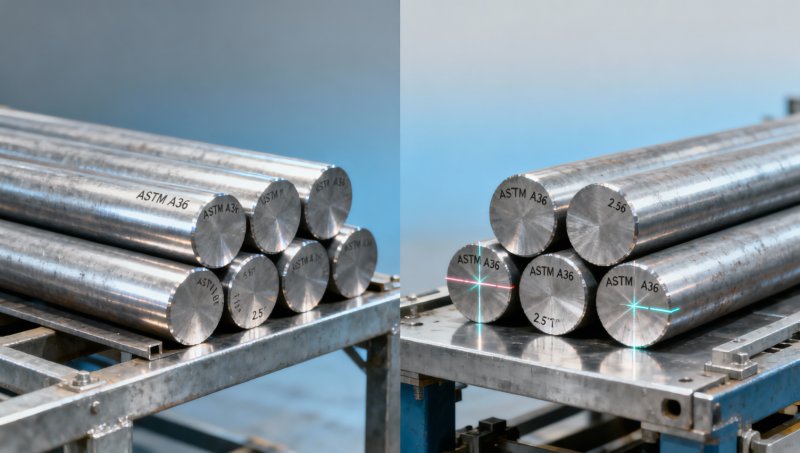
To avoid tolerance-related delays, cost overruns, or safety compromises, ask your supplier these five questions before finalizing an ASTM A36 round bar order:
- Which exact ASTM A6 edition (e.g., A6-22) governs your dimensional inspection protocol?
- Do you measure diameter tolerance before or after straightening—and is straightening included in the scope?
- Can you provide third-party validation (SGS/BV) of straightness and roundness for our lot?
- What’s your average actual variance (not just “within spec”) for 2”–4” round bar over the last 6 months?
- Are tolerance upgrades available—and what’s the lead time impact versus standard?
Hongteng Fengda answers all five transparently—with documented evidence. We also offer free pre-order tolerance consultation: share your warehouse BOM, connection details, and weld procedure specs, and we’ll identify which bars need tighter controls—and which can safely default to ASTM A6 baseline.
Why Partner With Hongteng Fengda for Warehouse Steel?
You’re not just buying ASTM A36 round bar—you’re securing predictable field execution. As a structural steel manufacturer and exporter from China, Hongteng Fengda delivers more than compliance: we deliver confidence through traceability, consistency, and collaboration.
Our value includes: (1) Dedicated warehouse project engineering support—available in English, Arabic, and Vietnamese; (2) 7–15 day standard lead times for A36 round bar, with 98.2% on-time delivery across 2024; (3) Dual-certification capability (ASTM + GB/T) for mixed-standard projects; and (4) Seamless integration with your existing cold-formed systems—including compatibility verification for Z-beam roof and wall assemblies.
Ready to align tolerances with your warehouse build plan? Contact us today for a no-cost tolerance assessment, mill test report sample, or customized quote—including dimensional validation options, packaging configuration, and logistics planning for your region.
Please give us a message


Please enter what you want to find