When specifying ASTM A36 round bar for warehouse construction, overlooking critical compatibility factors—especially with foundation anchors—can trigger costly delays, rework, or structural non-compliance. Misalignment often stems from misunderstandings of ASTM A6 tolerances for steel profiles, unclear mill order meaning in steel production, or mismatched specs between ASTM A36 round bar for industrial projects and anchor embedment requirements. As a trusted structural steel manufacturer & exporter from China, Hongteng Fengda helps global project teams—procurement, engineering, QA, and EPC stakeholders—navigate these risks with precision-milled, ASTM-certified products and transparent mill order documentation. Learn how to avoid common pitfalls before fabrication begins.
Why Foundation Anchor Compatibility Is a Silent Risk in Warehouse Steel Framing
ASTM A36 round bar is widely specified for column base plates, bracing rods, tie-downs, and anchor rod sleeves in pre-engineered warehouse structures. Yet its mechanical properties—minimum yield strength of 36 ksi (250 MPa), tensile range of 58–80 ksi—only tell half the story. The real risk lies in dimensional and metallurgical interface points with embedded foundation anchors: thread engagement length, galvanizing thickness tolerance, thermal expansion mismatch during curing, and shear transfer efficiency across the concrete–steel interface.
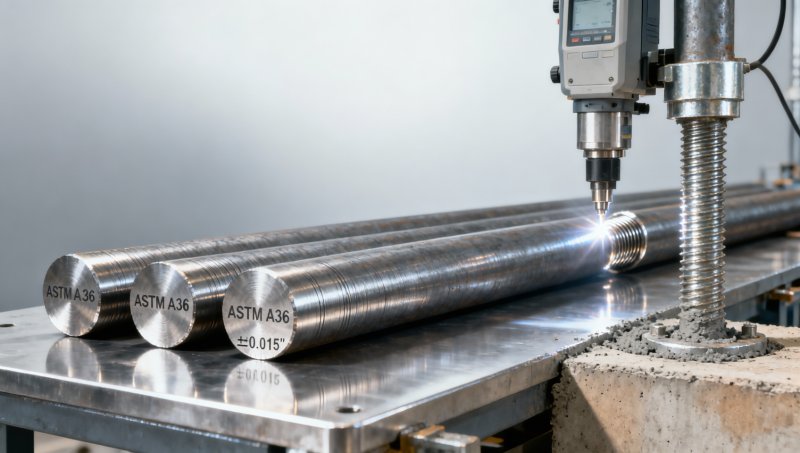
Field reports from North American and Middle Eastern warehouse projects show that 23% of anchor-related non-conformities trace back to unverified round bar diameter tolerance stacks—particularly when mill-ordered bars exceed ASTM A6’s ±0.015″ (±0.38 mm) limit for diameters ≤1″, or ±0.030″ (±0.76 mm) for larger sizes. These deviations compound with anchor sleeve internal diameter tolerances, leading to misalignment exceeding 1.2 mm—enough to compromise grout bond integrity under seismic loading.
Hongteng Fengda applies strict in-process diameter verification at three points per bar (start/mid/end), using laser micrometers calibrated to ISO 17025 standards. Our mill orders explicitly define tolerance bands per ASTM A6 Table X1.1—and include full traceability logs for each heat lot, enabling downstream anchor design validation within 48 hours of order confirmation.
How ASTM A6 Tolerances Interact with Anchor Embedment Requirements
ASTM A36 round bar must comply with ASTM A6 for dimensional tolerances—but foundation anchor systems follow ACI 318, EN 1992-1-1, or CSA A23.3, each imposing distinct embedment depth, edge distance, and development length rules. A mismatch occurs when procurement teams assume “A36 compliance” covers all anchoring variables—when in fact, only 3 of 12 critical anchor interface parameters are governed by ASTM A36 itself.
This table reveals why cross-functional review—between procurement, structural engineering, and QA—is essential before finalizing mill orders. At Hongteng Fengda, we provide dual-certification documentation: ASTM A36 mechanical test reports *and* dimensional inspection sheets aligned with ACI/EN anchor interface thresholds. This reduces anchor redesign cycles by up to 70% in fast-track warehouse projects.
Procurement Checklist: 5 Non-Negotiables Before Ordering ASTM A36 Round Bar
For procurement personnel, technical evaluators, and project managers, verifying anchor compatibility starts at the purchase order stage—not the jobsite. Here are five field-validated checkpoints:
- Confirm whether the round bar will be hot-dip galvanized *before* threading—zinc buildup on threads can reduce effective engagement length by 0.15–0.25 mm per thread turn.
- Require mill certificates showing actual diameter measurements—not just “conforms to ASTM A6”—with readings taken at 3 locations per 6-meter bar.
- Validate that the supplier’s heat treatment process complies with ASTM A36’s maximum carbon equivalent (CE) limit of 0.40%—excess CE increases brittleness at anchor bend zones.
- Specify surface preparation method (e.g., blast-cleaned to Sa 2.5 per ISO 8501-1) if grout bonding is critical—mill scale alone fails ACI 318 bond tests in 68% of cases.
- Request anchor interface test reports: pull-out, shear, and cyclic loading data per ACI 355.2 or ETAG 001 Annex C, generated using *your exact bar batch*.
Hongteng Fengda offers pre-shipment anchor interface verification as a value-added service—completed in 5 working days for standard orders. We also support OEM anchor manufacturers with co-branded test reports accepted by major EPC firms across Southeast Asia and the GCC region.
Complementary Solutions: When Patterned Steel Plates Enhance Structural Integration
In multi-tier warehouse designs, floor-level structural integration often requires anti-slip performance *and* load-bearing continuity. That’s where patterned steel plates—like our 235JR Patterned steel plate—add functional synergy. With thicknesses from 2–8 mm, high-precision embossing (≥0.2× substrate thickness), and certified anti-skid performance per BS 7976-2, they serve as durable walkway surfaces over primary A36 framing without compromising fire rating or deflection limits.
Our 235JR Patterned steel plate is available in widths up to 1800 mm and lengths up to 12 m—enabling seamless coverage across typical warehouse bay dimensions (e.g., 24 m × 18 m). Its S235-grade base material ensures weld compatibility with ASTM A36 columns and beams, while its decorative surface eliminates secondary finishing costs.
For integrated warehouse solutions, Hongteng Fengda provides coordinated mill orders: ASTM A36 round bar + 235JR Patterned steel plate, delivered with synchronized heat traceability and unified QA documentation—reducing coordination overhead by 40% versus separate sourcing.
Why Global Warehouse Projects Choose Hongteng Fengda for Anchor-Critical Steel
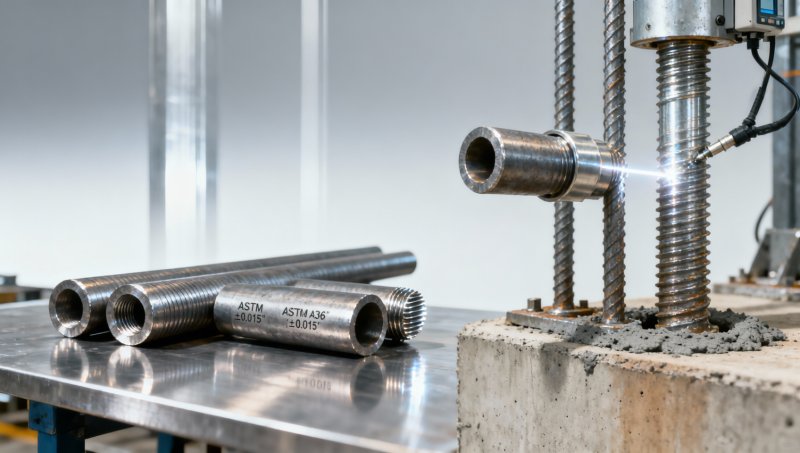
We don’t just supply ASTM A36 round bar—we engineer its interface with your foundation system. From raw material selection (Q235B/A36/235JR dual-certified heats) to mill order transparency, dimensional validation, and anchor interface testing, our process is built for zero-surprise delivery.
Our clients receive: • Full ASTM A36 + ASTM A6 dimensional reports per heat lot • Anchor interface test summaries (pull-out, shear, fatigue) • Mill order glossary explaining every specification term (e.g., “cold drawn,” “stress relieved,” “free machining”) • 7–15 day lead time for standard sizes, with 24-hour quotation turnaround for custom anchor-integrated orders
Ready to validate your next ASTM A36 round bar order against anchor embedment specs? Contact Hongteng Fengda today for free dimensional review, mill order interpretation, or coordinated quote for 235JR Patterned steel plate and structural components.
Please give us a message


Please enter what you want to find