ASTM A36 structural steel plate is widely used in construction and manufacturing because it offers a practical balance of strength, weldability, and affordability. But how do its mechanical properties affect its performance, and where is it most commonly used? This guide explains the key characteristics of A36 steel plate, its typical applications, and the factors to consider when selecting it for a project.
What ASTM A36 means for a steel plate
ASTM A36/A36M is a specification for carbon structural steel. It covers plates as well as certain shapes and bars intended for riveted, bolted, or welded construction. A36 plate is a general-purpose structural material: it is commonly selected when a project needs a workable steel with defined minimum properties, rather than a specialty alloy designed for a demanding environment.
The designation tells you more than a trade name, but it does not answer every design question. A plate still needs the correct thickness, dimensions, inspection documentation, and fabrication requirements for its intended use. The applicable edition of ASTM A36/A36M and any project-specific supplements should be identified in the purchase documents.
It is also worth separating the material specification from the design code. ASTM A36/A36M establishes material requirements; it does not, by itself, determine whether a particular plate connection, beam, or base is adequate for a building.
Mechanical properties and what they mean in practice
For A36 plate up to 8 inches thick, ASTM A36/A36M specifies a minimum yield strength of 36 ksi, approximately 250 MPa. For plate over 8 inches thick, the specified minimum yield strength is lower, at 32 ksi, approximately 220 MPa. The standard also specifies a tensile strength range of 58–80 ksi, approximately 400–550 MPa, subject to the specification’s provisions.
Yield strength is the stress level at which permanent deformation begins under a tensile test. Tensile strength describes the maximum stress reached in that test. Neither number should be treated as a direct allowable load for a finished part: plate bending, buckling, holes, welds, fatigue, and the applicable design rules can all govern before the material reaches its stated strength.
Thickness matters in less obvious ways too. A thicker plate adds strength and stiffness in many configurations, but it also adds weight, increases weld volume, and can make cutting and handling more difficult. If a base plate bends excessively, adding thickness may help; if anchor pullout or a weld controls the design, a thicker plate alone may not solve the problem.
A36 also has specified elongation requirements, which depend on product thickness and test conditions. Elongation gives an indication of ductility, but it is not a substitute for fracture-toughness or impact-test requirements. Where brittle fracture is a concern, particularly at low temperatures, the designer should specify the necessary toughness requirements rather than assume that the A36 designation provides them.
Why fabricators often choose A36
A36 is generally straightforward to cut, drill, form, and weld using established shop practices. That makes it useful for parts that must be processed into many different shapes, from small connection plates to large equipment supports. Its availability as a common structural grade can also make sourcing simpler, although price and lead time depend on the plate size, quantity, location, and market conditions.
Good weldability does not mean every joint can be welded without planning. Plate thickness, joint restraint, welding process, heat input, consumables, and ambient conditions all affect the procedure. Thick, highly restrained joints deserve particular attention because cooling and restraint can increase cracking risk. The fabricator should use an appropriate welding procedure and determine whether preheat or other controls are required under the applicable welding code.
For formed parts, the bend radius and direction relative to rolling should be reviewed with the fabricator. A tight bend that works on thin sheet may be impractical on a much thicker structural plate. Likewise, thermal cutting is convenient, but edge quality, dimensional tolerances, and any subsequent machining should be specified where they affect fit or fatigue performance.
Where A36 plate is commonly used
In building frames, A36 plate often appears as base plates under columns, gusset plates at bracing intersections, splice plates, stiffeners, and other connection pieces. These parts transfer forces between members; their geometry and weld or bolt arrangement can be as important as the grade of the steel itself.
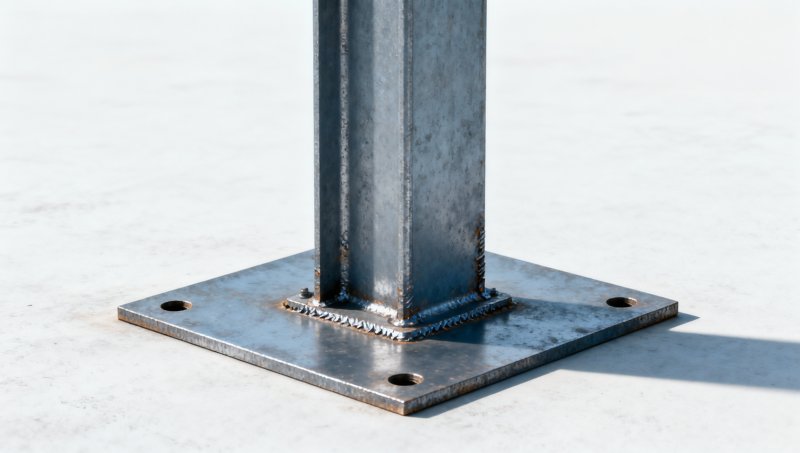
Consider a column base on a concrete foundation. The plate spreads the column load over an area of concrete and provides a location for anchor rods. But the selection is not simply “use A36 and make it thick.” The engineer must check bearing, plate bending, anchor forces, grout, welds, and the actual load combinations. A plate that is adequate in compression may need a different arrangement when significant uplift or moment is present.
In industrial settings, the same grade may be used for equipment frames, support brackets, guards, and fabricated bases. Here, a useful early question is whether the equipment produces vibration or repeated loading. A static-strength check alone may not capture fatigue concerns around weld toes, cutouts, or abrupt changes in section.
Plate can also be combined with structural sections in platforms, bridges, and other assemblies when the governing project specification permits it. For example, a fabricator may connect plate stiffeners or end plates to an H Girder. The section and the plate do not automatically have to be the same grade, but their individual specifications, connection details, and welding procedures must be compatible. Hongteng Fengda supplies structural sections and customized components for this kind of fabrication; the required grade should be confirmed for each item rather than assumed from the assembly name.
When another grade or specification may be a better fit
A36 is a sensible starting point for many ordinary structural parts, but it is not always the most economical choice once the whole structure is considered. A higher-strength grade may allow a smaller section in a strength-controlled design. That benefit can disappear, however, if stiffness, local buckling, fatigue, minimum thickness, or connection detailing controls instead. Comparing cost per ton alone misses the weight, fabrication, and installation consequences.
Corrosion is another boundary. Unprotected A36 is not weathering steel, stainless steel, or inherently corrosion-resistant steel. In an exposed or humid location, the project may need paint, galvanizing, or another protection system. Coating selection depends on the environment and expected maintenance; surfaces, holes, drainage, and weld details should be considered before fabrication, not after the assembly is finished.
Do not assume that a common grade from another standard is an automatic replacement. Grades such as Q235, SS400, and S275JR may be considered in some substitution discussions, but their requirements are not identical to A36. Chemistry, thickness-dependent properties, testing, tolerances, and documentation can differ. Any substitution should be reviewed against the project specification and accepted by the responsible engineer or purchaser.
Similarly, structural plate should not be specified for a pressure-containing component merely because it is available and weldable. Pressure equipment can be subject to a different material specification, design code, and inspection regime. The application—not familiarity with a grade—must determine the material requirements.
What to check before ordering
A clear order reduces the chance of receiving steel that is generally suitable but unusable for the job. Start with the ASTM designation and required edition, plate thickness, width, length, quantity, and applicable dimensional tolerances. If the plate will be cut into finished parts, provide drawings that distinguish finished dimensions from stock dimensions and identify critical edges, holes, and surface areas.
Ask for the required material test report and agree on traceability before cutting begins. A test report can identify the heat and report relevant chemical and mechanical test results, but the buyer should check that the document matches the supplied material and the purchase requirements. If impact testing, ultrasonic examination, special surface condition, or a particular inspection procedure is needed, state it explicitly; those requirements should not be assumed from the A36 name alone.
For international sourcing, confirm the units, tolerance standard, marking, packaging, and whether the quoted material is stock plate or processed plate. A nominal thickness that appears close in a conversion may not meet the drawing or tolerance requirements. Allowing for these details at quotation stage is usually easier than resolving a mismatch after the plate has been cut, coated, or shipped.
The practical choice is to match the plate to the actual duty: use A36 where its specified properties and fabrication characteristics satisfy the design, and ask for additional requirements where the service demands them. When in doubt, share the drawing, loading conditions, environment, and applicable code with the engineer and fabricator before placing the order.
Please give us a message


Please enter what you want to find