ASTM A36 steel remains a practical benchmark in structural steel supply because it balances cost, fabrication ease, and broad market availability. In construction, equipment frames, and general steel fabrication, it is often the first grade considered, yet not always the best final choice. That matters even more in export projects, where compliance, climate exposure, and performance margins can quickly reshape material selection.
Why ASTM A36 steel still matters
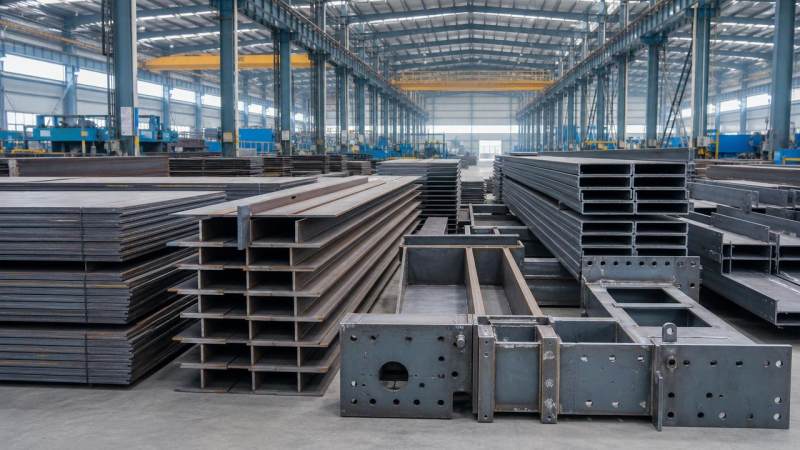
At its core, ASTM A36 steel is a carbon structural steel used for plates, bars, and rolled shapes in load-bearing and fabricated applications.
Its appeal is straightforward. The material is widely stocked, easy to weld, easy to machine, and familiar to fabricators across many regions.
That combination keeps ASTM A36 steel relevant for projects where dependable baseline performance is more important than premium alloy properties.
For many buyers, it also serves as a reference point. Even when another grade is eventually selected, comparisons often begin with A36.
What the grade offers in practical terms
ASTM A36 steel is valued less for exceptional strength and more for balanced performance in everyday structural work.
In actual use, the advantages usually appear during sourcing and fabrication rather than only in design calculations.
- Good weldability for frames, brackets, supports, and assemblies
- Reliable availability in common sections and plate dimensions
- Reasonable strength for buildings, platforms, and general machinery
- Lower material cost than many higher-strength alternatives
- Simple processing for cutting, drilling, bending, and fitting
These benefits explain why A36 continues to appear in workshops, warehouses, commercial buildings, and industrial support structures.
Typical uses across steel projects
ASTM A36 steel works best in applications where loads are predictable, service temperatures are moderate, and corrosion is managed through coating or design.
Common examples include beams, columns, base plates, connection plates, welded frames, stairs, walkways, equipment supports, and trailer components.
It also appears in cold-formed and fabricated structural systems when the project needs cost control and efficient manufacturing.
In that context, profiles such as C-Shaped Steel are often chosen for purlins, partition walls, storage racks, machinery frameworks, and support systems.
When made from premium-grade steel with accurate dimensional control, these sections offer high load-bearing capacity, uniform dimensions, and easier installation.
Galvanized, painted, and hot-dip finishes become especially relevant when the structure faces outdoor exposure or long service cycles.
Where it fits especially well
The limits that deserve closer attention
ASTM A36 steel is not a universal answer. Its limitations become clearer when structural demands rise or service conditions become more severe.
The first issue is strength efficiency. For some structures, A36 may require thicker or heavier sections than higher-strength grades.
That can increase total steel weight, shipping cost, and erection time, especially in export or large-span work.
The second issue is corrosion resistance. ASTM A36 steel does not provide inherent atmospheric corrosion protection.
Coatings, galvanizing, or other surface treatments are usually necessary in humid, coastal, agricultural, or chemical environments.
A third concern is specification alignment. Some projects are written around ASTM A992, ASTM A572, EN grades, or region-specific codes.
In those cases, substituting ASTM A36 steel without technical review can create approval delays or compliance issues.
When caution is justified
- Long-span structures where lighter high-strength sections reduce dead load
- Cold-service applications needing verified toughness
- Outdoor installations exposed to salt, moisture, or fertilizers
- Projects governed by strict seismic or regional design codes
- Systems needing optimized strength-to-weight performance
Alternatives worth comparing
Choosing an alternative does not mean A36 was wrong. It usually means the project priorities changed.
ASTM A572 is frequently considered when higher yield strength can reduce section size and improve structural efficiency.
ASTM A992 is common for wide-flange building members in many structural frameworks, particularly where code familiarity is important.
Weathering steel may be preferred where controlled surface oxidation can support corrosion performance in suitable environments.
EN, JIS, and GB equivalents also matter in international projects. Material selection often depends on the design code, local stocking, and certification pathway.
Suppliers with experience across ASTM, EN, JIS, and GB standards can simplify these comparisons and reduce conversion risk.
A quick comparison view
How material decisions are usually made in real projects
In practice, steel grade selection is rarely based on strength alone. Fabrication method, coating system, lead time, and export documentation also shape the decision.
A project using ASTM A36 steel may still perform very well if detailing is sound, protective finishes are appropriate, and the section design matches the service environment.
That is why experienced structural steel suppliers focus on both grade compliance and manufacturability.
Hongteng Fengda, as a structural steel manufacturer and exporter from China, works across standard and custom steel products for construction and industrial use.
This kind of capability matters when a project needs angle steel, channel steel, beams, cold formed profiles, or customized components produced to ASTM, EN, JIS, or GB requirements.
Stable production, consistent quality control, and dependable lead times often reduce more risk than material price alone suggests.
A practical framework for the next decision
When evaluating ASTM A36 steel, a useful next step is to compare the grade against actual project conditions rather than against generic expectations.
- Check whether the governing standard explicitly accepts A36
- Review load demands and whether higher-strength steel reduces section weight
- Assess corrosion exposure and required coating or galvanizing strategy
- Confirm fabrication needs such as welding, forming, and tolerance control
- Compare total installed cost, not only raw material price
- Request certification alignment for ASTM, EN, JIS, or GB when exporting
If the grade still fits after those checks, ASTM A36 steel often remains a sound and economical option.
If not, the better path is usually a controlled comparison with stronger or more environment-specific alternatives, supported by section design and supply feasibility.
That approach leads to clearer specifications, fewer sourcing surprises, and steel selections that hold up in both design review and field use.
Please give us a message


Please enter what you want to find