Understanding ASTM A106 Gr B mechanical properties at high temperature is essential for engineers, buyers, and project teams selecting reliable piping materials. This guide explores ASTM A106 Gr B pipe performance, ASTM A106 Gr.B specification, ASTM A106 Gr B chemical composition, and ASTM A106 Gr.B equivalent options, helping global steel users make informed decisions on safety, cost control, and high-temperature industrial applications.
In power generation, petrochemical processing, refinery lines, and general high-temperature fluid transport, ASTM A106 Grade B is one of the most frequently specified seamless carbon steel pipe materials. It is chosen not because it works in every condition, but because it offers a practical balance of strength, weldability, availability, and cost for temperatures commonly seen in pressure systems.
For technical evaluators, the key concern is how tensile strength, yield strength, and ductility change as temperature rises from ambient conditions to 400°C, 500°C, or beyond. For procurement teams, the focus is usually standard compliance, lead time, equivalent grades, mill traceability, and total project cost. For project managers and quality teams, the issue is long-term reliability, inspection control, and avoiding mismatch between design temperature and actual service conditions.
As a structural steel manufacturer and exporter from China, Hongteng Fengda supports global buyers with stable production coordination, standards-based quality control, and practical sourcing support for industrial steel applications. While ASTM A106 Gr B belongs to the piping field rather than structural sections, the same procurement logic applies: correct specification review, material verification, process control, and dependable supply reduce risk across the full project cycle.
What ASTM A106 Gr B Means in High-Temperature Service
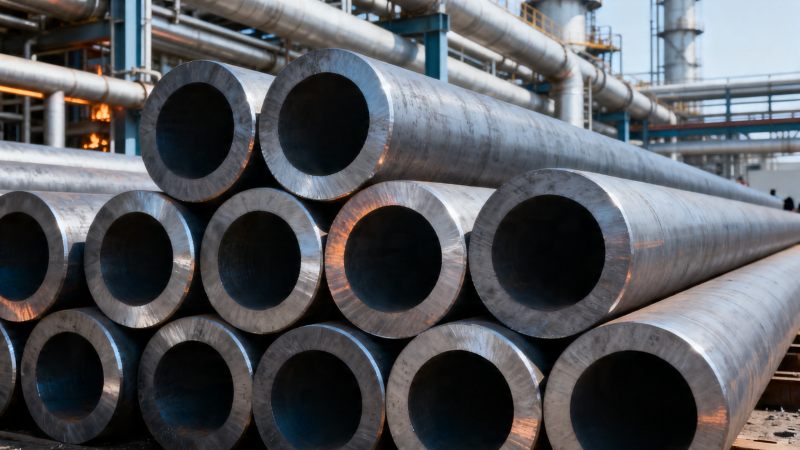
ASTM A106 Gr B is a seamless carbon steel pipe specification intended for high-temperature service. In practice, it is widely used for steam lines, process piping, boiler-related systems, and hydrocarbon transport where temperature and pressure are higher than ordinary water piping duties. The material is typically supplied in NPS 1/8 to NPS 48, although actual project scope depends on wall thickness, schedule, and manufacturing capability.
The reason this grade remains common is simple: it delivers reliable base mechanical properties at room temperature and retains usable strength through a moderate high-temperature range. Minimum tensile strength is generally 60 ksi, or about 415 MPa, and minimum yield strength is 35 ksi, or about 240 MPa. These values are baseline specification requirements, not guaranteed design allowables at elevated temperature.
When temperature rises, metals lose strength progressively. For ASTM A106 Grade B, engineers do not rely only on room-temperature mill test values. They also consider allowable stress from design codes such as ASME B31.3 or ASME Section II, because actual operating safety depends on temperature-adjusted limits, corrosion allowance, welding quality, and pressure cycle frequency.
A common mistake in sourcing is assuming that a pipe with acceptable room-temperature tensile results will automatically perform safely at 450°C or 500°C. In reality, project teams must check three layers: the ASTM material specification, the piping code, and the real process condition. A106 Gr B often performs well in conventional ranges, but it is not a universal substitute for alloy steel in all elevated-temperature environments.
Typical high-temperature applications
The following application patterns explain where this material is usually considered and where extra engineering review is needed.
- Steam and condensate systems operating roughly in the 200°C to 450°C range.
- Refinery and petrochemical process lines requiring seamless carbon steel pipe with stable pressure resistance.
- Industrial plants where moderate thermal cycling occurs during daily or weekly startup and shutdown.
- General high-temperature fluid service where alloy content and corrosion resistance requirements are limited.
If service conditions include high sulfur attack, severe creep exposure, long-duration temperatures above code limits, or aggressive corrosion media, engineers may compare A106 Gr B with alloy grades such as ASTM A335 P11 or P22 instead of treating it as a default selection.
Baseline property summary
Before discussing elevated-temperature performance, it helps to separate specification minimums from design-use values. The table below gives a practical comparison.
The key takeaway is that ASTM A106 Gr B starts with solid room-temperature mechanical values, but elevated-temperature selection should always be based on design code allowables and service environment, not just the mill certificate.
Mechanical Properties and Strength Retention at Elevated Temperature
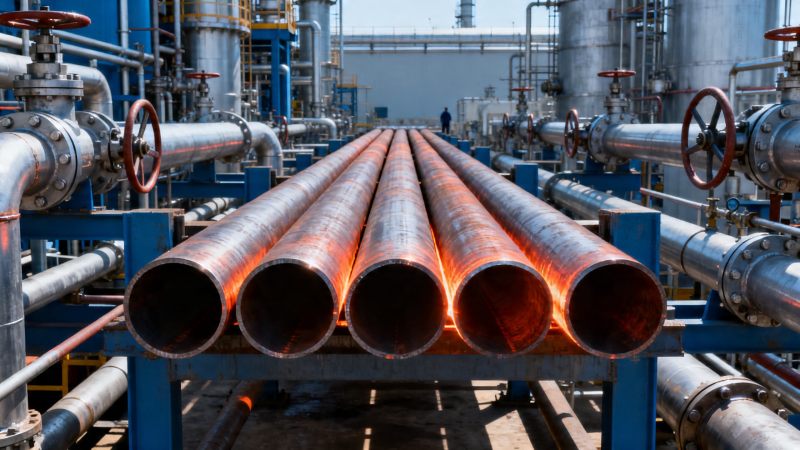
As temperature increases, yield strength and tensile strength gradually decrease, while ductility may change depending on the heating range and service duration. This is a normal metallurgical response. For carbon steel pipe such as ASTM A106 Gr B, short-term exposure at 300°C is very different from sustained service at 500°C for 20,000 to 100,000 operating hours.
In many industrial systems, the most important parameter is not the original tensile result but the allowable stress at operating temperature. For example, if a line runs at 425°C with pressure fluctuations and daily start-stop cycles, the effective design margin becomes narrower than a basic room-temperature certificate may suggest. That is why pressure piping design requires stress tables and thickness calculations, not only material test reports.
Another issue is creep resistance. ASTM A106 Gr B is suitable for many elevated-temperature applications, but it is still a carbon steel. In continuous high-temperature service near upper design limits, creep deformation becomes more relevant over time. If the system is expected to operate continuously for 10 to 20 years at high stress and high temperature, alloy steel may become the more conservative choice.
For operators and maintenance teams, thermal fatigue is also important. Repeated heating and cooling can initiate microcracks at stress concentration points such as elbows, welded joints, supports, and thickness transitions. Good pipe material cannot compensate for poor design detailing, improper support spacing, or uncontrolled welding heat input.
Typical performance trend by temperature
The table below shows a practical engineering view of how ASTM A106 Gr B is commonly evaluated as temperature rises. These are selection-oriented observations, not direct code design values.
The pattern is clear: ASTM A106 Gr B performs reliably in many moderate high-temperature duties, but the margin narrows as temperature and service duration increase. Buyers should request temperature-specific design review rather than relying only on the phrase “high-temperature pipe.”
Selection checkpoints for technical teams
- Confirm design temperature, normal operating temperature, and short-term upset temperature separately.
- Verify whether the line sees continuous service, intermittent service, or frequent thermal cycling.
- Review wall thickness with corrosion allowance, not just nominal schedule.
- Check if post-weld heat treatment is required by code, thickness, or service condition.
- Match the pipe material with flange, fitting, and welding consumable compatibility.
This 5-point review can prevent many specification errors during bidding, fabrication, and site installation.
ASTM A106 Gr B Chemical Composition, Specification, and Equivalent Grades
Material selection is not only about strength. ASTM A106 Gr B chemical composition directly affects weldability, hardness response, and high-temperature behavior. In standard supply, carbon content is limited to about 0.30% maximum, manganese is typically 0.29% to 1.06%, phosphorus is limited to 0.035%, sulfur to 0.035%, and silicon is at least 0.10%. These limits help balance processability and mechanical reliability.
From a procurement perspective, the ASTM A106 Gr.B specification should be checked together with dimensional standard, testing scope, and end-use code requirements. Pipe size tolerance, hydrostatic testing or NDT requirements, marking, heat number traceability, and documentation package all matter. A low-cost offer may not actually be competitive if it lacks complete inspection records or if supplementary requirements are unclear.
Buyers also often ask about ASTM A106 Gr.B equivalent materials. The practical answer is that equivalents depend on application, country standard, and code acceptance. Grades such as ASTM A53 seamless pipe, API 5L Grade B, or some EN carbon steel pipe grades may look comparable in chemistry or strength, but they are not automatically interchangeable in every high-temperature service. Specification intent is as important as nominal mechanical values.
During industrial sourcing, it is also common for one project to require multiple steel products beyond process pipe. For filtration units, screens, or chemical handling assemblies around the same plant, buyers may also source corrosion-resistant mesh materials. In such cases, 304 Stainless Steel Welded Mesh can be relevant for filters, sieve applications, chemical industry use, mining, architecture, and industrial enclosures where rust resistance and chemical durability are needed alongside carbon steel infrastructure.
Composition and comparison overview
The table below helps teams distinguish between specification-level review and purchasing assumptions.
For related stainless mesh applications, typical material options include SS 201, 304, 304L, 316, 316L, and 430. Common technical ranges include wire diameter from 0.0008 inch to 0.12 inch, mesh from 2 to 635 mesh, roll width up to 240 inches, and roll length up to 2000 feet. These figures show how procurement teams often coordinate several steel material families in one industrial package while keeping each material matched to its duty.
Common sourcing misunderstandings
- Assuming similar tensile strength means full equivalence across ASTM, API, and EN standards.
- Ignoring heat treatment condition and testing scope when comparing offers from different mills.
- Focusing only on price per ton instead of total installed cost, rejection risk, and document completeness.
- Overlooking accessory materials around the system, such as screens, strainers, and corrosion-resistant mesh components.
For B2B projects, a specification review meeting before purchase order release often saves more time than post-delivery correction. Even a 3 to 5 day clarification stage can reduce later fabrication delays by several weeks.
How Buyers and Project Teams Should Evaluate ASTM A106 Gr B for Real Projects
A practical procurement decision is rarely based on one mechanical property. Buyers need to evaluate at least 4 dimensions: compliance, operating fit, supply stability, and lifecycle cost. A compliant pipe that arrives 3 weeks late can disrupt shutdown schedules, while a cheap non-traceable lot can trigger reinspection, rejection, or replacement costs far above the initial savings.
For project managers, ASTM A106 Gr B should be reviewed together with fittings, flanges, valves, welding procedures, and insulation conditions. If one part of the line is upgraded for higher temperature but connected components remain underspecified, the system still carries risk. This is especially important in EPC projects where materials come from multiple suppliers across 2 to 4 countries.
Quality teams should insist on a complete document package. This usually includes mill test certificate, chemical composition results, tensile test results, dimensional inspection, heat number traceability, and any required NDT or hydrostatic testing records. Where project scope demands it, third-party inspection at pre-shipment stage may be added to reduce receiving uncertainty.
For international buyers, supply planning is also a risk-control tool. Standard production and export cycles for steel materials often range from 2 to 6 weeks depending on size, schedule, order quantity, and finishing requirements. If a project has shutdown dates or phased installation windows, material approval should start early rather than after civil or mechanical work begins.
Procurement checklist for decision makers
The following matrix can be used by engineers, procurement officers, QC teams, and financial approvers during supplier evaluation.
This kind of review is highly relevant for distributors, industrial contractors, and plant operators alike. The lowest quoted unit price only creates value if the material passes inspection, arrives on time, and performs over the intended service life.
Practical supplier coordination steps
- Issue a clear inquiry sheet with material grade, size range, quantity, and project temperature conditions.
- Ask for production lead time by batch, not only total quantity.
- Confirm whether third-party inspection is needed before shipment.
- Review packing, marking, and export documentation requirements.
- Align receiving inspection plan with warehouse and site installation schedule.
For global steel sourcing, disciplined communication often reduces hidden cost more effectively than aggressive price negotiation alone.
FAQ and Final Recommendations for Safer Material Selection
The most common questions around ASTM A106 Gr B relate to temperature range, equivalents, and purchasing risk. Clear answers help both technical teams and commercial teams move faster without weakening compliance control.
Is ASTM A106 Gr B suitable for all high-temperature piping?
No. It is suitable for many high-temperature services, especially in moderate elevated ranges, but not every service condition. Once temperature increases toward the upper range of carbon steel use, or if long-term creep, severe corrosion, or cyclic loading is significant, project engineers should compare it with alloy pipe grades and applicable code limits.
What is the difference between specification minimum strength and design allowable stress?
Minimum tensile strength of 415 MPa and minimum yield strength of 240 MPa are room-temperature specification benchmarks. Design allowable stress is lower and depends on operating temperature, code rules, joint factors, and service conditions. That is why a compliant mill certificate is necessary but not sufficient for design approval.
Can ASTM A106 Gr.B equivalent grades be used directly?
Only after technical review. Equivalent options may have similar chemistry or strength, but different standards are written for different service intents. Direct substitution without engineering acceptance can create documentation issues, inspection problems, or code nonconformity.
What should purchasers ask suppliers before ordering?
At minimum, ask for 6 items: specification confirmation, chemical composition report, tensile results, dimensional tolerance statement, traceability method, and realistic lead time. For more critical projects, add inspection plan, NDT scope, packing method, and export documentation checklist.
Final purchasing advice
- Use ASTM A106 Gr B where its high-temperature capability matches the actual service envelope, not just the project title.
- Review chemical composition, mechanical properties, and code allowables together.
- Do not approve equivalents without checking standard intent, inspection scope, and end-user acceptance.
- Choose suppliers that can support traceability, stable production, and practical export coordination.
For global buyers evaluating steel materials for industrial, construction, and manufacturing projects, Hongteng Fengda provides reliable supply support, customized coordination, and standards-oriented quality control across a wide range of steel products. If you need help reviewing specifications, comparing sourcing options, or planning a steel procurement package, contact us now to get a tailored solution and discuss your project requirements in detail.
Please give us a message


Please enter what you want to find