ASTM A106 Gr B Mechanical Properties: What Engineers Need to Verify
When reviewing ASTM A106 Gr B mechanical properties, engineers and technical evaluators need more than nominal values—they must confirm whether the material truly meets pressure, fabrication, and safety requirements. From tensile strength and yield strength to elongation and test compliance, each parameter affects project reliability. This article outlines the key properties to verify and why accurate material assessment matters in demanding industrial applications.
If you are checking ASTM A106 Gr B for a pressure or process line, the mistake is usually not misunderstanding the grade itself. The real problem is stopping at the headline numbers on a quotation or test certificate. For technical evaluation, you need to confirm what was tested, how it was tested, and whether the reported values match the pipe size, heat, and delivery condition you are actually buying.
A106 Grade B is widely used because it is familiar, available, and accepted across many industrial projects. But that familiarity can make reviews too casual. Below is the checklist experienced buyers and inspectors usually work through before they clear material for production, fabrication, or export.
Start with the minimum mechanical values, but do not stop there
For ASTM A106 Grade B, the baseline mechanical properties most people look for are straightforward: minimum tensile strength of 60 ksi, which is about 415 MPa, and minimum yield strength of 35 ksi, about 240 MPa. Those are the standard anchors. If a mill test report cannot clearly show compliance with those two values, the review should stop there.
That said, a pass on tensile and yield does not automatically mean the pipe is suitable. In actual project reviews, these values only tell you the material cleared the basic threshold. They do not tell you whether the pipe will behave well during bending, welding, hydrotesting, threading, or field fit-up. Engineers who have dealt with rework know this is where the trouble starts.
- Check that tensile strength is reported as an actual test result, not just printed as a standard requirement.
- Confirm yield strength is tied to the same heat or lot as the delivered pipe.
- Make sure the certificate identifies the governing standard as ASTM A106, not a loosely substituted equivalent.
- If the order includes mixed sizes, verify whether testing frequency and traceability cover each production batch correctly.
Elongation is where fabrication risk often shows up
People sometimes focus so much on strength that they ignore elongation. That is a bad habit, especially when the pipe will be cut, beveled, bent, flared, or welded into assemblies under site pressure. Elongation requirements in ASTM pipe standards depend on specimen configuration and are not always presented in a quick, one-line way. So if the certificate shows an elongation value, read it carefully and confirm the test basis. If it does not show elongation at all, ask why.
In practical terms, low ductility usually reveals itself later, not at receiving inspection. You see edge cracking during forming, poor tolerance after bending, or inconsistent weld behavior near the heat-affected zone. If the project includes shop fabrication, ductility matters more than many procurement teams expect.
This is also where suppliers with broader processing capability can be relevant. For example, if your source is not only supplying pipe but also supporting cutting, bending, punching, or welding, it helps to review whether their product range is already intended for those operations. Mid-project substitutions become risky when the material passed the paper review but was never a good fit for downstream fabrication.
Some buyers handling mixed industrial and structural demand will compare A106 Gr.B with adjacent carbon steel options available from a Carbon Steel Pipe Supplier, especially when they also need thickness from 2.0mm to 80mm, processing support, or compliance references such as ASTM, API, JIS, and ISO9001. That comparison can be useful, but only if the application standard allows it. A similar-looking pipe is not automatically an acceptable substitute.
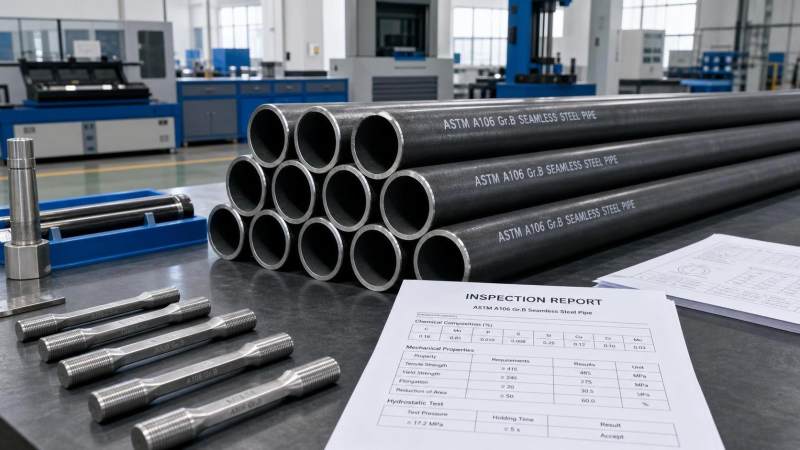
Check whether the test method matches the pipe you are evaluating
One recurring issue in technical reviews is that the reported ASTM A106 Gr B mechanical properties may be valid in form, but not clearly linked to the exact product condition. Was the tensile test taken from the same wall thickness range? Was it from seamless pipe produced in the same heat? Was the specimen orientation appropriate? If those links are weak, the numbers are much less useful.
Do not assume every mill certificate is equally readable. Some are clean and complete. Some list values with very little context. If you are reviewing for a pressure service project, ask for full traceability between heat number, size, schedule or wall thickness, and test report. That is not overchecking. It is basic risk control.
Do not confuse standard compliance with end-use suitability
This is a common purchasing shortcut: if the pipe meets ASTM A106 Grade B on paper, it gets treated as universally suitable for boilers, fluid service, chemical engineering, municipal works, and structural support pieces. That is too broad. The material may comply with the product standard while still missing project-specific needs such as impact testing, special NDE, additional chemistry limits, or purchaser-defined fabrication performance.
For low-temperature service, corrosive media, critical pressure systems, or owner specifications copied from refinery packages, there are often extra conditions outside the basic mechanical values. If those are not in the purchase order, they usually will not appear in the certificate by accident.
A good checklist question is simple: what failure are we trying to avoid? Burst risk, brittle behavior, weld cracking, deformation during fabrication, and traceability gaps are different problems. They require different evidence.
Watch for substitution language and near-equivalent grades
In export business, especially when orders combine structural and piping items, suppliers may mention grades such as Q345B, Q345E, API pipe, or other carbon steel categories in the same commercial discussion. That is not automatically a problem. Many manufacturers handle several standards in parallel. The problem begins when those adjacent products are treated as technically interchangeable without formal review.
If the project document says ASTM A106 Gr.B, verify that the material is supplied and certified to ASTM A106 Gr.B. Cross-standard comparisons can help pricing or sourcing strategy, but they are not a release decision by themselves. If an equivalent claim is made, mark it 【待核实】 until the project engineer or specification owner approves it in writing.
Review the certificate like an engineer, not like a purchaser checking a packing list
A lot of avoidable disputes come from reading the MTC only for grade, quantity, and shipment marks. For technical evaluation, slow down and check whether the certificate gives enough substance to support acceptance. Look for the actual measured values. Look for the standard edition if your project controls that. Look for consistency between marking, dimensions, and test record.
- Match the heat number on the pipe to the certificate.
- Confirm the grade is written as ASTM A106 Gr.B or equivalent project-approved notation.
- Read the mechanical test values, not just the compliance statement.
- Check dimensional tolerance and wall thickness consistency, because thin-side deviation can affect service margin even when the material strength passes.
- Verify whether supplementary tests required by contract are included or still pending.
If your supplier also offers broader manufacturing support, such as hot-rolled or non-oiled pipe in round, EMT, API, or thick-wall formats, that can be commercially useful. It does not reduce the need for grade-specific review. The more mixed the supply package, the more disciplined the technical separation needs to be.
Pay attention to what is missing
Experienced reviewers know that omissions are often more revealing than the values that are present. Missing elongation data, vague lot references, incomplete traceability, or certificates issued without a clear testing basis should trigger questions. Not every gap means the material is wrong, but every gap means the review is incomplete.
This matters even more for buyers sourcing internationally. Hongteng Fengda, as a structural steel manufacturer and exporter from China, operates in a market where global buyers often compare standard compliance, processing capability, lead time, and documentation quality at the same time. That makes documentation discipline part of the product itself. For technical evaluators, a clean certificate package is not paperwork overhead. It is proof that the supply chain is under control.
The practical release question
Before approving material, ask one final question: if this pipe reaches fabrication tomorrow, do we have enough verified evidence to defend the decision? For ASTM A106 Gr B mechanical properties, that usually means confirmed tensile and yield compliance, clear traceability, a reasonable understanding of ductility, and no unresolved substitution issue. If any of those points are unclear, hold the release and request clarification before the pipe moves into production or site installation.
That approach is less about being conservative for its own sake and more about avoiding the expensive kind of surprise: material that looked acceptable in procurement review but becomes a problem during welding, inspection, or service. In technical evaluation, the strongest habit is simple. Verify the numbers, verify the source, and verify that the standard on paper is the one your project actually needs.
Please give us a message


Please enter what you want to find