ASTM A106 Gr B mechanical properties play a critical role in determining pressure resistance, strength, weldability, and long-term service performance in piping systems. For buyers, engineers, and project managers comparing ASTM A106 Gr.B specification, ASTM A106 Gr.B equivalent, and ASTM A106 Gr B chemical composition, understanding these factors helps reduce procurement risk and improve application accuracy across industrial and construction projects.
In the steel supply chain, mechanical properties are not just laboratory values. They directly influence whether a seamless carbon steel pipe can handle design pressure, survive temperature fluctuation, support fabrication quality, and maintain dimensional stability during transport and installation. For industrial users, the gap between a compliant certificate and real field performance often comes down to how well these properties are understood before ordering.
This topic matters to a wide range of decision-makers, from operators and QC teams to procurement managers and financial approvers. A correct reading of tensile strength, yield strength, elongation, hardness tendency, and weld response helps reduce rework, avoid mismatched material selection, and improve total project cost control across oil and gas, power generation, fabrication, and building-support systems.
Why ASTM A106 Gr B Mechanical Properties Matter in Real Pipe Service
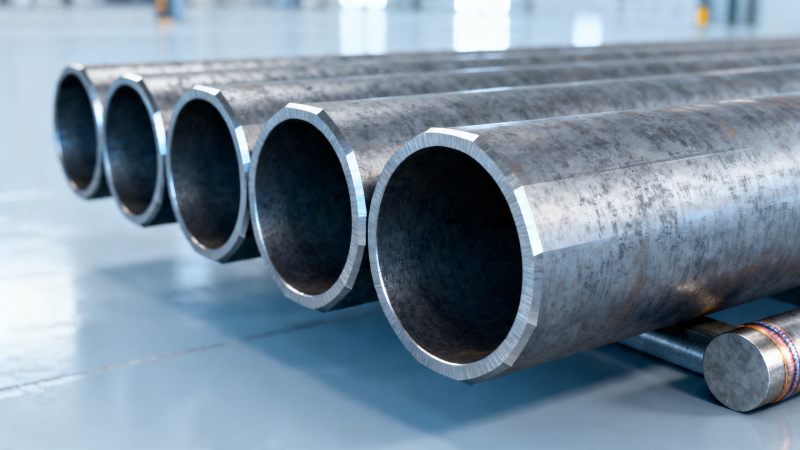
ASTM A106 Grade B is widely used for seamless carbon steel pipe in high-temperature and pressure-related service. In practice, pipe performance is shaped by several linked properties: minimum tensile strength, minimum yield strength, elongation, wall thickness consistency, and the steel’s response during bending, beveling, and welding. If one of these variables is not aligned with the application, even a nominally correct specification can lead to fabrication loss or service risk.
For most buyers, the first two values checked are tensile strength and yield strength. ASTM A106 Gr B generally carries a minimum tensile strength of 60 ksi, around 415 MPa, and a minimum yield strength of 35 ksi, around 240 MPa. These values define how much stress the pipe can tolerate before permanent deformation or failure. In pressure line design, this is essential for selecting a suitable schedule, outside diameter, and wall thickness combination.
Elongation is equally important, although it is often overlooked during purchasing. A pipe with adequate elongation is more forgiving during installation, cold forming, and field adjustment. In projects with multiple welding points or fit-up complexity, ductility can reduce crack sensitivity and improve construction efficiency. This is particularly relevant when site teams must handle pipes across 6 m to 12 m standard lengths and maintain alignment without introducing excessive stress.
Another practical point is weldability. ASTM A106 Gr B chemical composition, especially carbon, manganese, phosphorus, sulfur, silicon, and residual alloying content, affects heat input tolerance and weld quality. A material that meets strength requirements but has poor compositional consistency may create hardness variation in the heat-affected zone. That can increase the need for tighter welding procedures, additional inspection time, or post-weld heat treatment under certain service conditions.
Core performance links between test data and field use
- Pressure resistance depends on yield strength, wall thickness, and dimensional tolerance working together.
- Fabrication efficiency depends on elongation, straightness, and weldability, not strength alone.
- Long-term reliability is influenced by chemical consistency, heat treatment condition, and service temperature.
- Inspection acceptance often includes tensile testing, flattening, bending, hydrostatic testing, and visual checks.
The table below shows how key ASTM A106 Gr B mechanical properties affect typical pipe decisions in industrial projects.
The main takeaway is that ASTM A106 Gr B mechanical properties should be read as an integrated performance package. Strong numbers on the test certificate are useful, but they deliver value only when they also support pressure design, fabrication method, and site conditions.
Reading ASTM A106 Gr.B Specification, Chemical Composition, and Equivalent Grades Correctly
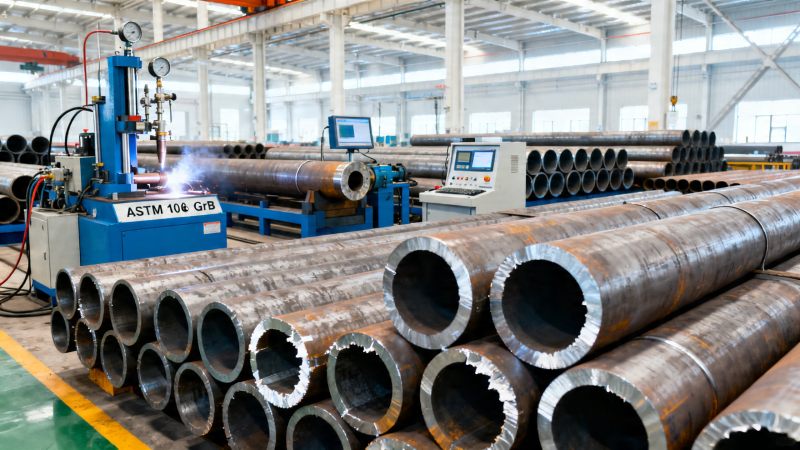
Many procurement problems start when buyers compare ASTM A106 Gr.B specification only by grade name. In reality, the grade must be checked together with manufacturing route, heat treatment condition, testing scope, and chemical composition limits. The specification defines more than strength. It also covers seamless production, test methods, marking, and acceptance criteria that influence whether the pipe is suitable for high-temperature service or general industrial use.
ASTM A106 Gr B chemical composition is important because it explains why the material behaves as it does during welding and service. Although exact heat analysis can vary within permitted ranges, carbon content is commonly controlled to maintain strength without sacrificing weldability. Manganese supports strength and toughness, while sulfur and phosphorus are kept low to reduce brittleness and improve process stability. Silicon may also contribute to deoxidation and mechanical balance.
Buyers also frequently search for ASTM A106 Gr.B equivalent grades. Equivalent comparison is useful, but it should never be treated as a one-line substitution. Materials from ASTM A53, API 5L, EN standards, JIS standards, or GB standards may appear similar in base chemistry or strength range, yet they may differ in manufacturing tolerance, hydrostatic test scope, notch toughness expectations, or intended service conditions. A “close equivalent” is not automatically a risk-free replacement.
For technical evaluation teams, it is safer to compare four checkpoints before approving an equivalent: minimum mechanical values, chemical limits, dimensional tolerances, and required inspection documents. This is especially true when the project includes pressure systems, elevated-temperature service, or third-party inspection by SGS, BV, or client representatives. Missing one document or one tolerance clause can delay approval by 3 to 7 working days or cause a full batch hold.
Comparison factors procurement teams should verify
The following table helps distinguish specification review from superficial grade matching.
For global buyers working across ASTM, EN, JIS, and GB systems, cross-standard supply experience becomes a real advantage. A manufacturer familiar with multi-standard steel production and documentation can reduce approval friction and improve material matching before shipment, rather than solving problems after arrival.
A practical review sequence
- Confirm end use: pressure line, structural support, fabrication component, or mixed industrial assembly.
- Match required strength, service temperature, and welding method.
- Review chemical composition and any equivalent-grade proposal line by line.
- Check MTC, dimensional tolerance, test method, and delivery condition before approval.
This disciplined review process is especially valuable for engineering contractors and distributors handling multiple package lots, where one incorrect substitution can affect 20 to 200 tons of downstream fabrication material.
How Mechanical Property Thinking Improves Broader Steel Procurement Decisions
Although ASTM A106 Gr B is a pipe material, the logic used to evaluate its mechanical performance also helps buyers make better decisions across other steel products. In many projects, piping systems do not stand alone. They connect with support frames, brackets, wall beams, lightweight roofs, mechanical columns, and steel structure purlins. When procurement teams align strength, weldability, corrosion resistance, and dimensional tolerance across these related materials, the overall project becomes easier to fabricate and install.
This is where support steel selection matters. For example, channel sections are frequently used to carry pipe racks, brackets, machinery frames, and secondary structural elements in industrial and construction settings. Choosing a supplier that understands both structural steel performance and export documentation can simplify project coordination, especially when orders include mixed products under ASTM, EN, JIS, or GB requirements.
A practical option for buyers comparing support materials is Channel Steel Supplier. This product line includes U channel steel in grades such as Q195, Q195L, Q235, Q235B, Q345B, Duplex, 201, 202, 304, and 316, with thickness from 1.5 mm to 25 mm, height from 80 mm to 160 mm, and standard lengths of 6 m to 12 m. Such ranges help project teams match light-duty supports and heavier bracket systems within one coordinated sourcing plan.
Material and finish options also matter in corrosive or outdoor service. Carbon structural steel, hot-dip galvanized channel steel, and hot-blown galvanized channel steel can be selected based on exposure level, coating need, and maintenance expectations. For projects near coastal, chemical, or humid environments, corrosion protection should be evaluated together with load-bearing capacity rather than treated as a separate afterthought.
Example of integrated procurement thinking
The table below shows how pipe performance criteria can be translated into support steel procurement logic.
For buyers handling construction, automobile manufacture, lightweight roof systems, wall beams, or mechanical columns, similar selection logic applies: check strength, weldability, tolerance, coating, and supply reliability as a package. The result is fewer mismatches between design intent and delivered material.
Useful selection checkpoints for support steel
- Thickness range should suit the actual loading condition; for example, 1.5 mm to 4 mm may fit light framing, while heavier sections may need 6 mm to 25 mm.
- Length planning should consider transport efficiency and site cutting loss, commonly within 6 m to 12 m.
- Tolerance should be reviewed early; thickness tolerance of ±0.02 mm and height tolerance of ±2 mm can support more stable fabrication quality.
- Certification and inspection needs may include ISO, CE, SGS, BV, BIS, UL, or NEMA depending on project and destination market.
For global sourcing programs, combining pipe knowledge with structural steel knowledge improves total procurement accuracy. That approach is one reason experienced Chinese manufacturers and exporters can support industrial projects more effectively than suppliers focused only on single-item delivery.
Common Risks, Inspection Priorities, and Selection Mistakes to Avoid
One common mistake is assuming that all ASTM A106 Gr B pipes with the same nominal size will perform the same in the field. They will not. Mechanical properties, wall thickness deviation, end condition, and heat treatment consistency can create significant differences in welding behavior and service life. For projects with strict pressure or safety demands, this difference becomes critical within the first installation phase, not years later.
A second mistake is focusing only on unit price. Low purchase price may look attractive at approval stage, but if the batch causes 5% to 8% additional repair welding, dimensional mismatch, or delayed inspection release, total installed cost can rise quickly. Finance teams increasingly look at landed cost, rework risk, inspection burden, and delivery reliability rather than ex-works price alone.
QC and safety teams should also review traceability. Material test certificates, heat numbers, dimensional reports, and, when required, third-party inspection records are basic control points. In export projects, incomplete markings or unclear batch traceability can delay customs clearance, site acceptance, or insurance handling. Even a 2-week delay may affect downstream contractors, crane scheduling, and labor planning.
For project managers, the selection process should be built around a practical risk checklist rather than product description alone. This is especially important when combining pressure pipe with structural accessories, coated sections, and OEM-fabricated components in one shipment.
Five inspection priorities before release
- Verify mechanical test values against project minimums, not only standard minimums.
- Check chemical composition consistency for welding-critical applications.
- Confirm dimensions, length, and end preparation against spool or support drawings.
- Review coating or galvanized finish where outdoor or corrosive exposure is expected.
- Ensure traceability documents match physical marking and packing list details.
The following table summarizes frequent procurement and application risks in steel projects related to pipes and associated support materials.
These controls are straightforward, but they require supplier discipline. Manufacturers with modern production facilities, stable QC procedures, and export documentation experience are generally better positioned to support multi-country projects with fewer acceptance issues.
FAQ and Practical Buying Guidance for Engineers, Buyers, and Project Teams
The questions below reflect common search intent from technical evaluators, procurement teams, distributors, and end users comparing seamless pipe grades and broader structural steel sourcing strategies.
How should buyers evaluate ASTM A106 Gr B beyond the grade name?
Start with 4 dimensions: mechanical properties, chemical composition, dimensional tolerance, and test documentation. If the pipe will be welded on site, put extra attention on chemistry and fabrication history. If it will operate under pressure or elevated temperature, verify that the project requirement does not exceed the standard minimum values. For larger packages, sample review before full production can prevent batch-level errors.
When is an equivalent grade acceptable?
An equivalent grade is acceptable only after technical confirmation that strength, chemistry, manufacturing route, and inspection scope fit the intended service. In general, equivalent review should be handled by engineering and QC together, not procurement alone. For pressure piping or regulated industrial use, approval usually needs document alignment before commercial confirmation.
What delivery and sourcing factors matter most in international steel orders?
Beyond material performance, buyers should check production capacity, lead time stability, export packing, and response speed for technical clarification. Typical lead times may range from 2 to 6 weeks depending on size mix, coating, and inspection level. For mixed structural steel and pipe orders, coordinated scheduling often saves more value than negotiating the lowest single-item price.
How can global buyers reduce sourcing risk from China?
Use a supplier that can support standard products and customized solutions with clear QC checkpoints. Hongteng Fengda, as a structural steel manufacturer and exporter from China, supports global construction, industrial, and manufacturing projects with angle steel, channel steel, steel beams, cold formed steel profiles, and customized structural steel components. For buyers across North America, Europe, the Middle East, and Southeast Asia, this combination of production capability, standard compliance, and dependable lead time helps reduce risk in both technical and commercial evaluation.
A short buying checklist
- Define service condition first: pressure, temperature, corrosion exposure, and fabrication method.
- Request MTC, dimensional tolerance, and inspection scope before final approval.
- Compare total procurement cost, including lead time and rework risk.
- For mixed packages, work with a supplier that can coordinate pipe-related and structural steel needs efficiently.
ASTM A106 Gr B mechanical properties are central to pipe performance because they influence pressure handling, weld quality, installation reliability, and lifecycle stability. When these values are reviewed together with ASTM A106 Gr.B specification, ASTM A106 Gr.B equivalent options, and ASTM A106 Gr B chemical composition, buyers can make more accurate decisions and avoid costly mismatches. If you are planning an industrial, construction, or manufacturing project and need reliable steel products, customized support, or coordinated sourcing for structural steel components, contact Hongteng Fengda to discuss specifications, obtain a tailored solution, and move your project forward with greater confidence.
Please give us a message


Please enter what you want to find