When buyers search for an ASTM A106 Gr.B equivalent, they often face conflicting claims about substitutions, standards, and real-world availability. This guide explains which grades are actually used, how ASTM A106 Gr.B specification and ASTM A106 Gr B chemical composition affect selection, and what to know before sourcing ASTM A106 Gr B pipe for industrial and structural projects.
For engineers, procurement teams, quality managers, and project owners, the issue is rarely just “what is the equivalent grade.” The real question is whether a proposed substitute will satisfy design temperature, pressure, fabrication, inspection, and delivery requirements without creating hidden compliance risks.
In practice, ASTM A106 Grade B is most commonly discussed in piping for refineries, power plants, process lines, and general industrial service. However, many buyers also compare it with carbon steel pipe grades used in structural and mixed industrial projects, especially when cost, stock availability, or export sourcing from Asia becomes a major factor.
As a structural steel manufacturer and exporter from China, Hongteng Fengda regularly supports global buyers who need clear standard interpretation, dependable material supply, and practical guidance across ASTM, EN, JIS, and GB systems. That matters because a technically acceptable comparison on paper may still fail at the purchasing stage if dimensions, testing scope, or lead time differ by 2–4 weeks.
Understanding ASTM A106 Gr.B and Why “Equivalent” Can Be Misleading
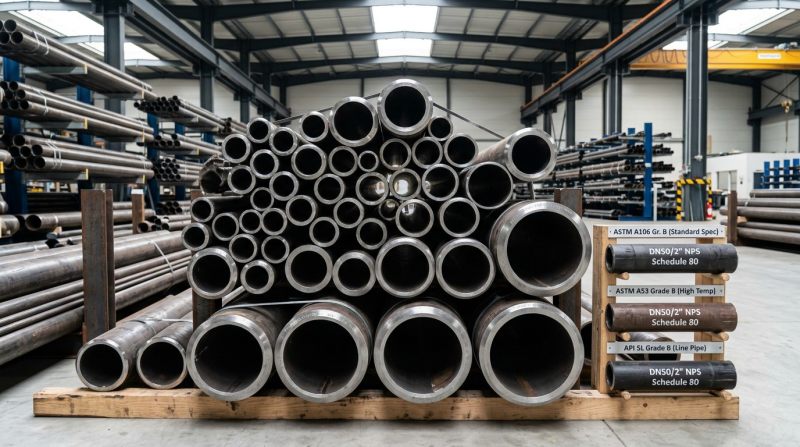
ASTM A106 Gr.B is a seamless carbon steel pipe specification primarily intended for high-temperature service. It is widely used where elevated temperature performance, pressure containment, and reliable weldability are required. Typical supply covers NPS sizes from small-bore process pipe to larger industrial line pipe, with schedules such as Sch 40, Sch 80, and heavier wall options depending on design demand.
The first common mistake is assuming that “equivalent” means chemically identical. In steel procurement, equivalence usually refers to approximate substitution for a defined application, not a perfect one-to-one replacement. Two grades may look close in carbon, manganese, and silicon ranges, yet still differ in manufacturing route, test requirements, impact expectations, or code acceptance.
The second mistake is ignoring the difference between material standard and product standard. ASTM A106 Gr.B is not just a chemistry label; it is a full pipe specification. If a buyer switches to another grade with similar composition but a different standard scope, the result can affect hydrostatic testing, nondestructive examination, marking, or required certificates.
For projects with mixed material demand, teams may source structural shapes, plates, and stainless bars alongside carbon steel pipe. In those cases, procurement efficiency matters. For example, some buyers combine process-line materials with corrosion-resistant components such as 316 Stainless Square steel rod for fabrication support, fixtures, or exposed assemblies where different service conditions apply. The key is keeping substitution logic separate for each product category.
What ASTM A106 Gr.B Typically Covers
In most industrial purchasing scenarios, ASTM A106 Grade B is selected for 3 main reasons: service temperature capability, seamless pipe construction, and broad acceptance in engineering documentation. Buyers often specify it when design documents call for carbon steel pipe under moderate to high pressure and temperatures that may reach several hundred degrees Celsius depending on system design and code review.
- Seamless manufacturing route for pressure service
- Frequent use in oil, gas, steam, and process piping
- Common documentation requirement in ASTM-based projects
- Compatibility with global sourcing and inspection practice
Why Buyers Ask for Equivalents
Requests for an ASTM A106 Gr.B equivalent usually come from 4 practical pressures: local stock shortages, budget control, standard conversion between regions, and the need to align procurement with mill availability. On export projects, especially across North America, Europe, the Middle East, and Southeast Asia, the acceptable substitute may depend on client approval, not just supplier recommendation.
Which Grades Are Actually Used as ASTM A106 Gr.B Equivalents
In real purchasing activity, the most frequently discussed comparisons for ASTM A106 Gr.B include ASTM A53 Grade B, API 5L Grade B, and several regional carbon steel pipe grades under EN, JIS, or GB systems. However, these are not interchangeable in every project. The right answer depends on whether the pipe is for pressure service, line pipe service, general mechanical use, or structural support integrated with industrial systems.
ASTM A53 Grade B is often the first alternative considered because it is widely available and familiar to distributors. Yet A53 and A106 are different standards. A53 may be seamless or welded, while A106 is specifically seamless. If the design, code, or owner specification requires seamless high-temperature pipe, ASTM A53 Grade B may not be acceptable even when size and basic strength appear close.
API 5L Grade B is another common comparison, especially in energy, pipeline, and cross-border procurement. It can be technically relevant where the end use is line pipe and project documents permit API material. Still, API 5L and ASTM A106 serve different standard intents. Line pipe requirements, traceability rules, PSL level expectations, and testing framework can create approval gaps if substitution is made too casually.
Regional grades such as EN P235TR1/P265TR1, JIS STPG370, or GB 20# are sometimes presented as cross-reference options. These can be useful for sourcing discussions, cost benchmarking, or preliminary technical evaluation, but they should always be checked against wall thickness tolerance, heat treatment condition, mechanical properties, and code acceptance before being treated as a direct replacement.
Practical Comparison of Commonly Used Grades
The table below shows how buyers usually compare candidate grades. It is not a substitution approval chart. Instead, it helps teams identify where further engineering and quality review is required.
The main takeaway is simple: these grades are actually used as market references, but not all of them are true drop-in replacements. For projects above 150°C, for critical pressure lines, or for owner-approved material lists, technical confirmation should happen before PO release, not after mill production starts.
A Useful Rule for Procurement Teams
If the requirement is written as “ASTM A106 Gr.B pipe,” treat A53 Grade B and API 5L Grade B as comparison candidates only. If the specification says “or approved equivalent,” then the process should include at least 3 checks: standard scope, mill route, and inspection/document compliance. That approach reduces rejection risk and avoids costly schedule slips of 7–21 days.
How ASTM A106 Gr.B Specification and Chemical Composition Affect Selection
Material selection should start with the ASTM A106 Gr.B specification itself, not with online comparison charts. The specification controls more than nominal strength. It influences manufacturing route, required tests, marking, and acceptable service conditions. For technical evaluators and QA teams, this is where many substitution proposals either pass or fail.
ASTM A106 Gr B chemical composition is one of the most discussed screening factors. Buyers commonly review carbon, manganese, phosphorus, sulfur, and silicon ranges because these elements affect weldability, strength balance, formability, and elevated-temperature behavior. Even small differences in carbon equivalent can influence welding procedure qualification or preheat decisions in field fabrication.
Mechanical properties matter as well, but they should be read with the service condition in mind. A material that meets a similar tensile range may still behave differently when forming, threading, bending, or welding. For instance, industrial fabrication teams often care about whether the material can maintain dimensional stability across multiple operations, especially in pipe spools, branch connections, and support assemblies.
This is also where buyers should avoid mixing unrelated stainless and carbon steel assumptions. A product such as 316 Stainless Square steel rod may be selected for corrosion resistance or fabrication flexibility in other assemblies, while ASTM A106 Gr.B pipe serves a very different pressure-service purpose. Similar product availability from one supplier is helpful, but engineering criteria must stay material-specific.
Key Selection Factors to Review
The table below highlights the practical factors that most often drive acceptance decisions on ASTM A106 Gr.B and any proposed equivalent grade.
For many projects, a 4-point review like this is more useful than a generic equivalence list. It helps finance approvers understand why two pipes with similar market descriptions can carry different risk levels, and it gives engineering teams a clear approval path before production begins.
Typical Review Thresholds
- Verify heat number traceability on 100% of supplied lengths for critical projects.
- Check whether lead time is 2–6 weeks for standard sizes or longer for heavy-wall seamless pipe.
- Review dimensional tolerance and end condition before cutting, beveling, or threading plans are finalized.
How to Evaluate ASTM A106 Gr B Pipe Before Sourcing
For sourcing teams, the safest approach is to evaluate ASTM A106 Gr B pipe in 5 stages rather than relying on a single cross-reference statement. This is especially important when the project combines industrial pipe systems with structural steel packages, custom components, or multi-standard procurement from one export supplier.
Stage 1 is application mapping. Identify whether the pipe is used for steam, process fluid, oil, gas, utility service, or structural-adjacent industrial use. Temperature band, pressure class, and installation method should be documented early. A material suitable for ambient utility piping may not be acceptable for 200–400°C service.
Stage 2 is standards verification. Confirm whether the project specification explicitly names ASTM A106 Grade B, permits equivalents, or references code-based approval. This step should involve engineering, QA, and procurement together. In many projects, 1 missing approval note can create full-batch hold status at inspection.
Stage 3 is mill and documentation review. Ask for MTC format, test scope, size range, manufacturing method, and export packing details. Stage 4 is commercial review, including MOQ, delivery window, and whether partial shipment is allowed. Stage 5 is pre-production confirmation, especially for mixed orders involving beams, channels, angle steel, cold formed profiles, and pipe products supplied under one schedule.
A 5-Step Sourcing Checklist
- Define service condition: medium, design temperature, pressure, and installation environment.
- Confirm the exact standard requirement: ASTM only, or ASTM with approved equivalent.
- Compare chemistry, mechanical properties, and manufacturing route.
- Review documents: MTC, inspection scope, marking, traceability, and packing list.
- Align delivery plan: standard sizes may move faster, while special schedules can extend lead time by 10–20 days.
Common Sourcing Risks
The biggest sourcing risk is buying by grade name alone. Another common issue is failing to distinguish between stock availability and specification compliance. A seller may have a nearby alternative in stock, but if the documentation does not match the project requirement, the apparent time saving can turn into a rejection cost after shipment arrives.
Export buyers should also look at production coordination. Suppliers with broader steel manufacturing capability can reduce procurement friction when a project needs more than one steel category. Hongteng Fengda supports global buyers with structural steel, custom profiles, and standard-compliant steel products, helping teams simplify supplier management while maintaining quality control across multiple line items.
Common Misunderstandings, Buyer Advice, and FAQ
One frequent misunderstanding is that the cheapest “equivalent” always lowers total project cost. In reality, an off-spec material can trigger re-approval, extra testing, fabrication delay, or replacement freight. On medium-size industrial jobs, even a 5–10 day delay can affect installation sequencing, labor allocation, and cash flow approval.
Another misunderstanding is that regional conversion charts are enough for final purchase decisions. They are useful for early-stage research, but not for contract-level compliance. Final decisions should be based on approved technical data, actual production capability, and documentation alignment with the end market.
For distributors and project managers, the most practical strategy is to classify demand into three groups: exact ASTM A106 Gr.B requirement, conditionally substitutable requirement, and non-critical commercial comparison. That three-tier method helps teams shorten internal review cycles and reduce conflict between engineering and purchasing goals.
Below are several frequently asked questions that often come up during material comparison, budgeting, and cross-border procurement.
Is ASTM A53 Grade B the same as ASTM A106 Gr.B?
No. They are often compared, and they may overlap in some commercial situations, but they are not the same standard. ASTM A106 Gr.B is a seamless carbon steel pipe specification for high-temperature service, while ASTM A53 Grade B covers pipe for mechanical, pressure, and general applications and may be supplied in welded or seamless form.
Can API 5L Grade B replace ASTM A106 Gr.B?
Sometimes, but only if the project specification, code basis, and client approval allow it. API 5L Grade B is often used for line pipe applications. It should not be treated as an automatic substitute for ASTM A106 Gr.B in process piping or elevated-temperature service without technical review.
What should purchasers check first?
Start with 4 items: service temperature, pressure duty, manufacturing route, and document requirement. After that, compare chemistry, strength minimums, testing scope, and available delivery time. This sequence usually gives faster and more reliable decisions than comparing only nominal grade names.
How long does sourcing usually take?
For common sizes and schedules, supply may be arranged within roughly 2–4 weeks depending on market conditions and export packing requirements. Special sizes, heavy walls, or bundled multi-product orders may need 4–8 weeks, especially if third-party inspection or custom marking is required.
Choosing an ASTM A106 Gr.B equivalent is not about finding a single universal match. It is about identifying which grades are actually used in the market, then testing those options against service condition, specification scope, and approval requirements. ASTM A53 Grade B, API 5L Grade B, and certain JIS or GB grades may all appear in comparison discussions, but each carries different acceptance boundaries.
For buyers managing industrial and structural steel procurement together, a reliable supplier should do more than quote price. The supplier should help verify standards, clarify documentation, coordinate production, and reduce sourcing risk across the full package. Hongteng Fengda supports global customers with stable manufacturing, quality-focused export service, and customized steel solutions for construction and industrial projects.
If you are evaluating ASTM A106 Gr B pipe, comparing international grades, or planning a mixed steel procurement package, contact us to discuss your specification, required dimensions, and delivery schedule. We can help you review technical fit, reduce purchasing uncertainty, and build a more practical sourcing plan for your project.
Please give us a message


Please enter what you want to find