Understanding ASTM A106 Gr B chemical composition is essential when selecting seamless carbon steel pipe for pressure and high-temperature service. This guide explains the ASTM A106 Gr.B specification, performance in real applications, and how ASTM A106 Gr.B equivalent grades compare, helping buyers, engineers, and project teams make informed decisions on ASTM A106 Gr B pipe selection, quality, and sourcing.
In steel procurement, composition data is not just a mill certificate detail. It directly affects weldability, strength retention, heat resistance, inspection acceptance, and lifecycle cost. For project managers, quality teams, and buyers working on boilers, refineries, power plants, or process piping, understanding what each element does helps reduce the risk of wrong grade selection, delayed approvals, or premature service failure.
Although Hongteng Fengda is widely known as a structural steel manufacturer and exporter from China, global buyers often evaluate multiple steel products and standards together during one sourcing cycle. That makes a practical, standards-focused review of ASTM A106 Grade B especially useful for technical and commercial comparison.
What ASTM A106 Grade B Means and Why Its Chemical Composition Matters
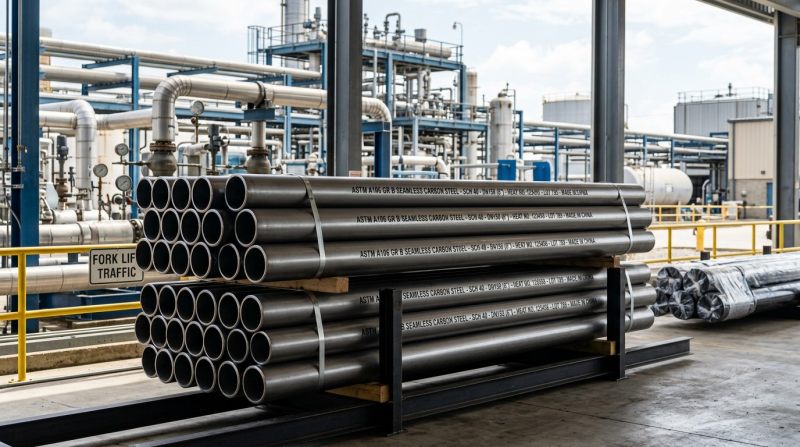
ASTM A106 is a standard specification for seamless carbon steel pipe intended for high-temperature service. Grade B is the most commonly specified option because it offers a balanced combination of strength, fabricability, and availability. It is widely used in oil and gas, steam lines, power generation, chemical processing, and industrial utilities where temperatures may range from ambient conditions to roughly 425°C, depending on design code and wall thickness.
The ASTM A106 Gr B chemical composition is controlled to provide predictable mechanical performance. Typical maximum values include carbon 0.30%, manganese 0.29% to 1.06%, phosphorus 0.035%, sulfur 0.035%, silicon not less than 0.10%, and combined limits for copper, nickel, chromium, molybdenum, and vanadium. These limits are not random. They are set to maintain a practical balance between tensile strength, ductility, weldability, and process consistency.
In project use, composition affects more than laboratory compliance. A pipe with carbon near the upper limit may deliver strength well, but can require tighter welding control than one with lower carbon equivalent. Manganese supports strength and toughness, while phosphorus and sulfur must remain low because excessive levels can reduce ductility and increase cracking risk during forming or welding.
For most buyers, three questions matter most: will the material pass code review, can fabricators weld it efficiently, and will it perform under temperature and pressure without unexpected maintenance costs? Chemical composition is one of the first checkpoints for all three.
Core composition limits and practical interpretation
The table below shows the common chemical limits typically referenced for ASTM A106 Grade B. Actual mill test certificates should always be checked against the latest applicable edition of the standard and project specifications.
The key takeaway is that ASTM A106 Gr B is engineered for a controlled middle ground. It is stronger than many basic carbon steel pipe options but still practical for fabrication across large project volumes, often from NPS 1/2 to NPS 24 and in multiple schedules.
Why this matters to different decision makers
- Engineers focus on pressure-temperature suitability, code compliance, and welding procedures.
- Procurement teams compare availability, lead time, equivalent grades, and total installed cost.
- Quality and safety personnel review heat numbers, chemistry reports, dimensional tolerances, and NDT records.
- Project managers need supply stability over 2 to 12 week delivery windows, depending on diameter and testing scope.
How Chemical Elements Influence Performance in Real Service Conditions
Knowing the ASTM A106 Gr B chemical composition is most useful when translated into actual operating performance. In pressure piping, service conditions rarely involve just one factor. Temperature, internal pressure, thermal cycling, corrosion environment, fabrication method, and inspection requirements all interact. A composition that looks acceptable on paper must still support reliable field performance.
Carbon is central to strength. As carbon content rises within the allowable range, tensile performance generally improves, but weldability becomes more sensitive. In field welding, especially on thicker wall pipe such as Schedule 80 or above, higher carbon equivalent may require stricter preheat control, qualified filler metal selection, and more disciplined heat input management. This is one reason experienced buyers ask for MTC review before releasing bulk fabrication.
Manganese plays a supporting role by increasing hardenability and helping control the effects of sulfur. Pipes with adequate manganese tend to offer better balance between strength and toughness. Silicon, usually at 0.10% minimum, contributes to deoxidation during steelmaking and can support more stable mechanical properties across production batches.
Residual elements such as chromium, nickel, copper, molybdenum, and vanadium are normally restricted by combined limits in standard carbon steel pipe. If these are too high without being intentionally alloyed and specified, the material may behave differently during welding or heat exposure. For critical systems, small chemistry differences can affect procedure qualification records, especially in regulated projects.
Performance impact by service factor
The following table connects composition control with jobsite and operating performance. It is a practical view often used during technical review and supplier comparison.
In practical terms, composition control reduces the probability of three common project problems: weld repairs, delayed approvals, and mixed-grade confusion. These issues can each add several days to several weeks to a project schedule, especially when hydrotest or shutdown windows are fixed.
Typical application environments
- Steam distribution systems in industrial plants where elevated temperature and pressure are continuous.
- Refinery and petrochemical lines where seamless pipe is preferred for pressure integrity.
- Power generation facilities requiring code-compliant carbon steel pipe in utility and process systems.
- General industrial piping where ASTM standards and global sourcing compatibility are important.
ASTM A106 Gr.B Equivalent Grades and Comparison Points for Sourcing
Many buyers search for ASTM A106 Gr.B equivalent grades when balancing availability, budget, and project specification requirements. Equivalent does not always mean identical. Two grades may be close in tensile strength or application range but differ in chemistry limits, impact requirements, manufacturing route, or acceptance under specific design codes. That is why substitution should never be based on name similarity alone.
Common comparison references may include ASTM A53 seamless grades, API 5L line pipe grades such as Grade B, and selected EN or JIS carbon steel pipe standards used in international projects. However, the final acceptance depends on the governing specification, service condition, and owner approval. For high-temperature piping, ASTM A106 Grade B is often preferred because its intended service scope is clearly established.
Procurement teams should compare at least five items before accepting an alternative: manufacturing method, chemistry, tensile and yield requirements, NDT/testing scope, and design code recognition. A lower unit price can become a higher installed cost if the substitute requires re-engineering, extra testing, or re-approval by consultants.
This principle also applies across broader steel sourcing portfolios. For example, a buyer evaluating pipe for process service may also source coated sheet or structural sections for the same project. In such mixed procurement packages, corrosion-resistant materials like Steel Plate Galvanized are often selected for enclosures, cable trays, roofing, light structural covers, or auxiliary fabricated parts, where zinc-coated surfaces in ranges such as 60–275g/m² help improve atmospheric corrosion resistance.
Comparison table for common reference grades
The table below is a screening tool, not a formal substitution approval matrix. It helps buyers identify where deeper technical review is needed.
A disciplined comparison process can prevent costly mismatches. In multi-country procurement, even small differences in document wording, heat treatment notation, or inspection standard references can stop material release at the port or site gate.
Five checkpoints before accepting an equivalent grade
- Confirm whether the project specification allows alternates or requires formal technical deviation approval.
- Match chemistry and mechanical properties, not just minimum tensile strength.
- Check whether the pipe is seamless, ERW, or otherwise manufactured, since this affects acceptance.
- Review inspection scope, including hydrotest, UT, dimensional checks, and marking.
- Verify documentation lead time, which can add 3 to 7 days if third-party review is required.
How to Evaluate ASTM A106 Grade B Pipe Quality, Delivery, and Supplier Capability
A correct grade on paper does not guarantee smooth project execution. Buyers should evaluate ASTM A106 Gr B pipe through a combined technical and commercial lens. In B2B steel purchasing, the real objective is not only compliant material, but also predictable delivery, traceable documentation, and low rework risk across the full procurement cycle.
Start with the mill test certificate. Review heat number traceability, chemical composition, tensile properties, size, wall thickness, and applicable testing records. For imported material, confirm whether the pipe will be delivered with standard export marking, bundling, end protection, and anti-rust preservation suitable for 20 to 45 day sea transit, depending on destination.
Next, assess manufacturing and inspection consistency. Reliable suppliers should be able to explain their dimensional control process, batch identification method, and response time for quality questions. For project cargo, buyers often request pre-shipment verification covering OD, WT, length, visual condition, and document consistency. This is especially important when multiple sizes and schedules are shipped together.
Commercially, lead time and production planning matter. Standard sizes may move faster, often within 2 to 4 weeks, while special schedules, larger diameters, or third-party inspection can extend timelines. For broader steel packages, suppliers with cross-category capability can simplify coordination. As an example, when buyers also need coated sheet materials, Steel Plate Galvanized in thickness ranges from 0.12mm to 6.00mm and widths from 600mm to 1500mm can be sourced for secondary steelwork, cladding, and equipment protection elements under standards such as ASTM, EN, JIS, and GB.
Practical supplier evaluation matrix
Use the following matrix when comparing mills, traders, or integrated exporters. It supports more objective evaluation than price-only decisions.
Suppliers with modern manufacturing, stable production planning, and strict quality control are usually better positioned to support international standards-based procurement. For project teams working across North America, Europe, the Middle East, and Southeast Asia, clear documentation and dependable lead times are often as important as the nominal steel grade itself.
Common mistakes during pipe sourcing
- Accepting “equivalent” material without checking code or end-user approval requirements.
- Reviewing only price per ton without considering testing, packing, and document completion.
- Ignoring heat traceability until final inspection, when correction becomes expensive.
- Ordering mixed schedules without a clear packing and identification plan.
FAQ and Final Selection Guidance for Buyers, Engineers, and Project Teams
ASTM A106 Grade B remains a practical choice for many pressure and high-temperature piping applications because its chemistry, mechanical properties, and industry familiarity create a strong balance between performance and procurement efficiency. Still, the best outcome depends on matching the grade to the exact service condition, fabrication method, and approval pathway.
For most project teams, an effective decision process has 4 steps: confirm design code and service condition, verify chemistry and mechanical properties on the MTC, review fabrication and inspection needs, and then compare supplier delivery capability. This approach helps reduce both technical and commercial uncertainty.
Below are practical questions frequently asked during sourcing and technical review. They reflect the issues most likely to affect approval time, installed cost, and operational reliability.
How is ASTM A106 Grade B different from general carbon steel pipe?
Its main distinction is intended service. ASTM A106 Grade B is specifically associated with seamless carbon steel pipe for high-temperature service. General carbon steel pipe standards may overlap in some pressure uses, but they are not always specified or accepted for the same thermal conditions or design documentation.
What should buyers check first on the chemical composition report?
Start with carbon, manganese, phosphorus, sulfur, and silicon. Then check whether residual alloy elements remain within allowed limits. If the pipe will be field welded or used in thicker sections, reviewing the chemistry early can prevent later welding procedure concerns or owner comments.
Is ASTM A106 Gr.B always interchangeable with API 5L Grade B?
No. They can be close in some property ranges, but they are written for different service intents. API 5L focuses on line pipe transportation systems, while ASTM A106 Grade B is commonly chosen for high-temperature pressure service. Any substitution should be technically reviewed and formally accepted before purchase.
What delivery and inspection details should be agreed before ordering?
Confirm quantity, size range, schedule, testing requirements, marking format, document package, packing method, and inspection witness points. For export projects, also agree on anti-rust protection, end caps if needed, and shipping schedule. These details can save 5 to 10 days of avoidable coordination after production.
Final recommendation
When evaluating ASTM A106 Gr B pipe, treat chemical composition as a decision tool rather than a background detail. It influences weldability, high-temperature reliability, documentation acceptance, and overall project risk. Buyers who compare chemistry together with delivery capability and inspection discipline are more likely to secure stable, fit-for-purpose material.
If you are sourcing steel products for industrial, construction, or manufacturing projects, working with an experienced Chinese manufacturer and exporter can simplify standard compliance, quality control, and schedule coordination. To discuss material options, request technical support, or obtain a customized steel sourcing solution, contact Hongteng Fengda for more details and project-based recommendations.
Please give us a message


Please enter what you want to find