Understanding ASTM A106 Gr B chemical composition is essential when evaluating ASTM A106 Gr B pipe for pressure and high-temperature service. This article explains the composition limits that affect performance, compliance, and sourcing decisions, while also touching on ASTM A106 Gr.B specification, ASTM A106 Gr.B equivalent, and ASTM A106 Gr B mechanical properties to help engineers, buyers, and project teams make informed steel selection choices.
For technical evaluators, purchasers, QC teams, and project managers, the composition limits are not just numbers on a mill test certificate. They directly influence weldability, strength consistency, heat resistance, inspection risk, and long-term service reliability. In industrial procurement, even a small variation in carbon, manganese, phosphorus, sulfur, silicon, or residual alloying elements can affect fabrication cost and compliance outcomes.
ASTM A106 Grade B is widely used for seamless carbon steel pipe in refineries, power plants, petrochemical units, and other elevated-temperature systems. Because buyers often compare it with ASTM A53, API 5L, or local substitutes, it is important to understand which chemical composition limits truly matter, which are standard requirements, and which should trigger additional review during sourcing and inspection.
What ASTM A106 Gr B Chemical Composition Includes
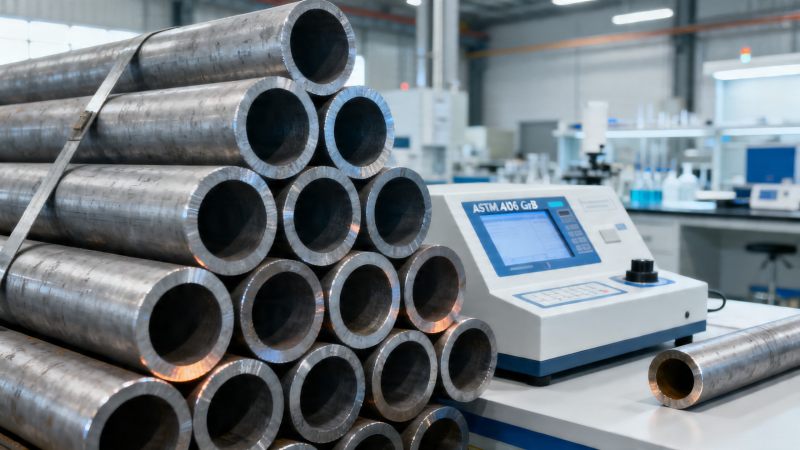
ASTM A106 Gr B pipe is a seamless carbon steel pipe grade intended for high-temperature service. Its chemical composition is controlled within defined maximum or range values to balance pressure resistance, manufacturability, and service stability. In practical purchasing, the key elements usually reviewed first are carbon (C), manganese (Mn), phosphorus (P), sulfur (S), silicon (Si), and in some cases chromium (Cr), copper (Cu), molybdenum (Mo), nickel (Ni), and vanadium (V) when residual limits are relevant.
Typical ASTM A106 Gr B composition limits are often read as carbon up to 0.30%, manganese from 0.29% to 1.06%, phosphorus up to 0.035%, sulfur up to 0.035%, and silicon at not less than 0.10%. Residual element caps may also apply, such as copper up to 0.40%, nickel up to 0.40%, chromium up to 0.40%, molybdenum up to 0.15%, and vanadium up to 0.08%, depending on the heat analysis and product review context.
These limits matter because ASTM A106 Gr B is expected to deliver a useful combination of minimum tensile strength around 415 MPa and minimum yield strength around 240 MPa while remaining suitable for forming, welding, and elevated-temperature operation. The chemistry is therefore not random. It is a controlled balance between mechanical performance and process reliability.
For importers and distributors, one common mistake is to focus only on mechanical properties and ignore chemistry. However, mechanical values can pass while chemistry still creates downstream risk. High carbon may reduce weldability. Low silicon may affect deoxidation quality. High sulfur may increase hot shortness or reduce toughness in certain fabrication conditions. This is why chemistry review should be part of the first 3 inspection checkpoints, not the last one.
Key element-by-element interpretation
Carbon is usually the first number engineers inspect because it strongly affects strength, hardness, and weldability. When carbon approaches the 0.30% maximum, the steel may deliver stronger base performance, but welding procedures often need tighter heat input control, preheating evaluation, or filler material matching depending on wall thickness and service conditions.
Manganese supports strength and contributes to hot-working behavior. A practical range of 0.29% to 1.06% gives the grade flexibility in manufacturing. If manganese is too low, strength consistency may suffer. If it is too high relative to carbon and sulfur, buyers may want additional review of weldability and actual process performance.
Phosphorus and sulfur are generally controlled as harmful elements. Both are usually limited to 0.035% maximum. In B2B supply, values close to the maximum are not always disqualifying, but they deserve attention when the pipe will be used in severe temperature cycles, extensive welding, or more demanding quality control plans.
The table below summarizes the composition items that are most frequently checked during technical assessment and incoming quality verification.
The main conclusion is simple: the most important numbers are not only the maximums but also how the element balance fits the intended service. A pipe intended for 400°C process lines, field welding, and long routing runs should be evaluated more carefully than a commodity order for low-complexity utility service.
Why Composition Limits Affect Performance, Compliance, and Risk
The reason ASTM A106 Gr B chemical composition matters is that performance in service starts at the metallurgical level. Even before hydrotesting, NDT, or installation, the chemistry shapes grain structure, weld response, and elevated-temperature behavior. In pressure piping systems running for 10,000 to 50,000 operating hours, stable chemistry helps reduce the chance of avoidable fabrication or service issues.
For compliance, the buyer should not assume that a pipe marked with the correct grade automatically matches the intended project specification. Some projects require supplementary inspection, stricter residual control, or additional traceability. If the actual heat analysis sits very close to standard maximum values, the material may still comply with ASTM A106 Gr.B specification, but the project engineer may request tighter review for welding procedure qualification or critical line class use.
From a sourcing perspective, chemistry affects cost indirectly. Lower impurity control and more consistent heat composition often correlate with better process discipline, but they can also influence mill selection, delivery planning, and rejection risk. A rejected batch can add 2–6 weeks to a project schedule, which is often more costly than a modest difference in unit price.
For QC and safety personnel, the practical question is not only “Does it pass?” but also “Does it fit the service margin?” A106 Grade B is frequently selected because it balances availability and performance. However, if the application involves repeated thermal cycling, thicker walls, complex welding, or stricter owner specifications, chemistry review should be integrated with mechanical test review, dimensional checks, and traceability verification.
Common risk points in procurement and application
- Accepting mill certificates without checking whether heat analysis and product analysis align with project tolerances.
- Comparing ASTM A106 Gr.B equivalent materials only by tensile strength while ignoring carbon and impurity differences.
- Using the same welding assumptions for thin-wall and heavy-wall pipe, even though carbon-equivalent sensitivity may differ.
- Overlooking residual elements when the pipe will operate under higher-temperature or stricter inspection conditions.
Mid-project material coordination
In many steel supply chains, piping material is purchased together with structural items for industrial projects. During these mixed procurement stages, buyers also review related steel products for supports, frames, and secondary fabrication. For example, when project teams source pressure piping together with structural members, they may also compare plate or coil options for brackets, platforms, and fabricated supports. In such cases, Cold Rolled Steel Coil can be relevant for construction and steel structures where clean surface condition, dimensional consistency, and customized processing are required.
For structural applications, available grades such as Q355, Q345B, Q420, Q460, Q550D, and 16Mo3 are typically selected according to strength level, fabrication route, and project environment. Common size capability may cover thickness from 0.1 mm to 300 mm, width from 0.6 m to 3 m, and length from 4 m to 12 m or as required. This is different from ASTM A106 pipe chemistry control, but it shows how a reliable steel supplier can support broader project packages under ASTM, EN, JIS, and GB-oriented workflows.
The comparison below shows how specific composition-related factors can influence downstream project outcomes.
For most buyers, the best practice is to evaluate chemistry, mechanical properties, and manufacturing consistency as one package. That approach reduces the chance of late-stage nonconformance and gives finance and project teams a more realistic view of total procurement risk.
How to Review ASTM A106 Gr.B Specification, Equivalent Grades, and Mechanical Properties
ASTM A106 Gr.B specification is often referenced together with dimensions, manufacturing route, testing requirements, and end-use conditions. While chemical composition is a core part of the standard, it should be reviewed alongside tensile testing, flattening or bend requirements where applicable, hydrostatic or NDT verification, marking, and documentation. For serious industrial procurement, this means checking at least 4 categories: chemistry, mechanics, dimensions, and certification traceability.
ASTM A106 Gr B mechanical properties typically include minimum tensile strength of 60 ksi, approximately 415 MPa, and minimum yield strength of 35 ksi, around 240 MPa. These baseline values make Grade B a practical choice for many pressure and elevated-temperature systems. However, the final suitability still depends on wall thickness, design code, operating temperature, weld procedure, and line criticality.
When buyers ask for ASTM A106 Gr.B equivalent, the answer is rarely a perfect one-to-one substitution. Some users compare it with ASTM A53 Grade B or API 5L Grade B, but these are not identical in scope, manufacturing expectation, or elevated-temperature intent. An “equivalent” material may look similar on paper yet behave differently in certification review, project approval, or fabrication practice.
This is especially important for distributors and project contractors who want wider sourcing flexibility. A lower-priced alternative may still require additional client approval, revised welding documentation, or extra testing. In time-sensitive projects, that can erase the apparent cost advantage within 1 procurement cycle.
A practical review sequence
- Confirm the standard and grade designation exactly match the project requirement.
- Check chemical composition limits against the mill test certificate and any project-specific restrictions.
- Review tensile and yield values, then compare them with design and fabrication assumptions.
- Assess whether any proposed equivalent grade changes the approval path, test plan, or lead time.
- Verify traceability, heat number consistency, and inspection documentation before shipment release.
Equivalent comparison logic
A smart equivalent review starts with service conditions, not just chemistry. If the application is high-temperature pressure service, the alternative should be assessed for seamless manufacturing suitability, standard scope, and owner acceptance. If the pipe is intended for more general use, the comparison may be broader, but chemistry and mechanical property differences should still be documented clearly.
The key conclusion here is that ASTM A106 Gr B should be selected as part of a system decision. Chemical composition limits are the foundation, but they gain meaning only when connected to design pressure, operating temperature, weldability expectations, and approval requirements across the full project chain.
Procurement, Inspection, and Quality Control Checklist for Buyers
For global buyers sourcing from China or other export markets, a strong procurement process reduces both technical and commercial risk. Hongteng Fengda supports international construction, industrial, and manufacturing projects with stable production coordination, strict quality control, and familiarity with ASTM, EN, JIS, and GB-oriented requirements. That matters when a project combines schedule pressure, multiple steel categories, and cross-border documentation review.
In practice, ASTM A106 Gr B pipe purchasing should include pre-order alignment, production-stage verification, and pre-shipment control. These 3 stages help reduce disputes about grade, chemistry, dimensions, and certification. For project managers, that also creates a clearer handover path between engineering, procurement, QA, and site teams.
A useful QC rule is to define acceptance checkpoints before the order is placed. At minimum, buyers should specify grade, size range, test requirements, documentation format, and whether third-party inspection is needed. For medium-to-large orders, especially those tied to shutdown schedules or EPC milestones, even a 7–10 day approval delay can affect site planning and contractor sequencing.
The table below offers a practical review framework for procurement teams, technical staff, and decision makers.
The most effective procurement strategy is not the lowest unit price by itself. It is the combination of compliant chemistry, predictable lead time, document accuracy, and supplier responsiveness. For many industrial buyers, that is what protects budget, timeline, and operational safety at the same time.
FAQ for engineers, buyers, and project teams
How important is carbon content in ASTM A106 Gr B?
It is one of the most important items because it affects both strength and weldability. A value near the 0.30% maximum may still comply, but project teams should review wall thickness, welding method, and any preheat requirement before approval.
Can ASTM A53 Grade B replace ASTM A106 Gr B?
Sometimes it may be considered for less demanding use, but it should never be assumed as a direct replacement without technical review. Scope, manufacturing expectations, temperature service intent, and client approval may differ significantly.
What documents should buyers request?
At minimum, request the mill test certificate, heat analysis, mechanical test results, size and quantity list, marking details, and any inspection report required by contract. For critical orders, third-party verification before shipment is often a practical safeguard.
ASTM A106 Gr B chemical composition limits matter because they shape weldability, high-temperature suitability, inspection confidence, and overall project risk. When reviewed together with ASTM A106 Gr.B specification, possible equivalent grades, and ASTM A106 Gr B mechanical properties, these limits give engineers and buyers a more complete basis for material selection.
For companies managing industrial or construction supply chains, working with an experienced structural steel manufacturer and exporter helps simplify coordination across standards, product categories, and documentation requirements. If you need support with steel sourcing, customized specifications, or broader project steel solutions, contact Hongteng Fengda to discuss your requirements, request technical details, or get a tailored quotation.
Please give us a message


Please enter what you want to find