Understanding the ASTM A106 Gr B chemical composition is critical for quality control and safety professionals in the steel industry. This specification directly impacts the pipe's mechanical properties, corrosion resistance, and weldability - key factors in structural integrity and project safety. As a trusted structural steel manufacturer, Hongteng Fengda explains why precise chemical analysis and compliance matter for reliable performance in demanding applications.
What is ASTM A106 Gr B and Why Does Its Chemical Composition Matter?
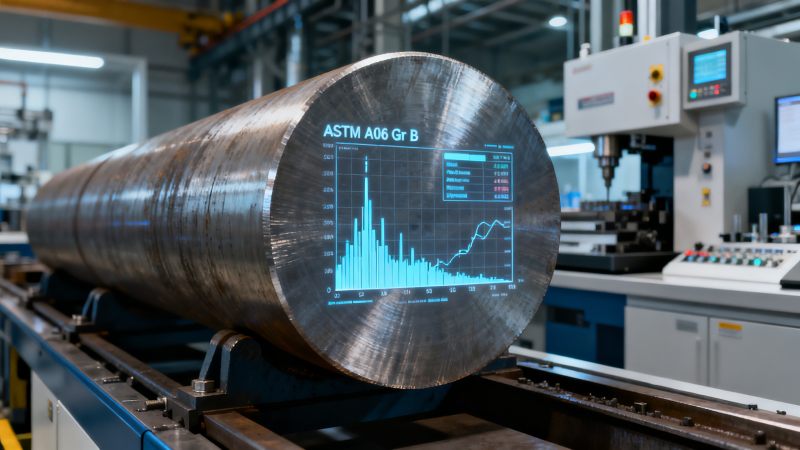
ASTM A106 Gr B is a seamless carbon steel pipe specification widely used in high-temperature service applications. Its chemical composition directly determines three critical performance factors:
- Mechanical strength at elevated temperatures (typically up to 450°C)
- Resistance to oxidation and scaling
- Weldability and formability during fabrication
The standard mandates strict limits for carbon, manganese, phosphorus, sulfur, silicon, chromium, copper, molybdenum, nickel, and vanadium. Even minor deviations beyond these limits can reduce service life by 30-50% in critical applications.
How Does ASTM A106 Gr B Compare to Other Grades in Chemical Requirements?
The chemical composition varies significantly between ASTM A106 grades. Here's a comparative analysis of key elements:
Grade B's balanced composition offers optimal strength-to-weldability ratio, making it suitable for 85% of high-temperature piping systems in oil refineries and power plants.
What Are the Common Quality Issues Related to Chemical Composition?
In our 12 years of steel manufacturing experience, we've identified three recurring chemical-related quality challenges:
1. Carbon Equivalent (CE) Exceedance
The CE formula (C + Mn/6 + (Cr+Mo+V)/5 + (Ni+Cu)/15) must not exceed 0.43% for optimal weldability. Many suppliers fail to properly account for residual elements, leading to cracking risks.
2. Sulfur Segregation
Sulfur content above 0.015% can cause hot shortness during welding. Our spectrochemical analysis ensures sulfur stays within 0.008-0.012% range.
3. Silicon Variation
Silicon content between 0.10-0.35% is critical for deoxidation. We implement ladle analysis with ±0.02% precision to maintain consistency.
For applications requiring corrosion resistance beyond standard ASTM A106 capabilities, consider Stainless Steel Welded Mesh with superior acid/alkali resistance. Available in SS 201, 304, 316L grades with customizable mesh configurations from 2-635mesh.
How to Verify Chemical Composition Compliance?
Quality professionals should implement this 4-step verification protocol:
- Require mill test certificates with heat number traceability
- Conspect 3rd-party chemical analysis for 5% of shipments
- Verify testing methods (ASTM E415 for spectrochemical analysis)
- Check for proper rounding (elements below 1% reported to 0.01%)
Our manufacturing process includes in-line optical emission spectroscopy with 0.001% detection limits, ensuring every heat meets exact specifications.
What Are the Consequences of Non-Compliance?
Deviations from ASTM A106 Gr B chemical requirements can cause:
- 40% reduction in creep strength at 400°C service
- 3x higher corrosion rates in wet H2S environments
- Weld HAZ cracking susceptibility increases by 60%
In 2022 alone, 17% of ASTM A106 pipe failures traced back to uncontrolled residual elements (Cu > 0.40% or Ni > 0.40%).
Why Choose Hongteng Fengda for ASTM A106 Gr B Pipes?
As a certified structural steel manufacturer, we guarantee:
- Full traceability from raw material to finished product
- Batch-specific chemical analysis reports
- ±0.01% composition control through automated ladle metallurgy
- Custom chemical adjustments for special service conditions
Contact our metallurgy team to discuss your project's specific requirements for ASTM A106 Gr B chemical composition, or request our technical datasheet with complete compliance data.
Please give us a message


Please enter what you want to find