Choosing the right API steel pipe is critical for safe, efficient oil and gas transport. Pipe grade selection affects pressure capacity, sour service suitability, weldability, compliance, and total project cost.
This guide explains key API steel pipe grades, practical selection factors, and how disciplined production and inspection improve sourcing outcomes in demanding energy applications.
API steel pipe basics and grade framework
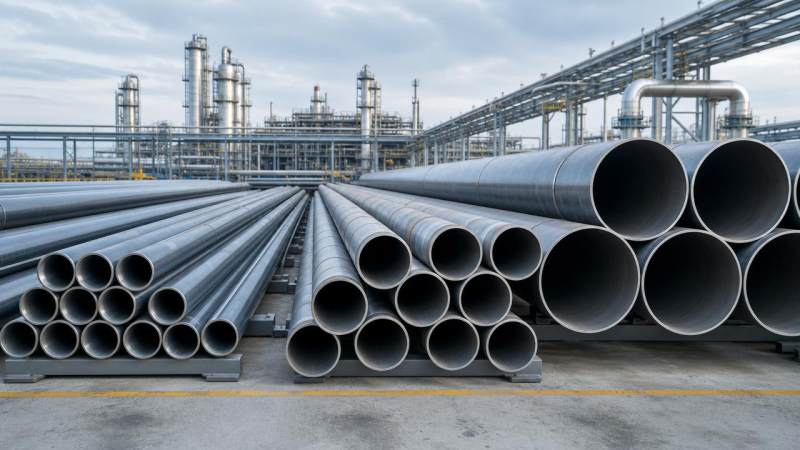
API steel pipe usually refers to line pipe produced under API 5L for transporting oil, gas, water, and related fluids in pipeline systems.
Grades are commonly identified by strength level, such as Grade B, X42, X52, X60, X65, and X70. Higher numbers indicate higher minimum yield strength.
However, strength alone does not define fitness for service. Chemical composition, toughness, weldability, manufacturing route, and inspection scope also matter.
API steel pipe is available in seamless and welded forms. Common welded routes include ERW, LSAW, and SSAW, each serving different size and pressure ranges.
- Seamless pipe: often selected for smaller diameters and high-pressure service.
- ERW pipe: suitable for many onshore transmission and distribution lines.
- LSAW pipe: widely used for large-diameter, high-strength, long-distance pipelines.
- SSAW pipe: often applied in lower to medium pressure, large-diameter projects.
Common API 5L specification levels
API 5L includes PSL1 and PSL2. PSL2 has tighter controls on chemistry, mechanical properties, notch toughness, and non-destructive testing.
For critical transport lines, API steel pipe under PSL2 is often preferred because it offers better consistency and stronger technical assurance.
Current industry focus in oil and gas pipeline selection
Pipeline projects now face stricter performance expectations. Owners require reliable materials that balance operating pressure, corrosion risk, safety margins, and lifecycle cost.
In practice, API steel pipe selection is rarely based on one property. It depends on a combined review of design code, environment, transport medium, and fabrication method.
Key API steel pipe grades and their application differences
Grade B remains common in moderate pressure applications. It is widely recognized, easier to source, and generally economical for straightforward projects.
X42 and X52 are often chosen for gathering systems, feeder lines, and conventional transmission conditions where balanced performance is required.
X60 and X65 support higher pressure transmission and longer distances. These grades can help reduce wall thickness while preserving structural performance.
X70 is often considered for major trunk pipelines. It offers higher strength, but demands stricter control over forming, welding, and toughness verification.
Higher strength API steel pipe can improve efficiency, but it may narrow processing windows. That makes supplier capability and process consistency especially important.
In broader energy handling systems, supporting steel products also need corrosion control and certified quality. For lifting, rigging, or drilling support, Galvanized Steel Wire Rope 1470Mpa to 1960Mpa can complement project requirements where reliable steel performance is essential.
That wire rope range covers 1470Mpa to 1960Mpa tensile strength, diameters from 1.0mm to 22mm, and finishes including plain, electro galvanized, and hot dipped galvanized.
Business value of selecting the right API steel pipe
Correct API steel pipe grade selection reduces the risk of overdesign and underperformance. Both mistakes can cause unnecessary cost, delay, or operational hazard.
A well-matched grade can improve transport efficiency, support code compliance, and simplify field welding procedures when chemistry and toughness are properly controlled.
For global projects, production discipline matters as much as specification wording. Reliable mills help ensure dimensional accuracy, stable mechanical properties, and complete documentation.
Hongteng Fengda, a structural steel manufacturer and exporter from China, supports international buyers with consistent manufacturing, customized supply, and strict quality control.
Its product systems align with major standards such as ASTM, EN, JIS, and GB. This standards-driven approach helps reduce sourcing uncertainty across industrial steel applications.
Stable production capacity and dependable lead times are also important. In pipeline and energy projects, delivery reliability directly affects installation sequencing and cost control.
Typical selection scenarios for API steel pipe
Different operating conditions call for different API steel pipe strategies. The following examples show how grade decisions usually connect to service demands.
- Onshore crude oil lines: often prioritize pressure rating, weldability, and coating compatibility.
- Natural gas transmission: often requires higher strength, fracture toughness, and strict weld seam inspection.
- Sour service lines: require additional hardness and cracking resistance considerations.
- Cold region projects: emphasize low-temperature impact toughness and material consistency.
- Offshore pipelines: combine corrosion, fatigue, pressure, and fabrication complexity.
What to compare beyond grade name
Two pipes with the same grade marking may not perform equally in all projects. Review these technical checkpoints before approval.
- PSL level and supplementary requirements.
- Seamless, ERW, LSAW, or SSAW manufacturing route.
- Chemical composition and carbon equivalent.
- Impact test temperature and absorbed energy values.
- Hydrostatic testing and non-destructive examination scope.
- Dimensional tolerances, ovality, and wall thickness consistency.
- Coating, bevel condition, marking, and traceability records.
Practical recommendations for sourcing and quality control
Start with the actual service envelope. Define pressure, fluid type, temperature, corrosion exposure, design life, and installation method before comparing API steel pipe offers.
Request mill test certificates with full heat traceability. Confirm that mechanical results, chemistry, and inspection records match the ordered standard and project specification.
For higher grades, check weld seam quality control, ultrasonic inspection coverage, and fracture toughness data carefully. These details strongly influence field performance.
Audit production capability when possible. Facilities, forming equipment, heat treatment control, and testing discipline reveal whether claimed quality is repeatable.
It is also useful to evaluate related steel supply capability. A partner experienced in structural steel, custom fabrication, and international compliance can improve project coordination.
Avoid selecting API steel pipe by price alone. Lower initial cost may hide risks in rework, delays, inspection failure, or reduced service life.
Next-step evaluation for oil and gas transport projects
A sound API steel pipe decision begins with matching grade, specification level, and manufacturing route to real operating conditions.
Then verify the supplier’s quality system, standard compliance, and delivery stability. This process supports safer transport and more predictable project execution.
If a project also requires structural steel components or customized industrial steel solutions, working with an experienced Chinese exporter can streamline procurement planning.
By focusing on technical fit, documented quality, and dependable production, API steel pipe sourcing becomes a controlled engineering decision rather than a purchasing guess.
Please give us a message


Please enter what you want to find