When comparing API 5L Grade B seamless pipe vs welded pipe, technical evaluators must weigh pressure performance, dimensional consistency, cost, and application suitability.
For projects requiring dependable strength and compliance, seamless carbon steel pipe API 5L grade B is often a key option.
This article explains the practical differences, common use cases, and sourcing considerations in the steel industry.
API 5L Grade B Pipe Basics and Standard Scope
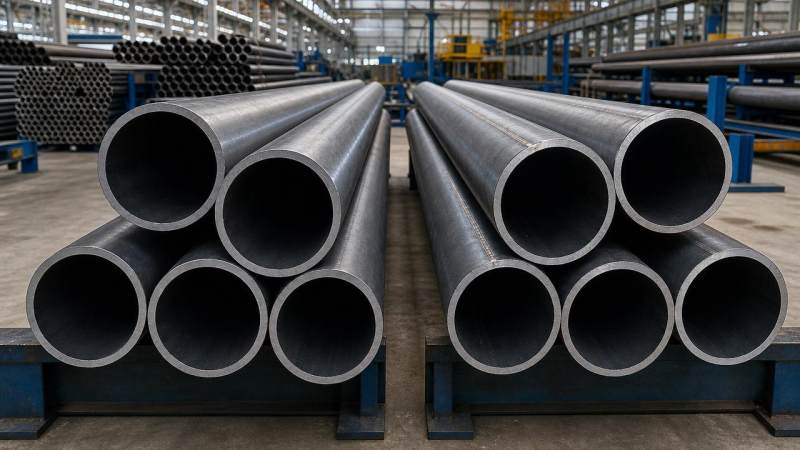
API 5L Grade B is a widely used line pipe grade for oil, gas, water, and structural transmission systems.
It appears in both seamless and welded forms, depending on manufacturing route and service requirements.
The standard focuses on chemistry, tensile properties, dimensions, hydrostatic performance, marking, and inspection.
In many projects, seamless carbon steel pipe API 5L grade B is selected where pressure margin or wall integrity carries extra importance.
Welded pipe remains common where long lengths, tighter budget control, and broad availability are preferred.
How the two types are made
Seamless pipe is produced from a solid billet that is heated, pierced, and rolled into a hollow section.
Because no seam is formed, the pipe body is continuous around the circumference.
Welded pipe starts as steel plate or coil, then is formed and welded along a longitudinal or spiral seam.
Modern welding and non-destructive testing greatly improve reliability, but the seam remains a design consideration.
Current Industry Focus in API 5L Grade B Selection
Today, pipe selection is driven by more than nominal grade alone.
Buyers compare manufacturing stability, traceability, lead time, coating compatibility, and logistics efficiency.
In export supply, consistency across batches often matters as much as base mechanical strength.
- Higher attention to test certificates and heat traceability.
- Closer review of OD, WT, straightness, and end preparation.
- More demand for anti-corrosion treatment and project-specific coatings.
- Preference for stable global standards such as ASTM, EN, JIS, and GB alignment.
A structural steel manufacturer and exporter with broad standard familiarity can reduce sourcing risk in mixed-material projects.
That matters when pipe is procured alongside beams, channels, angles, and custom steel components.
Seamless Pipe vs Welded Pipe: Technical Differences That Matter
The core comparison is not simply better versus cheaper.
It is about matching process characteristics to real operating demands.
Pressure and safety margin
Seamless carbon steel pipe API 5L grade B is commonly chosen for pressure lines, refinery support systems, and critical industrial circuits.
Without a weld seam, engineers often view it as providing a simpler stress path under demanding conditions.
However, welded pipe can also perform well when properly manufactured, tested, and used within design limits.
Dimensional control and fabrication
Welded pipe may offer tighter outside diameter consistency, which helps in automated fit-up and repeated fabrication work.
Seamless pipe may be favored when machining allowance, wall robustness, or heavy-duty threading is required.
Cost and procurement impact
Welded options generally reduce material cost per ton and can shorten supply cycles in larger sizes.
Seamless pipe often carries a premium, but that premium may be justified by service conditions or specification demands.
Application Value Across Steel Projects
In practical steel projects, pipe rarely stands alone.
It works within a broader package of structural, mechanical, and fabricated steel products.
For that reason, material coordination and supplier capability influence the final pipe decision.
For example, industrial plants may combine API 5L pipe with formed steel supports, access platforms, and equipment frames.
In those environments, a supplier experienced in structural steel and custom fabrication adds practical value.
Some projects also source sheet and plate products for housings, guards, or formed components.
A related option is High Carbon Steel Plate , available in widths from 100mm to 3000mm and thickness from 0.1mm to 400mm.
Its smooth surface finish, high tensile strength, and forming capability suit stamped or bent steel parts in supporting assemblies.
Typical Use Cases by Service Condition
The following classification helps narrow pipe type selection by operating context.
- Use seamless for stricter pressure confidence and thicker wall demands.
- Use welded for larger diameters and cost-sensitive transmission work.
- Confirm code acceptance before final substitution.
Practical Checks Before Final Specification
A reliable decision requires more than comparing quotation prices.
Technical verification should cover manufacturing route, testing scope, and downstream fabrication needs.
- Verify pipe type clearly in the purchase order.
- Check size range, schedule, and tolerance requirements.
- Review hydrostatic, ultrasonic, and seam inspection records where applicable.
- Confirm end condition, beveling, and coating compatibility.
- Match mill certificates to heat numbers and shipment markings.
- Assess whether transport length affects loading efficiency and site handling.
For international supply, stable quality control is essential.
Hongteng Fengda supports global construction, industrial, and manufacturing projects with dependable steel products and customized solutions.
With modern facilities and strict inspection, products are supplied to major international standards and export markets.
Selection Guidance for Better Project Outcomes
API 5L Grade B seamless pipe vs welded pipe is ultimately a fit-for-purpose decision.
Seamless carbon steel pipe API 5L grade B usually offers stronger appeal for pressure-sensitive and mechanically demanding service.
Welded pipe often delivers better economy and supply flexibility for standard transmission or structural applications.
The most effective approach is to align design pressure, fabrication method, inspection level, and budget before ordering.
When project schedules involve mixed steel categories, coordinated sourcing helps control cost, reduce delays, and simplify compliance review.
For detailed specifications, request material data, dimensional options, and supply recommendations based on the actual operating environment.
Please give us a message


Please enter what you want to find