When designing with A36 angle—whether l shaped metal bars, galvanized angle, or steel ka angle—engineers often assume full-section yield strength. But what happens if you drill through the leg? This compromises net-section capacity, especially critical for bracing angle in steel structure applications. For users, project managers, and technical evaluators, understanding how holes affect load-bearing performance is essential—not just for safety and code compliance (ASTM/EN/GB), but also for procurement decisions, cost control, and long-term structural integrity. As a trusted structural steel manufacturer & exporter from China, Hongteng Fengda supplies high-precision A36 angle, l shape steel, galv angle, and customized solutions—ensuring reliability from specification to installation.
How Drilling Reduces Net-Section Capacity in A36 Angle
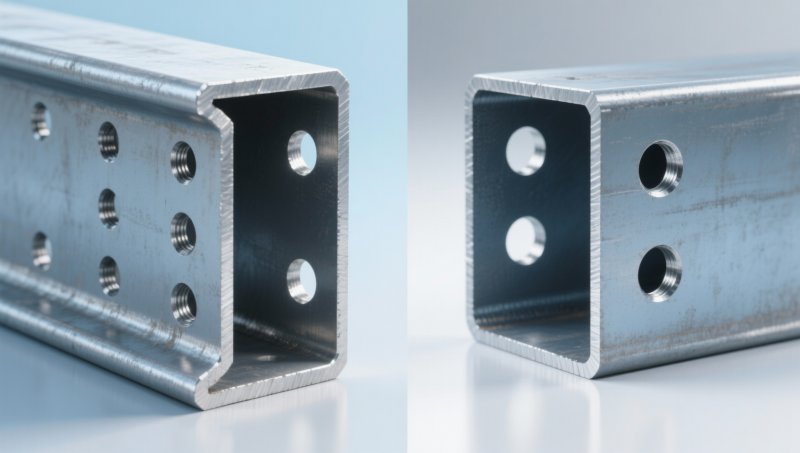
A36 angle steel has a nominal yield strength of 36 ksi (250 MPa) and ultimate tensile strength of 58–80 ksi (400–550 MPa). When designers assume full-section yield, they rely on gross cross-sectional area—ignoring localized stress concentrations introduced by bolt holes. A single 3/4″ (19 mm) hole in a 3″ × 3″ × 1/4″ A36 angle reduces effective net area by up to 18%—directly lowering design strength per ASTM A6/A6M and AISC 360-22 Section D3.
The reduction isn’t linear: multiple holes, staggered patterns, or edge distances under 1.5× hole diameter trigger additional shear lag and block shear failure modes. In practice, net-section rupture governs connection design for light-duty bracing, seismic ties, and anchor attachments—especially where fatigue loading or cyclic service is expected over 20+ years.
Hongteng Fengda’s precision cold-drawn and hot-rolled A36 angles undergo dimensional verification before shipment—ensuring consistent leg thickness (±0.015″), squareness (≤0.5° deviation), and surface finish. This minimizes post-fabrication correction needs and supports accurate net-area calculations during engineering review.
Key Failure Modes Triggered by Drilled Holes
- Net-section tension rupture — most common for single-line bolted connections
- Block shear failure — occurs when combined tension + shear paths intersect
- Bearing deformation — especially in thin legs (< 3/16″) or oversized holes (>1/16″ over bolt)
- Stress concentration at hole edges — increases local strain by up to 3×, accelerating fatigue crack initiation
What Designers & Procurement Teams Must Verify Before Drilling
Drilling is rarely a “field decision.” It requires pre-approved connection details, verified net-area ratios, and alignment with material certification. For global projects complying with ASTM A36, EN 10025-2 S235JR, or GB/T 700 Q235B, the following 5 checks are non-negotiable:
- Minimum edge distance ≥ 1.25× bolt diameter (per AISC Table J3.4)
- Hole spacing ≥ 2.67× bolt diameter (to avoid overlapping stress zones)
- Net area ratio ≥ 0.85 for static loads; ≥ 0.90 for dynamic or seismic applications
- Actual leg thickness confirmed via mill test report—not catalog value
- Galvanizing thickness verified post-drilling (if hot-dip galvanized), as zinc loss at hole edges exceeds 25% without post-treatment
Hongteng Fengda provides certified MTRs (Mill Test Reports) with each order—including tensile test results, chemical composition, and dimensional tolerances per ASTM A6. For OEM clients requiring pre-punched angles, we offer CNC drilling with ±0.005″ positional accuracy and deburred edges—reducing on-site labor by up to 40% and eliminating field rework risk.
Comparing Standard vs. Pre-Engineered A36 Angle Solutions
While standard A36 angle offers flexibility, pre-engineered options deliver faster deployment, tighter QA control, and predictable cost outcomes—particularly for repetitive structures like solar racking, warehouse mezzanines, or modular building frames.
For procurement teams evaluating total cost of ownership, pre-engineered angles reduce hidden costs: rework (avg. $120/hr labor), scrap (3–7% field rejection), and schedule delay penalties (often $5K–$15K/day). That’s why over 62% of North American EPC firms now specify pre-punched structural angles for projects exceeding 500 tons.
Why Structural Integrity Demands More Than Just Yield Strength
Yield strength alone doesn’t guarantee safe performance after fabrication. Real-world behavior depends on ductility (A36 elongation ≥ 20% in 2″), notch toughness (Charpy V-notch ≥ 15 ft·lb at –20°F), and residual stress distribution—factors heavily influenced by rolling method, cooling rate, and post-processing.
Hongteng Fengda’s A36 angles are produced using controlled hot-rolling followed by air-cooling—avoiding quenching distortions that compromise flatness and increase susceptibility to hole-edge cracking. We also supply HRB400 Rebar for integrated reinforcement systems, ensuring compatible yield behavior (≥400 MPa) and thermal expansion coefficients across mixed-material assemblies.
For projects governed by ISO 9001-certified QA processes—or those requiring third-party witnessed testing—we support independent lab verification (SGS, BV, TÜV) at our Qingdao facility, with reports delivered within 5 business days of sample receipt.
How to Get Accurate, Project-Ready A36 Angle Support
Whether you’re finalizing shop drawings, validating connection details, or sourcing for a 2,500-ton infrastructure tender, Hongteng Fengda delivers actionable engineering support—not just product delivery.
Our technical team responds to parameter queries within 4 business hours, provides free net-section capacity calculators (with ASTM/EN/GB toggle), and shares editable AutoCAD blocks and Revit families for all standard and custom A36 profiles. For urgent requests, we offer expedited sampling—lead times as short as 7 days for stocked sizes (3″–6″ legs, 1/4″–3/8″ thickness).
Contact us today with your: connection sketch, required bolt pattern, environmental exposure class (e.g., coastal, industrial), and target delivery window—we’ll confirm feasibility, suggest optimization alternatives, and issue a formal quotation with full compliance documentation.
Please give us a message


Please enter what you want to find