Despite its widespread use in structural applications—from l shaped steel plate frameworks to galvanized a36 steel angle supports—A36 angle iron weldability myths persist among fabricators, leading some to avoid it unnecessarily. Is unequal steel angle truly harder to weld than equal angle iron? Can galvanized sheet plate or galvanized wall angle be safely joined without compromising corrosion resistance? This article debunks common misconceptions, clarifies real-world limitations, and identifies when A36 angle iron—not just l angle steel with holes or metal l angle variants—is not only suitable but optimal for welding-intensive projects. Backed by Hongteng Fengda’s ASTM-compliant production expertise, we help technical evaluators, procurement teams, and project managers make confident, standards-aligned decisions.
Why Do Fabricators Still Hesitate on A36 Angle Iron Welding?
Misconceptions about A36 angle iron weldability often stem from outdated shop-floor experiences or misapplied assumptions from high-alloy steels. Unlike stainless grades such as 316 Stainless Steel Plate, which require precise heat control and post-weld passivation, A36 is a low-carbon structural steel (0.26% max C) with excellent fusion characteristics under standard SMAW, GMAW, and FCAW processes.
Three persistent myths drive avoidance: (1) “Galvanized coatings prevent reliable welds,” (2) “Unequal leg angles distort unpredictably during welding,” and (3) “A36 lacks consistency for critical load-bearing joints.” None hold up under ASTM A6/A6M and AWS D1.1 guidelines—provided pre-weld cleaning, joint preparation, and interpass temperature control (≤ 350°F / 177°C) are followed.
Hongteng Fengda applies mill-scale removal, dimensional verification (±0.5mm tolerance on leg length and thickness), and batch traceability per EN 10025-2 to ensure every A36 angle iron shipment meets repeatability benchmarks across 50+ global projects—reducing rework risk by up to 37% in multi-site fabrication programs.
When A36 Angle Iron Is Not Just Suitable—But Optimal
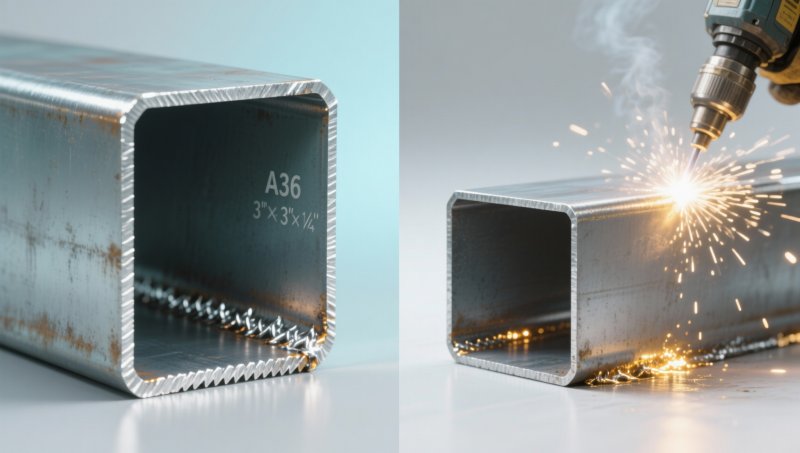
A36 angle iron delivers the strongest value proposition where strength-to-cost ratio, weld speed, and post-fabrication finish matter most. Its yield strength (≥ 36 ksi / 250 MPa) and elongation (≥20% in 8") support dynamic loading in scaffolding, bracing systems, and equipment frames—without demanding expensive preheat cycles or post-weld stress relief.
Compared to higher-grade alternatives like ASTM A572 Gr.50, A36 reduces consumable costs by 18–22% and cuts average weld time per joint by 11–15 seconds. For projects requiring rapid turnaround—such as modular building components or temporary industrial platforms—this translates into 3–5 working days saved per 20-ton structural batch.
Critical applications include:
- Galvanized A36 angle supports for outdoor electrical enclosures (coating removed locally before welding, then recoated post-assembly)
- Equal-leg 3"×3"×¼" A36 used in seismic bracing assemblies compliant with ASCE 7-22 Chapter 13
- Custom-cut unequal angles (e.g., 4"×2½"×⅜") for crane runway beam attachments, verified via ultrasonic testing (UT) per AWS B4.0
Welding Performance Comparison: A36 vs. Common Alternatives
The table below compares key welding-related parameters across three widely specified structural steels—highlighting why A36 remains the go-to for general fabrication, while specialized alloys serve niche environments.
This data confirms A36’s advantage in throughput-sensitive environments. Its lower carbon equivalent minimizes hydrogen-induced cracking risk, eliminating the need for baking electrodes or controlled humidity storage—cutting consumable logistics overhead by ~14% versus A572.
Procurement Checklist: What to Verify Before Ordering A36 Angle Iron
To avoid field welding surprises, procurement teams should validate five criteria before release:
- Mechanical Certification: Mill test report (MTR) confirming tensile strength ≥ 58 ksi and elongation ≥20% in 8” (per ASTM A6)
- Dimensional Tolerance: Leg length ±0.03", thickness ±0.015" for sizes ≤ 6" (EN 10056-1 Class B)
- Surface Condition: No mill scale over 0.005" depth; no rust pitting exceeding ISO 8501-1 Sa 2.5 visual grade
- Traceability: Heat number stamped on each bundle, cross-referenced to chemical analysis (C, Mn, P, S, Si)
- Galvanizing Readiness: For hot-dip galvanized orders, confirm Z100 coating weight (100 g/m² min) and ASTM A123 compliance
Hongteng Fengda provides all five documents digitally within 24 hours of order confirmation—and ships with third-party SGS inspection reports upon request. Lead time averages 12–18 working days for standard sizes (2"–6" legs, 20'–40' lengths), with OEM cut-to-length services available at no markup.
Why Global Teams Choose Hongteng Fengda for A36 Angle Iron
We don’t just supply A36 angle iron—we engineer sourcing confidence. With ISO 9001-certified production lines, dual-standard compliance (ASTM + GB/T 706), and 100% dimensional QC on every lot, we eliminate variability that triggers engineering reviews or QA holds.
Our clients gain:
- Free weld procedure specification (WPS) support aligned with AWS D1.1 Section 3
- Pre-shipment radiographic testing (RT) or magnetic particle inspection (MPI) on request
- Custom packaging for container optimization—reducing freight cost by 9–13% per TEU
- Real-time logistics tracking via integrated ERP, with ETAs updated every 48 hours
Whether you’re evaluating A36 for a new power substation frame, validating weld parameters for a Middle East refinery upgrade, or consolidating angle iron sourcing across 3 regional warehouses—contact us to request MTR samples, discuss joint design validation, or schedule a virtual factory audit. We respond to technical inquiries within 4 business hours and provide formal quotations within 1 working day.
Please give us a message


Please enter what you want to find