Choosing between A36 structural steel and A572 Grade 50 involves more than comparing strength values. Both grades have approximately the same density, so a beam made from one does not automatically weigh less than an identical beam made from the other. A572 Grade 50 has a higher minimum yield strength, however, which may allow a smaller section where strength governs the design. Whether that reduction is practical depends on deflection, buckling, connections, availability, and total project cost.
For technical evaluators, the useful question is therefore not simply “Which steel is stronger?” It is “Can the additional strength be converted into a lighter, economical member without compromising the rest of the design?”
A36 vs A572 Grade 50 at a glance
These are commonly used comparison values, not a substitute for the applicable ASTM edition or the material test report. ASTM requirements vary with product form, dimensions, and other specified conditions. Confirm the required properties for the actual plate, shape, bar, or component before completing the design or purchase order.
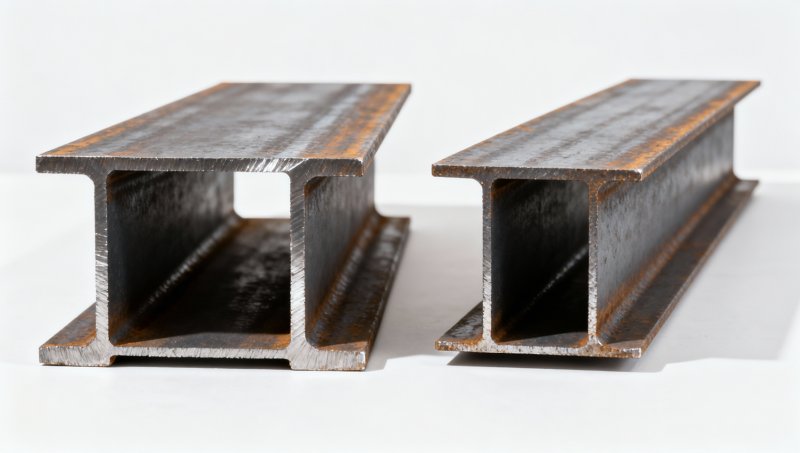
Strength: what does the higher yield value change?
Yield strength is the stress level associated with the onset of permanent deformation under the applicable test definition. On the commonly compared minimum values, A572 Grade 50 has about 39% more yield strength than A36: 50 ksi compared with 36 ksi. That difference can be useful for members whose design is governed by yielding, including some tension members and bending members.
It does not mean that every A572 member carries 39% more load. Design resistance also depends on the member’s shape, section properties, stability, connection details, and the provisions of the governing design standard. In a compression member, for example, buckling may control before the full yield strength can be used. In a connection, the bolt group, weld, or connected material may become the limiting element.
Tensile strength deserves separate attention. A572 Grade 50 generally has a higher specified minimum tensile strength than A36, but yield and tensile strength serve different purposes in structural checks. A tension member may need to satisfy both gross-section yielding and net-section fracture. Selecting a higher yield grade does not remove the need to examine holes, connection geometry, and the applicable fracture limit state.
Weight: the saving comes from the section, not the grade
At the same dimensions and length, an A36 beam and an A572 Grade 50 beam have essentially the same mass. The potential advantage arises only if the design permits a smaller cross-section, a thinner plate, or another geometry with less steel.
Consider a simplified tension-member comparison. If gross-section yielding alone governs, the required gross area is inversely proportional to the specified yield strength. For the same design load and resistance factor, the theoretical area ratio is:
Required A572 area / required A36 area = 36 / 50 = 0.72
That suggests a theoretical reduction of about 28% in gross area, and therefore approximately 28% in member weight for the same length. It is an illustrative upper-level comparison, not a project weight guarantee. Net-section fracture, minimum thickness, bolt spacing, slenderness, corrosion allowance, and available section sizes may require a larger member. The connection itself could also become heavier or more complicated.
For a beam, the calculation is usually less direct. A smaller section may have enough nominal bending strength with Grade 50 steel but insufficient stiffness or lateral stability. Always compare actual section properties and complete the relevant limit-state checks rather than applying the 28% figure to the whole structure.
Where higher-strength steel may not reduce member size
Deflection and vibration
The elastic modulus of the two grades is approximately the same. For members with identical geometry under the same service load, elastic deflection is therefore approximately the same. Switching the material specification alone will not make a beam noticeably stiffer.
If floor deflection, equipment alignment, vibration, or appearance governs, reducing the section may make serviceability worse even when the strength check passes. A long-span floor beam is a common situation in which the designer should examine stiffness before assuming that Grade 50 will save weight. Camber and changes to the framing layout may help in some designs, but they need their own engineering review.
Buckling and stability
Compression members and beams without adequate lateral restraint can be controlled by instability. The available resistance depends on factors such as unbraced length, end conditions, section shape, and local plate slenderness. Higher yield strength can improve resistance in some buckling regimes, but the benefit is not proportional to the increase in yield strength in every case.
Reducing a section can also change its radius of gyration or flange and web proportions. The result may be a member that looks attractive on a yield-strength basis but is less efficient once buckling is checked. Compare complete designs under the governing code, including lateral-torsional and local buckling where applicable.
Connection and fabrication limits
A lighter member must still provide enough material for bolts, welds, bearing, block shear, and load transfer. A thin connection element may not have room for the required bolt arrangement, while a reduced flange or web can complicate welding and erection. In some assemblies, keeping a slightly heavier member simplifies the connection enough to reduce overall fabrication effort.
Both grades are widely used in welded structures, but weldability is not established by the grade name alone. Review the actual chemistry, thickness, restraint, service conditions, and applicable welding code. Welding procedures, consumable selection, and any preheat requirements should be determined for the specific joint rather than assumed to be identical.
How to compare cost without relying on price per ton
A572 Grade 50 may carry a different unit price from A36, depending on section, quantity, market, and supply route. Even when its price per ton is higher, a successful reduction in tonnage can offset some or all of that difference. Conversely, a small weight saving can disappear if the preferred section is difficult to source or requires more fabrication.
A useful comparison should include:
- Delivered material cost: the actual quoted section, grade, quantity, and destination—not a generic market estimate.
- Fabrication: cutting, drilling, welding, handling, and any changes to connection details.
- Transport and erection: member lengths, shipment constraints, lifting plans, and assembly sequence.
- Availability: whether the required grade and size can be supplied within the project schedule.
- Finishing: coating preparation, galvanizing requirements, and design details that affect drainage or distortion.
- Documentation: inspection, traceability, and material test reports required by the project.
For repeated members in a large frame, even a modest reduction per piece can matter. For a one-off bracket or a short beam, the cost of redesign and procurement may outweigh the saving. The right comparison is the installed solution, not just the steel grade.
Applying the choice to structural components
Beams and girders: Evaluate Grade 50 when bending strength controls and suitable smaller sections are available. Retain or compare A36 where deflection, vibration, or bracing requirements set the section size.
Columns and bracing: Check axial resistance together with effective length, local slenderness, and connection design. Higher yield strength may be valuable, but long, slender members can be dominated by stability.
Angles, channels, and built-up components: Examine the actual load path and connection eccentricity. A smaller angle or thinner plate may reduce member weight while creating a more demanding connection or fabrication detail.
Plates and custom parts: Confirm the specified mechanical requirements at the ordered thickness. Plate dimensions, cutting tolerances, hole layouts, and minimum practical thickness can matter as much as the nominal grade.
On projects that combine structural frames with lifting or cable equipment, evaluate each material for its own function. Steel wire rope is not a substitute for A36 or A572 structural members, and its tensile-strength rating should not be compared directly with structural steel yield strength. For a separate rope requirement, Galvanized Steel Wire Rope 1470Mpa to 1960Mpa is offered in diameters from 1.0 mm to 22 mm and multiple constructions. Rope selection still requires verification of construction, coating, breaking force, and the relevant application standard.
What should be specified before requesting a quote?
A technically useful inquiry identifies more than the grade. Provide the product form, section designation or plate dimensions, lengths, quantity, applicable standard and edition, tolerances, and destination. Include any project-specific requirements for testing, traceability, surface condition, fabrication, and coating.
If a substitution is being considered, share the governing design basis and identify whether the supplier is quoting the original size or an alternative section. A grade change does not authorize a dimensional change: the structural engineer must review the proposed member and its connections against all applicable strength and serviceability requirements.
Hongteng Fengda supplies structural products including angles, channels, beams, cold-formed profiles, and customized components. For an evaluation involving alternative specifications, the practical next step is to confirm the available sizes and documentation for each option, then compare the resulting designs on the same loading and code basis. Availability and conformance should be verified against the specific order.
Which grade is the better decision?
Choose A36 when it meets the design requirements and its available sections, fabrication details, or delivered cost make it the more practical option. Give A572 Grade 50 a closer look when yielding governs and the higher strength can be translated into a genuinely smaller, readily available member.
The most defensible choice comes from checking the complete load path. If stiffness, buckling, or connection geometry fixes the section size, the stronger grade may provide little weight benefit. If strength controls across a large number of members, Grade 50 may offer a meaningful reduction in steel quantity. Compare both designs—not just the numbers on their material specifications.
Please give us a message


Please enter what you want to find