When evaluating support members, understanding the real strength limits of A36 angle iron is essential for safe and cost-effective design. This article outlines how load direction, section size, connection details, and buckling behavior affect performance in practical applications. For technical evaluators, it offers a clear basis for comparing specifications, assessing risks, and selecting reliable structural steel solutions.
What technical evaluators really need to know about A36 angle iron limits
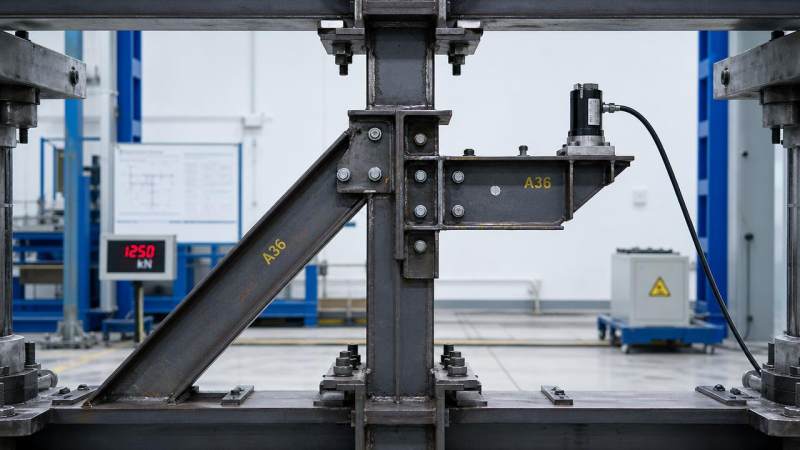
For most support applications, the strength limit of A36 angle iron is not defined by yield strength alone. The controlling issue is usually how the member behaves under real loading and restraint conditions.
A36 steel is commonly specified because it is available, weldable, and cost-effective. However, in support framing, the allowable performance of an angle depends on section geometry, unbraced length, eccentricity, and connection stiffness.
Technical evaluators usually are not asking whether A36 angle iron is “strong.” They are asking whether a specific size, orientation, and connection arrangement can safely carry compression, tension, bending, or combined loading.
That is the key point: the practical limit of a support angle often arrives before the base material reaches its nominal yield value. Local buckling, leg bending, fastener tear-out, and overall instability can govern first.
Start with the material limit, but do not stop there
The base reference for a36 angle iron is ASTM A36 steel, which typically has a minimum yield strength of 36 ksi, or about 250 MPa, and tensile strength around 58 to 80 ksi.
Those values are useful, but they do not directly tell you what a support member can carry in service. They only define the material threshold before permanent deformation or fracture becomes a concern.
In technical evaluation, the more important question is how much of that theoretical strength remains available after accounting for slenderness, hole reduction, residual stress, and load path eccentricity.
For example, an angle used as a short tension brace may utilize a large portion of its material capacity. The same angle used as a long compression support may lose capacity quickly due to buckling.
Why load direction changes the real capacity so much
Support applications rarely load angle steel in a perfectly ideal way. A36 angle iron may be loaded axially, through one leg, eccentrically from a seat, or by combined bending and shear.
When load passes through only one leg, the member tends to twist and bend as well as carry direct force. This reduces usable strength compared with a concentric axial loading assumption.
That is why technical reviewers should ask where the reaction enters the angle, how the angle is connected, and whether the unsupported leg becomes the weak point under service conditions.
In shelf brackets, pipe supports, equipment frames, and secondary building members, even moderate eccentricity can significantly lower the safe working range of a36 angle iron compared with handbook values.
Compression supports: buckling is often the first governing limit
In compression applications, the main limit is often not steel yield but member instability. A slender angle can fail by flexural buckling or flexural-torsional buckling well before reaching 36 ksi.
This is especially important when single angles are used as vertical supports, bracing posts, or equipment stand members. Their unsymmetrical shape makes them less forgiving than doubly symmetric sections.
The effective slenderness ratio, unbraced length, end restraint, and load eccentricity should be reviewed carefully. A small change in unsupported length can produce a large drop in compression capacity.
For technical evaluation, this means the same a36 angle iron size may be acceptable in a short welded frame but unsuitable in a longer bolted field-installed support with weaker restraint.
Tension members are simpler, but connections can become the weak link
When an angle works mainly in tension, the material itself is usually easier to use efficiently. But the design still depends on net section reduction, hole placement, edge distance, and block shear resistance.
Many field failures in light support systems are not caused by the body of the angle. They occur at the connection, where bolt holes reduce area and stress becomes concentrated.
Single-leg bolted connections deserve special attention because they introduce shear lag and uneven force transfer. This can lower effective tensile capacity compared with gross-section expectations.
Therefore, evaluators should compare the member strength and the connection strength separately. If the connection is not balanced with the angle size, increasing section thickness alone may not solve the problem.
Bending in angle supports is easy to underestimate
Angles used as brackets, shelf supports, edge frames, and lintel-like secondary members often experience bending rather than pure axial loading. In these cases, leg width and orientation matter greatly.
An equal angle loaded with one leg horizontal can show very different stiffness and stress distribution from the same section rotated or connected along the opposite leg. Torsional response may also increase.
Because angle sections are not symmetric about both principal axes, the neutral axis location and section modulus are less intuitive than in flat bars or I-beams. Simplified assumptions can be misleading.
For practical review, check whether the loaded leg is laterally restrained, whether the vertical leg acts as a stiffener, and whether the support detail introduces secondary twisting under service load.
Section size selection should focus on stability, not only thickness
Buyers sometimes compare angle steel only by thickness, assuming a thicker section always solves capacity concerns. In reality, leg dimensions and radius characteristics also affect stiffness and buckling behavior.
A larger leg size may improve the radius of gyration and reduce slenderness more effectively than a minor thickness increase. Depending on the load case, this can deliver better structural efficiency.
This is why technical evaluators should request full section properties, not only nominal dimensions. Area, centroid location, principal moments of inertia, and radii of gyration all matter in support applications.
When comparing suppliers, it is also important to confirm tolerance control. Small dimensional variation can influence fit-up, connection alignment, and in marginal cases the real reserve capacity of the support.
Connection details often determine whether the support is reliable in service
In actual projects, the limit state may come from welded toes, bolt group eccentricity, leg tear-out, or deformation around anchors. A good section can still perform poorly if the connection detail is weak.
Evaluate whether the angle is welded continuously, intermittently, or bolted through one leg only. Each arrangement changes force distribution, stiffness, and the likelihood of rotation under load.
For base-supported equipment frames, anchor placement and seat bearing are especially important. If the support reaction is offset, local bending can become the controlling issue even at moderate loads.
Good manufacturing quality helps here. Accurate hole positioning, straightness control, and consistent leg geometry reduce installation stress and help the designed load path perform as intended in the field.
How technical evaluators can assess support risk more effectively
A practical evaluation should begin with the actual service role of the angle: brace, seat, hanger, edge support, frame member, or connection element. Each role activates different limit states.
Next, define the dominant loading: compression, tension, bending, shear, or a combination. Then check unsupported length, connection eccentricity, restraint conditions, and environmental exposure.
After that, compare section properties against the relevant design standard being used by the project team, such as ASTM-based, EN-based, JIS-based, or GB-aligned structural criteria.
For international sourcing, technical consistency matters as much as nominal grade. Reliable manufacturers should be able to provide standard compliance, dimensional data, and production quality records for review.
Corrosion exposure can reduce long-term support reliability
Even when initial strength is adequate, corrosion can gradually reduce cross-section and undermine connection zones. This is especially important for outdoor supports, humid facilities, and industrial environments.
Where corrosion risk is meaningful, protective strategy should be evaluated alongside structural capacity. In some support systems, galvanized sheet and coil products are also used for covers, housings, or secondary formed parts.
For projects requiring corrosion resistance in associated fabricated components, Steel Coil Galvanized can support fabrication needs with grades such as DX51D+Z to S550GD+Z, zinc coatings up to 275 g/m², and widths from 600 mm to 1500 mm.
That does not replace the structural review of a36 angle iron, but it shows why technical evaluators often assess the whole support assembly, including durability measures that affect lifecycle cost and maintenance risk.
What to request from a supplier before approving A36 angle iron for support use
Technical approval should not rely on a catalog line alone. Ask for material certificates, dimensional tolerances, section property data, applicable standards, and confirmation of manufacturing consistency.
If the angle will be fabricated, also review welding suitability, hole-making practice, surface condition, and packing quality for export handling. These factors influence both installation efficiency and final performance.
For custom supports, it is useful to confirm whether the supplier can provide OEM processing, cut lengths, punching, or welded assemblies under controlled quality procedures rather than ad hoc fabrication.
Experienced structural steel exporters usually add value not by claiming maximum strength, but by helping buyers match the right section, standard, and fabrication route to the real support demand.
Common mistakes when comparing A36 angle iron options
One common mistake is treating all angles with similar nominal size as functionally equivalent. Different tolerances, corner radii, and manufacturing quality can affect both fit and performance.
Another mistake is comparing only price per ton. A cheaper section may create higher total cost if it requires reinforcement, causes site adjustment, or introduces uncertainty in approval and inspection.
A third mistake is using yield strength as the sole decision metric. In support applications, stiffness, stability, and connection behavior are often more important than the base material number alone.
Finally, some evaluations ignore service environment. If moisture, chemicals, or maintenance limitations are part of the operating condition, durability protection becomes part of structural reliability, not a separate issue.
Overall judgment: where A36 angle iron works well, and where caution is needed
A36 angle iron performs well in many support applications when loads are moderate, lengths are controlled, and connections are designed to limit eccentricity and instability. It remains a practical and widely accepted material choice.
Its limits appear sooner when the member is long and slender, loaded through one leg, exposed to twisting, or detailed with weak connections. In those situations, nominal steel strength can be a misleading guide.
For technical evaluators, the best approach is to judge a36 angle iron as a structural system component, not just as a material grade. The section, the connection, and the service condition must be reviewed together.
If those factors are checked carefully, A36 angle supports can be specified with confidence, balancing safety, manufacturability, sourcing reliability, and overall project cost.
Please give us a message


Please enter what you want to find