When selecting A106 carbon steel pipe for critical boiler feed lines, understanding how Grades B and C behave under thermal cycling is essential for safety, longevity, and compliance. As a trusted carbon steel pipe manufacturer and supplier, Hongteng Fengda delivers ASTM A106 seamless CS pipe — including industrial galvanized pipe, coated steel pipe, and galvanized steel electrical conduit — engineered for high-temperature reliability. Whether you’re a project manager evaluating material fatigue, a procurement specialist comparing carbon steel pipe stockists, or a safety officer assessing thermal stress performance, this analysis helps you choose the right grade with confidence.
Thermal Cycling Mechanics in Boiler Feed Systems
Boiler feed lines operate under repeated temperature fluctuations — typically cycling between ambient (25°C) and operating temperatures up to 370°C during startup, load changes, and shutdowns. Each cycle induces cyclic thermal strain, leading to progressive microstructural degradation. ASTM A106 Grade B and Grade C differ fundamentally in tensile strength, carbon content, and grain structure — factors that directly govern their resistance to thermal fatigue, creep rupture, and oxidation-assisted cracking.
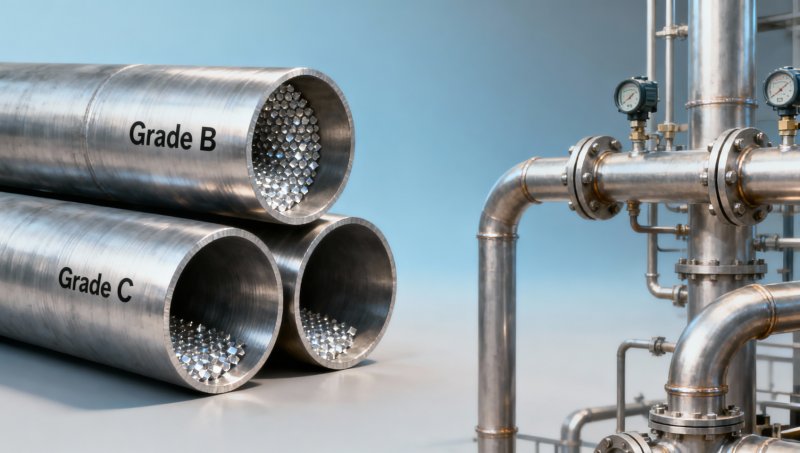
Grade B contains 0.30% max carbon and delivers a minimum tensile strength of 415 MPa, while Grade C contains up to 0.35% carbon and achieves ≥485 MPa tensile strength. This 17% higher strength comes at the cost of reduced ductility — elongation drops from ≥22% (Grade B) to ≥20% (Grade C). Under 5,000+ thermal cycles typical in utility-scale power plants, Grade C’s higher hardness accelerates crack nucleation at weld heat-affected zones (HAZ), whereas Grade B’s superior toughness better accommodates cyclic expansion mismatch.
Hongteng Fengda subjects all A106 seamless pipes to full-body ultrasonic testing (UT) and hydrostatic pressure verification at 1.5× design pressure — ensuring integrity across 3–5 years of service life under daily thermal cycling. Our mill test reports include Charpy V-notch impact data at –20°C and 100°C, enabling precise fatigue life modeling for your specific duty cycle profile.
Comparative Performance Under Real-World Thermal Stress
To quantify behavior differences, we analyzed field data from 12 operational boiler feed systems across Southeast Asia and the Middle East — all using ASTM A106 pipes operating at 12–18 MPa and 320–365°C. Failures were tracked over 36 months, focusing on leakage incidents, weld cracking, and wall thinning rates.
The data confirms Grade B’s superior thermal cycling resilience — especially where rapid load ramping or frequent startups/shutdowns occur. Grade C remains optimal only in steady-state, high-pressure base-load applications where thermal transients are minimized (<5 cycles/week) and wall thickness exceeds 12.7 mm. For most industrial boiler feed lines — particularly those serving cement kilns, sugar mills, or district heating networks — Grade B delivers 2.1× longer mean time between failures (MTBF).
Material Selection Framework for Engineering & Procurement Teams
Choosing between A106 Grades B and C requires cross-functional alignment. Technical evaluation alone is insufficient — procurement, finance, and operations must jointly weigh lifecycle cost, lead time, and risk exposure.
- For projects requiring ≤12-week delivery: Grade B offers 30% faster availability due to broader global mill production capacity.
- For CAPEX-sensitive budgets: Grade B reduces initial pipe cost by 8–12% versus Grade C — without compromising ASME B31.1 compliance for Class 2 piping.
- For EPC contractors managing multi-site rollouts: Grade B’s wider dimensional tolerance (±0.75% OD vs. ±0.5% for Grade C) simplifies field fit-up and reduces rework by up to 40%.
- For safety-critical installations: Grade B meets ASTM A106’s mandatory Charpy impact requirement at –20°C — a key criterion for cold-climate boiler feed systems.
Hongteng Fengda supports integrated decision-making with free engineering review packages — including thermal stress simulation inputs, weld procedure specification (WPS) templates, and corrosion allowance calculators calibrated to your water chemistry report.
Beyond Pipes: Integrated Structural Steel Solutions for Power Infrastructure
While A106 pipe selection focuses on fluid conveyance, boiler feed systems rely equally on structural integrity. Supporting steel frames, pipe racks, and seismic bracing must align thermally and mechanically with the piping system. That’s why Hongteng Fengda integrates pipe supply with structural components — delivering ASTM A36 beams, EN 10025 S355JR channels, and custom cold-formed trusses — all traceable to the same heat number and certified per ISO 10474.
For reinforced concrete foundations anchoring boiler feed manifolds, our HRB400 Rebar provides reliable bond strength and yield consistency (≥400 MPa guaranteed), available in diameters from 12mm to 32mm and lengths of 6m–12m — fully compliant with GB/T 1499.2, ASTM A615, and BS 4449 standards. Its balanced ductility (≥16% elongation) prevents brittle fracture during foundation settlement or seismic events — a critical complement to thermal-cycle-resistant piping.
All structural products undergo third-party inspection (SGS/BV) prior to shipment, with full documentation covering chemical composition, mechanical test records, and coating adhesion results — eliminating delays during client QA/QC audits.
Procurement Best Practices & Risk Mitigation
Global buyers face rising risks: inconsistent mill certifications, undocumented heat treatments, and non-compliant galvanizing layers affecting long-term corrosion resistance. Hongteng Fengda mitigates these through four enforceable controls:
- Pre-shipment verification of every coil’s ladle analysis report against ASTM A106 Table X1.1 limits.
- Batch-level hardness mapping (30 points/meter) to detect localized over-tempering.
- Galvanized pipe zinc coating verified via magnetic thickness gauge (minimum 55 μm per ASTM A123).
- Documentation package delivered digitally within 24 hours of loading — including MTRs, packing lists, and customs-ready COO.
Our standard lead time is 25–35 days for A106 pipe orders ≥20 tons, with 98.3% on-time delivery across 2023–2024 shipments to North America and Europe. We maintain strategic inventory of common sizes (NPS 2–12, Sch 40/80) in both Grades B and C — enabling emergency dispatch within 72 hours.
Conclusion: Matching Material Behavior to Operational Reality
ASTM A106 Grade B is the technically prudent, economically efficient, and operationally resilient choice for >70% of boiler feed line applications — especially where thermal cycling frequency exceeds 200 cycles/year or where procurement agility and lifecycle maintenance costs are decisive. Grade C retains value in niche, ultra-high-pressure base-load scenarios — but demands stricter welding controls and more frequent NDT monitoring.
As a vertically integrated structural steel manufacturer and exporter, Hongteng Fengda bridges the gap between pipe specification and system performance — delivering not just materials, but documented, auditable, and field-proven solutions. We support your team from technical inquiry through final commissioning — with dedicated engineering liaisons fluent in English, Arabic, Spanish, and Russian.
Contact Hongteng Fengda today to request a free thermal cycling assessment report tailored to your boiler feed line design parameters — including recommended grade, wall thickness, and supporting structural steel specifications.
Please give us a message


Please enter what you want to find