Why does a106 seamless pipe stay on the shortlist for heat and pressure service?
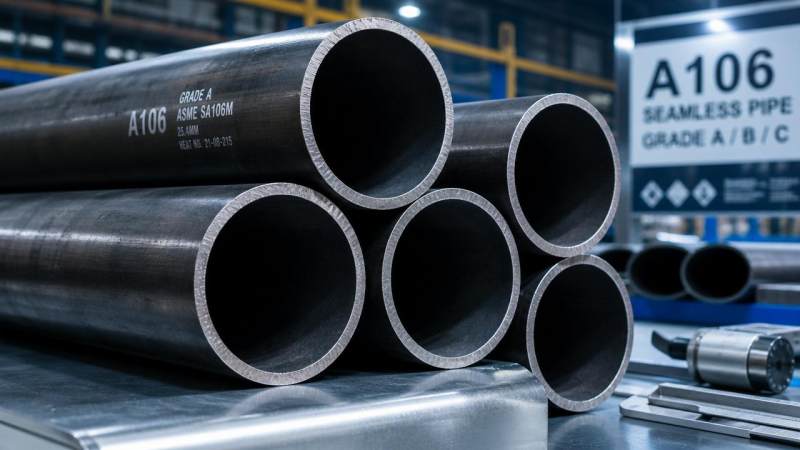
When carbon steel pipe is reviewed for elevated temperature duty, a106 seamless is usually one of the first standards checked.
That happens for a practical reason. ASTM A106 is designed for seamless carbon steel pipe used in high-temperature service.
In real projects, the question is rarely just “Does it meet the standard?”
A better question is whether the pipe fits the temperature window, pressure demand, fabrication route, and documentation needs of the job.
For that reason, technical review often starts with three checks: service temperature, design pressure, and grade selection.
If one of those is mismatched, even compliant material can become a poor choice.
This is also where sourcing discipline matters. Suppliers with stable process control and standard familiarity reduce the risk of paperwork gaps and property variation.
Companies such as Hongteng Fengda, active in ASTM, EN, JIS, and GB-based steel supply, are often evaluated on that consistency rather than on price alone.
What does ASTM A106 actually cover, and what does it not promise?
A106 seamless refers to seamless carbon steel pipe for high-temperature service. The keyword is “seamless,” which means no welded longitudinal seam.
That structure helps when the line will see pressure cycling, heat, or demanding process conditions.
Still, the standard does not automatically guarantee suitability for every corrosive fluid, sour service condition, or very low-temperature environment.
It mainly defines chemical composition, mechanical properties, heat treatment expectations, dimensions, and testing requirements for the pipe standard itself.
In other words, ASTM A106 gives a recognized baseline. It does not replace system design calculations or service-specific material review.
That distinction matters when a line also includes structural supports, secondary framing, or equipment brackets.
For example, in plant expansions, pipe selection may sit beside support member selection such as Z-beam sections used in lightweight roof, wall beam, or bracket systems.
Those are different product categories, but both require the same discipline: check grade, dimensions, tolerances, coating needs, and certification before approval.
How should the temperature range of a106 seamless be judged in practice?
This is where many reviews become too simplified. People often ask for a single maximum temperature number.
In practice, acceptable temperature depends on code design rules, wall thickness, pressure level, corrosion allowance, and the selected grade.
A106 seamless is commonly chosen for moderate to high-temperature service, especially where standard carbon steel remains acceptable under the governing code.
More cautious reviews use allowable stress tables from the applicable design code rather than relying on catalog language.
That is the safer route because two pipes with the same OD can perform very differently once wall schedule and service temperature are combined.
As a quick screening rule, consider these checkpoints:
- Confirm the continuous operating temperature, not only startup or upset temperature.
- Check whether oxidation, scaling, or corrosion changes the safe service margin.
- Review code allowable stress at temperature, not room-temperature strength alone.
- Verify whether post-fabrication heat exposure affects adjacent components or coatings.
If the service moves far beyond the normal carbon steel comfort zone, alloy pipe may become the more reliable answer.
Is a106 seamless a pressure pipe by default, or does pressure use depend on more than the standard?
It is suitable for pressure service, but pressure capacity is never defined by the material standard alone.
Actual pressure use depends on outside diameter, wall thickness, design temperature, joint efficiency assumptions, corrosion allowance, and code formula.
That means two a106 seamless pipes with the same grade can have very different pressure ratings if their schedules differ.
A thin-wall pipe may pass incoming inspection and still fail the intended duty review.
The table below helps organize the usual screening logic before deeper design verification.
So, yes, a106 seamless is widely used for pressure systems, but it should be approved through design data, not assumption.
Grade A, B, or C: where do the differences really matter?
The most common commercial discussion is usually Grade B, because it fits many industrial requirements and is widely available.
Grade differences mainly show up in chemical limits and strength levels. As strength rises, design flexibility may improve in some cases.
But stronger does not always mean better. Fabrication route, welding practice, availability, and approval history can outweigh a nominal strength increase.
A simple way to compare the grades is this:
- Grade A: lower strength, less common for many modern heavy-duty selections.
- Grade B: the usual benchmark for general refinery, power, and process piping review.
- Grade C: higher strength, but it should be checked against fabrication and code acceptance needs.
When comparing quotations, grade should never be read alone. Size range, schedule availability, heat treatment, and testing scope must be aligned.
This is similar to structural steel evaluation, where a profile may be offered in Q235B, Q345B, S355, or A572 grades, yet the best choice still depends on use conditions.
That same evaluation habit is useful for a106 seamless: match the standard to the service, not just to the purchase list.
Which mistakes cause the most trouble during technical review and sourcing?
The biggest errors are usually small on paper. They only become visible after fabrication or site installation begins.
One common mistake is treating ASTM A106 as a complete service approval instead of a material starting point.
Another is comparing prices without matching the inspection and documentation package.
A lower offer may exclude required testing, tighter tolerance control, or clear heat traceability.
The following checklist is often more useful than generic sourcing advice:
- Verify whether the pipe is truly seamless and correctly marked.
- Check grade, schedule, and length against actual design documents.
- Review MTC completeness, including chemistry and mechanical test records.
- Confirm whether extra testing is needed for project or client standards.
- Ask about lead time stability, especially for nonstandard sizes.
In export supply, consistency matters as much as nominal compliance. Stable manufacturing, quality control, and dependable delivery often save more cost than a cheaper line item.
That is one reason integrated steel suppliers are evaluated across both structural and industrial product categories, from pipe-related materials to coated profiles like a second Z-beam option used in workshop and bracket systems.
What is the best next step when selecting a106 seamless for a project?
Start by defining the service envelope clearly. Temperature, pressure, medium, corrosion expectation, and code basis should all be visible in one review sheet.
Then compare grade and schedule options against that service envelope rather than against a generic catalog description.
If the application is straightforward, Grade B in the right schedule may be enough. If conditions are harsher, deeper material review is worth the time.
It also helps to confirm whether the supplier can support international standard documentation, dimensional consistency, and repeatable delivery performance.
For technical evaluation, the strongest decision is rarely the fastest quote comparison.
It is usually the option that balances compliance, service fit, fabrication practicality, and supply reliability.
If you are narrowing down a106 seamless choices, build the review around real operating data, not only standard names. That approach leads to fewer surprises and better long-term performance.
Please give us a message


Please enter what you want to find