Understanding 7x19 wire rope breaking strength is essential when evaluating rope for lifting, rigging, and industrial applications. Diameter and material grade both influence the force a rope can withstand before failure, but published values also depend on construction and the applicable standard. The distinction that matters most is straightforward: a rope’s minimum breaking force is not its working load limit.
A useful comparison therefore starts with more than the nominal diameter. Construction, wire grade, finish, core, end termination, and the basis of the published figure all affect whether two catalogue entries describe equivalent products. A larger number on a data sheet is not necessarily a better answer if the rope cannot run correctly over the equipment’s sheaves or survive its operating environment.
What a 7x19 construction tells you—and what it does not
A 7x19 rope is commonly described as seven strands, each containing 19 wires. Its relatively large number of small wires makes it a flexible construction compared with some ropes made from fewer, larger wires. That can be useful in control cables, winch lines, and other applications involving repeated bending, provided the particular rope is approved for the intended service.
The designation alone does not establish a breaking force. Two ropes marked 7x19 and the same nominal diameter can differ in wire material, tensile grade, coating, manufacturing details, and the standard used to determine the published value. Nor does the construction designation tell you whether a finished assembly has a swaged eye, a socket, or another termination.
Flexibility also comes with a practical trade-off. Smaller outer wires can be more susceptible to wear and corrosion damage in some environments. A rope that bends readily is not automatically the best choice for dragging across abrasive surfaces or operating over poorly maintained sheaves.
Why diameter has such a strong effect
For geometrically similar ropes made to the same construction and wire grade, breaking force increases approximately with the square of nominal diameter. This is because the amount of steel resisting tension increases roughly with cross-sectional area.
As an illustration—not a catalogue rating—increasing diameter from 8 mm to 10 mm gives a diameter ratio of 1.25. Squaring that ratio gives approximately 1.56, so an otherwise comparable rope might have about 56% more breaking force. Real published values can differ because ropes are not perfectly scaled copies: tolerances, metallic area, wire properties, and manufacturing details all matter.
The same relationship works against an undersized rope. A modest reduction in diameter can produce a larger proportional reduction in the force it can carry. That is one reason to check the actual product identification rather than assume that a rope is acceptable because it looks close to the specified size.
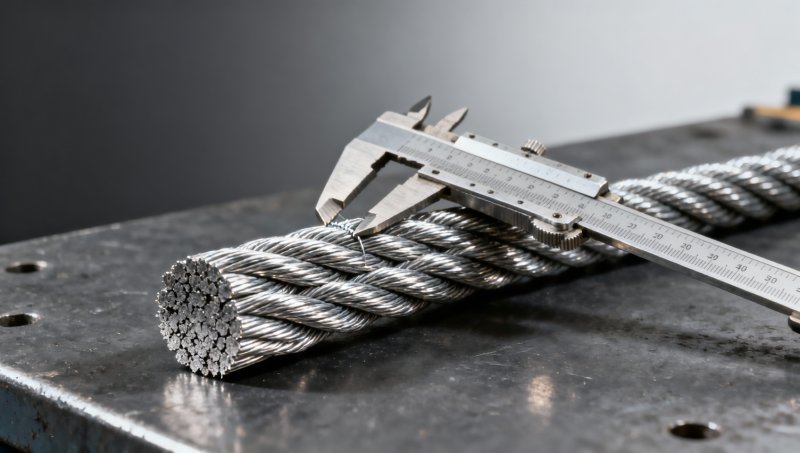
Measure diameter over the outermost points of the rope, across its widest dimension, using a suitable instrument and the measurement procedure specified for the product. A flattened, worn, or distorted rope may not give a meaningful result from one reading. Compare measurements at suitable positions and orientations, and follow the applicable inspection criteria rather than applying a generic diameter-loss threshold.
There is another constraint: more diameter is not always an upgrade. A replacement must fit the sheave groove, drum, fittings, and equipment design. A rope that is too large for the groove can be damaged in service; it may also change how the rope spools. Verify compatibility before substituting a stronger nominal size.
Material and finish: compare the exact rope, not the label
Carbon steel wire ropes are available in different wire tensile grades. In general, a higher wire grade can support a higher specified breaking force when construction and other factors are comparable. The grade should be taken from the manufacturer’s documentation, however, not inferred from a description such as “high strength.”
A higher tensile grade may be useful where the equipment has limited space for a larger rope. It should not be selected on strength alone: bending fatigue, abrasion, corrosion, and termination compatibility still need attention. The strongest rope in a catalogue is not necessarily the one with the best service life on a particular machine.
Galvanized carbon steel is often considered where atmospheric corrosion is a concern. Stainless steel may be appropriate for more corrosive or cleanliness-sensitive applications, but its suitability depends on the stainless grade and the actual exposure. Chlorides, trapped moisture, chemicals, and temperature can all change the assessment. Neither a galvanized finish nor a stainless designation eliminates the need for inspection.
Do not assume that stainless and galvanized 7x19 ropes of the same diameter have interchangeable breaking-force ratings. Obtain the value for the exact construction, material, and finish. If a rope is plastic-coated, check whether the stated diameter refers to the steel rope or the overall coated diameter; the coating does not provide the same tensile resistance as the rope beneath it.
Breaking force, assembly strength, and working load are different numbers
Minimum breaking force, often abbreviated MBF, is a specified minimum force associated with breaking the rope under the relevant standard and test conditions. It is a threshold for the rope product, not a load that should be applied in normal operation. A measured test result may exceed the minimum, but a single higher result does not replace the manufacturer’s rated value.
Working load limit, or WLL, is the maximum load permitted for a defined use under specified conditions. The relationship between breaking force and working load depends on the applicable design factor, equipment rules, and product standard. There is no single factor that should be applied indiscriminately to every 7x19 rope, sling, winch, or lifting arrangement.
For example, if an applicable specification required a design factor of 5 and the governing minimum breaking force were 50 kN, a simple calculation would give 10 kN before considering other limitations. That arithmetic is only an illustration. It does not establish a permissible load for a particular rope assembly or lifting operation.
The termination can change the governing value. An eye, clip arrangement, swaged fitting, or socket must be designed and installed for the rope and application. The assembly’s rating may be lower than the rope’s nominal breaking force, and connected shackles, hooks, anchors, or sheaves can impose a lower limit still. Use the rated capacity of the complete, correctly assembled system—not the strongest individual component.
Load geometry matters too. In a multi-leg sling, tension in each leg changes with the sling angle and load distribution. Unequal loading, off-center lifting, acceleration, snagging, or shock loading can raise forces beyond a simple static weight calculation. These effects belong in the lift or equipment design, not in an informal adjustment made on site.
How to compare supplier data and standards
When two quotations show different breaking strengths for the same nominal diameter, ask what each number represents. One supplier may quote a minimum breaking force; another may show an actual test result, a calculated value, or a load in different units. Kilonewtons, kilogram-force, and pounds-force should not be compared without conversion, and a mass stated in kilograms is not itself a force.
The documentation should identify the applicable product standard and edition, construction, nominal diameter, wire grade or material, finish, and minimum breaking force. For a finished assembly, request the termination details and assembly rating as well. Where traceability or verification is required, agree in advance on the inspection documents, identification, and testing to be supplied.
ISO 2408 addresses steel wire ropes for general purposes, while EN 12385 includes requirements for steel wire ropes and different rope categories. Their applicability depends on the specific product and part of the standard. In the United States, specifications such as ASTM A1023/A1023M cover certain stranded carbon steel wire ropes for general purposes. A citation alone is not proof that a particular rope meets every requirement: check its scope, edition, ordering details, and the supplier’s documentation.
This distinction matters when sourcing internationally. A material grade or standard familiar in one market may not be a direct substitute for another without checking the technical requirements. Ask the supplier to resolve discrepancies before purchase rather than trying to reconcile incompatible certificates after the rope has arrived.
The rope may be adequate while its support is not
Rigging evaluations often stop at the rope and fitting, even though the load must pass into a frame, bracket, base plate, or other structural component. A rope’s breaking force says nothing by itself about the capacity of a welded lug or the local strength of the plate supporting it. Hole geometry, edge distance, welds, loading direction, and the supporting structure require their own engineering checks.
For fabricated supports, material selection and traceability deserve the same care as rope selection. Hongteng Fengda is a China-based structural steel manufacturer and exporter supplying standard and customized steel products. Its Carbon Steel Plate Manufacturer offering includes carbon steel plate grades such as A36, Q235, and S235JR for applications that can include brackets and bearing plates. These grades are not automatically interchangeable; confirm the governing standard, thickness-dependent properties, and project requirements before specifying one.
A plate grade, like a rope grade, is only one input. The completed connection must be assessed for its actual loading and fabrication details. A suitable steel certificate does not, on its own, establish the load rating of a lifting point.
What to check before approving a rope
Start with the required service: static or moving load, expected bending cycles, sheave and drum arrangement, environment, and consequences of failure. Then obtain the manufacturer’s rating for the exact rope and verify that its construction and fittings are permitted by the equipment manufacturer and applicable rules.
Before installation, check identification, condition, diameter, termination, and the matching hardware. During service, follow the applicable inspection and discard criteria for broken wires, corrosion, deformation, wear, and other damage. Internal deterioration may not be obvious from a quick visual check, particularly where moisture or contamination can enter the rope.
If the available documentation gives only a diameter and a breaking-strength figure, the evaluation is not finished. Request the construction, material grade, standard, and assembly information first. Those details determine whether the number is comparable—and whether it is relevant to the load path being approved.
Please give us a message


Please enter what you want to find