430 stainless steel plate is often chosen for one simple reason: it lowers material cost without giving up basic stainless appearance and workable corrosion resistance. That makes it useful in appliances, decorative panels, trim, and some light industrial applications. But it is not a universal substitute for austenitic grades. If chloride exposure, frequent moisture, welding performance, or severe corrosion resistance matters, 430 can fail earlier than buyers expect. For engineers, purchasers, and project teams, the right question is not whether 430 stainless steel plate is “good” or “bad,” but where it is the right fit and where it creates avoidable risk.
What Is the Real Buying Question Behind 430 Stainless Steel Plate?
Most readers comparing 430 stainless steel plate are not looking for a textbook definition. They usually want to know four practical things:
- Is 430 stainless steel plate good enough for my environment?
- How much money can I save compared with higher-cost stainless grades?
- What are the hidden limitations in fabrication, welding, and service life?
- When should I choose another material instead?
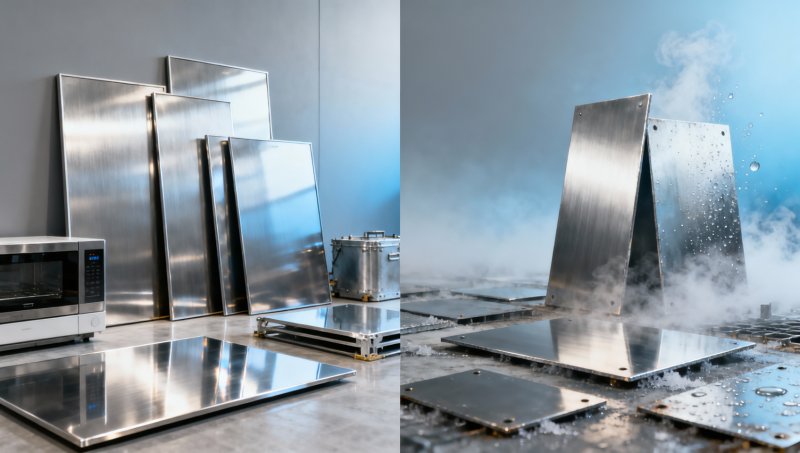
The short answer is this: 430 is a ferritic stainless steel with decent corrosion resistance in mild indoor or low-aggression environments, good formability for many sheet and plate applications, and strong value when appearance and moderate durability matter more than maximum corrosion performance. It works best in dry or mildly humid settings, decorative uses, appliance housings, and components with limited exposure to harsh chemicals or salt.
It becomes a weak choice in coastal, chloride-rich, acidic, or highly wet environments, and in applications that require excellent weld toughness or deep corrosion margin. That is where many sourcing mistakes happen.
Where 430 Stainless Steel Plate Works Well
430 stainless steel plate performs well when the service conditions are controlled and the buyer is prioritizing cost efficiency with acceptable stainless performance.
Typical successful use cases include:
- Household appliance panels and shells
- Indoor decorative cladding and trim
- Kitchen backsplashes and non-critical food-contact surfaces
- Elevator interior panels
- Display fixtures and commercial interiors
- Light industrial covers and guards
- Automotive trim and non-structural components
Why does it work in these cases? Because 430 offers several practical advantages:
- Lower nickel-related cost exposure: as a ferritic grade, it typically costs less than many austenitic stainless options.
- Good surface finish potential: it is widely used where visual appearance matters.
- Reasonable oxidation resistance: suitable for some mildly elevated temperature environments.
- Magnetic properties: useful in applications where magnetism is not a problem or is even preferred.
For buyers managing budget pressure, 430 can be a smart choice when the environment is stable and the product is not expected to resist aggressive corrosion for many years outdoors.
Where 430 Stainless Steel Plate Fails or Creates Risk
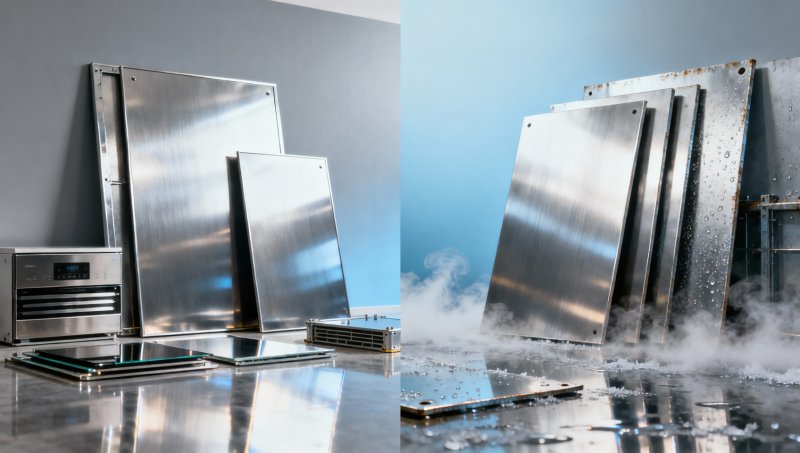
This is the part many articles understate. 430 stainless steel plate fails not because it is poor quality, but because it is often used outside its suitable range.
Common failure-risk scenarios include:
- Coastal and marine environments: salt exposure can lead to staining, pitting, and faster surface deterioration.
- High-humidity outdoor use: repeated wet-dry cycles increase corrosion risk.
- Acidic or chemical processing areas: 430 has limited resistance compared with more corrosion-resistant stainless grades.
- Heavy welding requirements: ferritic stainless steels can present challenges in weld zones and may not be ideal for demanding fabricated assemblies.
- Applications requiring strong toughness at low temperatures: 430 is not the first choice where impact toughness is critical.
- Highly polished surfaces in harsh service: visual staining can quickly become a customer complaint even if structural failure does not occur immediately.
In business terms, the failure is often not immediate breakage. It may be premature cosmetic degradation, warranty complaints, maintenance costs, or replacement earlier than planned. For procurement and project managers, that means the lowest purchase price does not always mean the lowest total cost.
430 vs Other Common Choices: How to Make a Smarter Comparison
Many buyers compare 430 stainless steel coil or plate with other materials without first defining service conditions. That leads to poor substitutions.
430 vs 304 stainless steel
- 430 is usually more economical.
- 304 generally offers better corrosion resistance and broader application safety.
- 304 is often the better option for wet, outdoor, or food-related environments with higher hygiene and durability demands.
430 vs 201 stainless steel
- Both are often considered for cost-sensitive applications.
- 201 stainless steel pipe and sheet may be used in some decorative or structural contexts, but actual suitability depends heavily on forming, corrosion exposure, and specification control.
- Buyers should compare not just price, but corrosion behavior, fabrication route, and end-use environment.
430 vs coated carbon steel or steel coil for construction
- For some construction-related uses, stainless is not always the most economical route.
- Galvanized or coated steel may be more practical where structural performance, coating system, and controlled replacement cycles are acceptable.
For example, in construction, light industry, agriculture, fluid transport, and infrastructure support applications, buyers may also evaluate Galvanized Pipe Manufacturers when corrosion protection, long service life, and cost control are key concerns. Products such as DX52D galvanized steel pipe, available in hot-dip galvanized or electroplated forms, are widely used for general low-pressure fluid pipelines, water, gas, oil-related transport, support frames, sheds, bridges, containers, and machinery applications. With compliance to standards such as ASTM, EN, JIS, DIN, AISI, and GB, this type of solution can be a better fit than stainless in some budget-driven or structurally oriented projects.
The key lesson is simple: compare materials by environment, fabrication method, service life expectations, and replacement cost—not by price per ton alone.
What Engineers, Buyers, and QC Teams Should Check Before Choosing 430
If you are evaluating 430 stainless steel plate for a project, use a short practical checklist:
- Environment: Is the material used indoors, outdoors, coastal, industrial, or chemical-exposed?
- Moisture frequency: Will it stay mostly dry, or face regular condensation, washdown, or standing water?
- Appearance standard: Is minor staining acceptable, or will surface defects create customer rejection?
- Fabrication process: Will the part require extensive welding, deep forming, or polishing?
- Expected service life: Is this a short-cycle commercial product or a long-life engineered installation?
- Maintenance plan: Can the surface be cleaned and inspected regularly?
- Compliance requirements: Are there project, food-contact, or regional standard requirements that limit grade selection?
This step matters for more than technical accuracy. It helps finance approvers and decision-makers avoid overbuying or underbuying. Overbuying wastes budget on unnecessary grade performance. Underbuying creates corrosion, rework, downtime, and reputation risk.
When 430 Stainless Steel Plate Is the Right Value Choice
430 stainless steel plate is the right value choice when all of the following are true:
- The environment is mild and not chloride-heavy.
- The application is mainly decorative, light-duty, or non-critical.
- Cost pressure is important.
- Basic corrosion resistance is sufficient.
- Welding demands are limited or well controlled.
In these situations, 430 can deliver a clean stainless appearance, practical durability, and better budget efficiency than more expensive grades.
It is not the right choice when the application involves outdoor coastal exposure, aggressive washdown, chemical contact, strict long-term corrosion appearance requirements, or demanding fabrication performance. In those cases, a higher-performance stainless grade or a different protected steel solution is usually more economical over the full project life.
Conclusion: Use 430 for the Right Conditions, Not for Every Stainless Job
430 stainless steel plate has a clear place in the market: it is a cost-effective ferritic stainless steel for controlled environments where moderate corrosion resistance and good appearance are enough. It works well in appliances, interior decorative applications, trim, and some light industrial uses. It fails when buyers expect it to perform like a more corrosion-resistant stainless grade in wet, salty, or chemically aggressive service.
The best purchasing decision comes from matching the grade to the actual use condition. For sourcing teams, engineers, and project managers, that means looking beyond initial price and focusing on exposure risk, fabrication needs, maintenance expectations, and lifecycle cost. When applied correctly, 430 stainless steel plate is a smart and efficient material. When misapplied, it becomes an avoidable cost problem.
Please give us a message


Please enter what you want to find