When comparing 316 vs 304 stainless steel in corrosive settings, technical evaluators need more than a basic grade overview.
316 stainless steel is widely chosen for exposure to chlorides, chemicals, and moisture.
However, price, fabrication needs, strength requirements, and service life all matter.
This guide explains how 316 stainless steel compares with 304 for demanding steel applications.
It also highlights practical selection points for industrial, structural, and processing projects.
What is the main difference between 316 and 304 stainless steel?
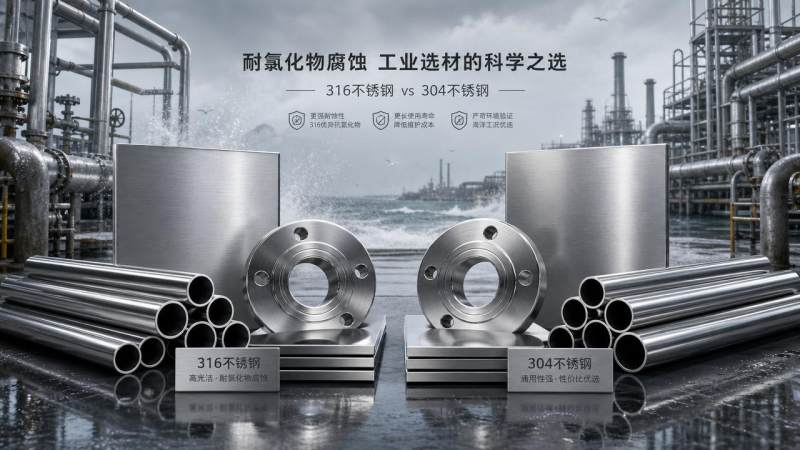
The biggest difference is alloy chemistry, especially molybdenum content.
304 stainless steel is an austenitic grade with good general corrosion resistance.
316 stainless steel adds molybdenum, usually around 2% to 3%.
That addition improves resistance to chlorides, pitting, and crevice corrosion.
In clean indoor environments, both grades often perform well.
In aggressive service, 316 stainless steel usually keeps a larger safety margin.
This is why it appears frequently in marine, chemical, and coastal installations.
Why does molybdenum matter?
Molybdenum strengthens the passive oxide layer on stainless steel surfaces.
That layer helps the metal resist local attack from salt and harsh media.
Without enough resistance, 304 can show rust spots or pitting earlier.
When is 316 stainless steel the better choice in corrosive settings?
316 stainless steel becomes the better choice when corrosion failure has high consequences.
Typical examples include saltwater exposure, coastal humidity, and chloride cleaning agents.
It is also preferred for food processing lines using frequent chemical washdowns.
Pharmaceutical systems and chemical handling equipment often specify 316 stainless steel too.
For outdoor structural parts near the sea, grade choice affects maintenance cycles.
A lower upfront price can become expensive if corrosion causes replacement or downtime.
- Marine fittings, railings, supports, and enclosures
- Chemical tanks, piping, and transfer systems
- Water treatment components with chloride exposure
- Heat exchangers in aggressive process environments
- Architectural steel near coastlines or deicing salts
If service conditions are mild, 304 may still be fully acceptable.
The key is matching grade performance to the actual corrosion risk.
How do 316 and 304 compare in cost, fabrication, and lifecycle value?
304 is usually less expensive than 316 because it contains no molybdenum.
That cost difference matters in large-volume steel procurement.
Still, material price alone should not decide the final grade.
A better question is total lifecycle value under real operating conditions.
If corrosion risk is low, 304 often delivers excellent cost efficiency.
If corrosion risk is moderate or high, 316 stainless steel may reduce long-term costs.
Those savings can come from less maintenance, longer replacement intervals, and lower failure risk.
What about welding and processing?
Both grades offer good formability and weldability for many fabrication methods.
Low-carbon variants help control carbide precipitation after welding.
For pipe systems, low-carbon material is often selected for better welded-zone corrosion behavior.
One practical option is 304L Stainless Steel Pipe.
This ultra-low-carbon grade contains no more than 0.03% carbon.
It helps address susceptibility to intergranular corrosion after welding operations.
It also retains corrosion resistance, toughness, and machinability for many process lines.
Available ranges can include wall thicknesses from 0.5mm to 50mm.
Common finishes include pickling, sandblast, bright polished, and mirror polishing.
Standards such as ASTM, EN, JIS, GB, DIN, and AISI support international project requirements.
How can you judge whether 304 is risky in a corrosive environment?
Start by identifying the actual corrosion drivers instead of using assumptions.
The most common driver is chloride concentration.
Temperature, stagnant moisture, poor drainage, and crevice design also increase risk.
Cleaning chemicals can matter as much as the base process media.
Even a sheltered component may corrode if salt deposits remain on the surface.
- Check whether chlorides are present in water, air, or cleaning agents.
- Review operating temperature and wet-dry cycling frequency.
- Inspect design details for trapped moisture and crevices.
- Confirm if welding, finishing, and passivation are properly controlled.
- Estimate the cost of maintenance, shutdowns, and replacement.
If several risk factors appear together, 316 stainless steel deserves serious consideration.
If conditions remain mild and surfaces stay clean, 304 can still be efficient.
What mistakes are common when selecting 316 stainless steel or 304?
One common mistake is assuming all stainless steel behaves the same.
Another is focusing only on purchase price without considering service life.
Some projects specify 316 stainless steel correctly but ignore poor surface finishing.
Contamination from carbon steel tools can also trigger premature rust staining.
Improper weld treatment may reduce corrosion resistance in critical zones.
Design details matter too, especially where water can collect.
- Do not choose grade by name recognition alone.
- Do not ignore site-specific chloride exposure.
- Do not overlook fabrication, finishing, and passivation quality.
- Do not expect 316 stainless steel to solve bad design practices.
Which grade fits different steel applications best?
The best grade depends on environment, budget, and expected lifespan.
The table below summarizes common decisions for 316 stainless steel and 304.
Quick decision guide
Choose 304 for general indoor or low-corrosion environments with cost sensitivity.
Choose 316 stainless steel for chloride exposure, coastal use, or aggressive chemical cleaning.
How should a final material decision be made?
A good decision combines environment data, fabrication method, standards, and cost analysis.
Review not only grade, but also finish, welding practice, and inspection requirements.
For exported steel products, standard compliance is equally important.
Hongteng Fengda supplies structural steel products and customized solutions for global projects.
Its production supports ASTM, EN, JIS, and GB requirements across different markets.
That helps reduce sourcing uncertainty when material consistency matters.
In corrosive settings, the right choice is rarely about the alloy alone.
It is about selecting the grade that matches exposure, design, processing, and service expectations.
In summary, 316 stainless steel offers stronger protection where chlorides and chemicals are real threats.
304 remains a practical and economical grade for many less aggressive environments.
Before ordering steel, compare exposure level, maintenance targets, and lifecycle cost carefully.
That simple review can prevent over-specification or premature corrosion failure.
Please give us a message


Please enter what you want to find