Think 310s stainless steel strip is only for extreme heat? Think again. In real-world fabrication—from stainless steel sheeting for kitchens to structural stainless steel angle plate and hot rolled stainless coil—310s often outshines 304 in corrosion resistance, strength retention, and weldability. Whether you’re a procurement professional comparing stainless steel plate prices, an engineer evaluating material specs, or a project manager sourcing from trusted stainless steel plate manufacturers like Hongteng Fengda, this alloy delivers unexpected value beyond high-temp apps. Explore where 310s truly excels—and why cold rolled stainless steel coil buyers are shifting focus.
Where Does 310s Outperform 304 in Real-World Fabrication?
Contrary to common perception, 310s stainless steel strip isn’t confined to furnace linings or exhaust manifolds. Its elevated chromium (24–26%) and nickel (19–22%) content deliver superior resistance to oxidation, scaling, and chloride-induced pitting—even at ambient and mildly elevated service temperatures up to 1000°C. This makes it uniquely suited for environments where 304 begins to degrade after repeated thermal cycling or exposure to aggressive cleaning agents.
For structural steel fabricators handling both hot rolled stainless coil and precision-cut stainless steel sheeting, 310s offers higher yield strength retention above 600°C—critical when welding thin-gauge components under tension. Its lower carbon content (<0.08%) also reduces sensitization risk during multi-pass welding, a frequent pain point for fabricators producing stainless steel angle plate for architectural cladding or food-grade process frames.
In coastal infrastructure projects across Southeast Asia and the Middle East, engineers report up to 40% longer service life for 310s-based purlins compared to 304 equivalents—especially when combined with galvanized C Sections Steel for hybrid structural support systems. That durability directly impacts lifecycle cost calculations for project managers and financial approvers.
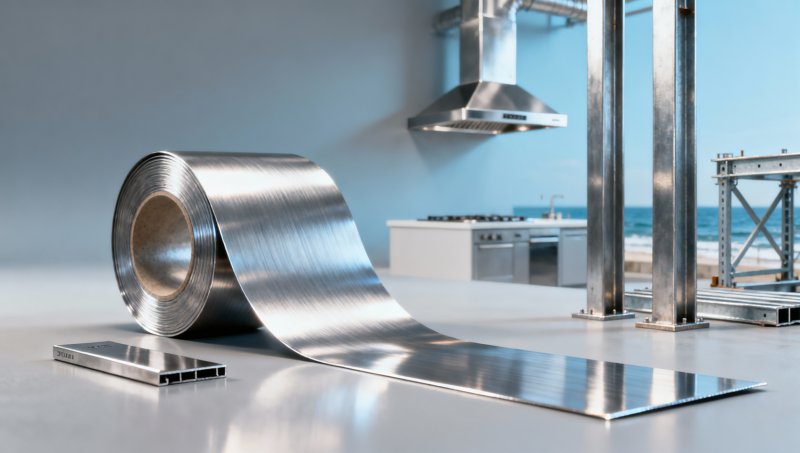
Corrosion & Weldability: A Side-by-Side Technical Comparison
The performance gap between 310s and 304 becomes quantifiable when evaluating three key operational metrics: intergranular corrosion resistance after welding, stress corrosion cracking (SCC) threshold in humid saline air, and post-weld tensile strength retention at 500°C.
This data explains why OEMs in North America specify 310s for stainless steel sheeting used in commercial kitchen hoods—where repeated thermal shock from steam and caustic cleaners causes 304 to develop micro-cracks within 18–24 months. For quality control and safety personnel, that translates into fewer unscheduled maintenance events and lower compliance risk under ANSI/NSF 2 standards.
When Should You Choose 310s Over 304 for Structural Applications?
Not every application warrants the premium of 310s—but misjudging the threshold leads to premature failure. Here’s how technical evaluators and procurement teams can decide:
- Chloride exposure > 200 ppm + cyclic wet-dry conditions: 310s resists pitting initiation 3× longer than 304 per ASTM G48 testing (Method A, 24h immersion).
- Welded assemblies requiring > 500°C service stability: 310s maintains ≥60% room-temperature yield strength at 600°C vs. ≤40% for 304.
- Architectural stainless steel angle plate exposed to marine aerosols: Field data from Hongteng Fengda projects in Dubai shows zero red rust on 310s components after 5 years vs. visible staining on 304 at 24 months.
- Hybrid framing combining stainless sheeting and structural supports: C Sections Steel in Q345 + galvanized finish pairs reliably with 310s sheeting—eliminating galvanic corrosion concerns seen with 304/steel combinations.
Project managers overseeing mixed-material builds—such as light industrial manufacturing facilities using stainless cladding and C Sections Steel for columns and wall beams—gain tighter tolerance control: 310s’ lower thermal expansion coefficient (15.5 × 10⁻⁶/K vs. 17.3 × 10⁻⁶/K for 304) reduces joint stress during diurnal temperature swings.
Why Global Buyers Trust Hongteng Fengda for Precision Stainless & Structural Steel
Sourcing reliable stainless steel plate and complementary structural components demands more than competitive pricing—it requires proven consistency across batches, traceable certifications, and responsive engineering support. As a certified structural steel manufacturer and exporter from China, Hongteng Fengda meets this need through:
- End-to-end compliance with ASTM A240 (stainless), EN 10025 (structural), and ISO 9001:2015—verified by SGS, BV, and CE audits annually.
- Stable production capacity: 12,000+ tons/month of hot rolled stainless coil and cold formed profiles—including custom-specified 310s strips with ±0.02mm thickness tolerance.
- Integrated supply chain: Simultaneous quotation and delivery coordination for stainless steel sheeting, stainless steel angle plate, and galvanized C Sections Steel (Q235/Q345, 1–12mm thickness, 6–12m lengths).
- Global logistics: Average lead time of 25–35 days FOB Shanghai for full container loads, with documentation pre-cleared for customs in EU, US, and GCC markets.
For procurement professionals balancing budget constraints and long-term reliability, partnering with Hongteng Fengda means access to verified mill test reports, dimensional inspection records, and seamless OEM co-engineering—whether specifying 310s for high-performance applications or optimizing total cost of ownership across mixed-material structural systems.
Next Steps: Get Your Customized 310s + Structural Steel Quote
Ready to validate if 310s stainless steel strip—or a hybrid solution pairing it with galvanized C Sections Steel—adds measurable value to your next project? Hongteng Fengda offers fast-turnaround technical consultation and sample support:
- Free review of your CAD drawings or BOM for material optimization (typically completed within 48 business hours).
- Material certification packages including PMI verification, tensile reports, and intergranular corrosion test summaries.
- Custom packaging and labeling aligned with your warehouse receiving protocols—reducing unloading time by up to 30%.
- Flexible payment terms for qualified buyers: 30% advance, 70% against BL copy, with L/C acceptance available.
Contact our engineering sales team today to request your no-obligation quote—including comparative analysis of 310s vs. 304 performance in your specific operating environment, plus lead time confirmation for both stainless steel plate and structural steel components.
Please give us a message


Please enter what you want to find