Choosing between 304L stainless steel pipe and standard 304 can directly affect welding performance, corrosion resistance, and long-term project cost. For operators and end users in industrial and structural applications, understanding this difference is essential for safer use, better durability, and more efficient material selection. This guide explains what truly matters when comparing the two grades.
What is the real difference between 304L stainless steel pipe and 304?
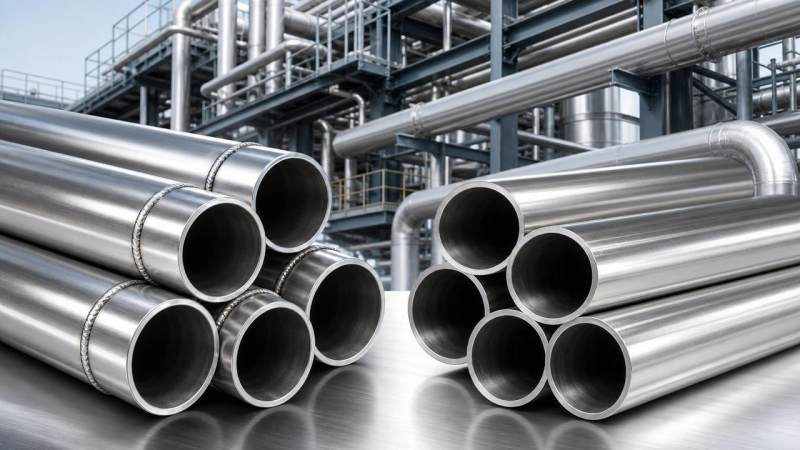
At first glance, 304L stainless steel pipe and 304 stainless steel pipe seem almost identical. Both belong to the austenitic stainless steel family. Both are widely used in fabrication, process piping, structural supports, and equipment exposed to moisture or mild chemicals.
The key difference is carbon content. Grade 304L is the low-carbon version of 304. That small chemical adjustment changes welding behavior, reduces the risk of carbide precipitation, and improves resistance to intergranular corrosion after welding.
For operators, this is not just a laboratory detail. It affects whether a welded pipe system keeps its corrosion resistance at heat-affected zones, whether maintenance frequency increases, and whether the material remains suitable for demanding service conditions over time.
Why carbon content matters in daily use
- Lower carbon in 304L reduces the chance of chromium carbide formation during welding.
- Less carbide precipitation means less chromium depletion near welds.
- Better chromium availability helps the passive layer remain stable in corrosive environments.
- The result is more reliable weld area performance, especially in piping systems that cannot tolerate localized corrosion.
In practical terms, if your pipe will be cut, welded, assembled on site, and then exposed to moisture, process fluids, or outdoor conditions, the grade decision should not be made on price alone.
304L stainless steel pipe vs 304: side-by-side comparison for operators
The table below gives a direct comparison between 304L stainless steel pipe and standard 304 from the perspective of fabrication, field installation, and long-term operation.
This comparison shows why many industrial buyers specify 304L stainless steel pipe even when the base mechanical properties look close. In welded service, the lower-carbon option often reduces risk and simplifies material selection.
Which applications should choose 304L stainless steel pipe first?
Not every project needs the same stainless steel solution. The right choice depends on fabrication method, operating environment, maintenance access, and the consequences of early corrosion failure.
Best-fit scenarios for 304L
- Welded pipelines in food processing, water treatment, light chemical transfer, or humid production areas.
- Structural tube assemblies exposed to outdoor weather, where welded corners and joints are common corrosion starting points.
- Industrial platforms, machine frames, or support systems where long maintenance intervals are expected.
- Projects requiring fabrication across multiple workshops or job sites, where welding consistency can vary.
When standard 304 may still be acceptable
- Non-welded or lightly fabricated components.
- Indoor dry environments with limited corrosion exposure.
- Projects where budget is very tight and service conditions are clearly mild.
For operators, the question should be simple: will this pipe be welded, and will the weld area face humidity, chemicals, cleaning agents, or outdoor exposure? If the answer is yes, 304L stainless steel pipe usually deserves priority.
How welding changes the grade decision in steel projects
In steel fabrication, the material is only part of the result. Welding procedure, fit-up quality, filler selection, and surface finishing also affect service life. Even a good grade can underperform if weld heat input and post-weld cleaning are poorly managed.
That is why users should evaluate stainless pipe not only by chemical grade, but also by supplier discipline. A capable manufacturer should understand dimensional control, heat influence, traceability, packaging, and export compliance.
Hongteng Fengda supports global construction, industrial, and manufacturing projects with stable production capacity and strict quality control. For buyers handling mixed steel procurement, this matters because stainless components often need to integrate with structural steel sections, beams, channels, and customized fabricated parts under the same delivery schedule.
Practical welding checkpoints
- Confirm whether the pipe will be fully welded, tack-welded, or mechanically joined.
- Check if the service medium includes chlorides, cleaning chemicals, or standing water.
- Review whether post-weld pickling, passivation, or surface cleaning will be performed.
- Ask the supplier to confirm relevant standards, tolerances, and mill documentation.
These checks reduce common mistakes such as treating all stainless pipe as interchangeable or assuming a polished appearance means equal corrosion performance.
Material selection in mixed projects: why compatibility and sourcing discipline matter
Many operators do not buy stainless pipe in isolation. A project may also include beams, channels, angle steel, cold formed sections, and transport-related components. In these cases, procurement efficiency depends on choosing suppliers that understand both product performance and project coordination.
For example, infrastructure or industrial platform projects may combine stainless piping with carbon steel support members and rail-related systems. In such mixed supply chains, buyers often review complementary products like Rail for railway rail, bridge railings or deck handrail applications, where grades such as U74, U71Mn, Q235, 55Q, and 50Q are selected by load, geometry, and service environment.
Typical rail specifications can include lengths from 12m to 30m, thickness from 3mm to 24mm, rail height from 134mm to 170mm, head width from 68mm to 73mm, and bottom width from 114mm to 150mm, with tolerance around ±1%. Surface conditions such as oil, black, galvanized, or painted finishes are also chosen based on storage and installation needs.
This kind of sourcing overlap shows why a manufacturer with export experience, standard familiarity, and customized production capability can help reduce coordination risk across steel categories rather than supplying one isolated item only.
What should buyers check before ordering 304L stainless steel pipe?
When operators face procurement pressure, it is easy to focus only on nominal grade and quoted price. A better approach is to compare supply offers across technical, commercial, and operational checkpoints.
Use this selection table to evaluate whether a 304L stainless steel pipe offer is truly suitable for your job.
A pipe quote becomes useful only when these details are clear. Otherwise, low unit price can quickly turn into high installation cost, rework, or premature maintenance.
Is 304L stainless steel pipe more expensive, and is it worth it?
In many markets, 304L stainless steel pipe may carry a small premium over standard 304, but the total project impact is usually broader than raw material price. The real cost question is not “Which pipe is cheaper per ton?” but “Which choice lowers total lifecycle risk?”
Cost factors users often overlook
- Repair cost in weld zones is often higher than the initial material premium.
- Downtime in processing or utility systems can exceed material savings very quickly.
- Corrosion-related replacement creates secondary costs in labor, insulation removal, reinspection, and logistics.
- If export compliance documents are incomplete, delays can affect the whole project schedule.
For this reason, 304L stainless steel pipe is often the more economical choice in welded industrial systems, even if its initial price is slightly higher. When service conditions are mild and fabrication is minimal, standard 304 can still be a reasonable budget option.
Standards, certification, and supplier capability: what supports a safer purchase?
In global steel sourcing, technical suitability must be matched by reliable execution. Buyers should look for a supplier that can work with mainstream standards, maintain production consistency, and support custom requirements without losing delivery control.
Hongteng Fengda serves customers across North America, Europe, the Middle East, and Southeast Asia with structural steel products and customized solutions. The company’s manufacturing and quality control approach is aligned with common international standards such as ASTM, EN, JIS, and GB, which is important for projects involving both standard sections and OEM steel components.
For operators and procurement teams, this means one practical advantage: fewer disconnects between drawing requirements, production output, documentation, and shipment timing. In cross-border projects, that coordination is often as important as the base material itself.
Supplier questions worth asking
- Can you supply according to ASTM, EN, JIS, or GB requirements relevant to my project?
- Can you support mixed orders including structural sections and custom steel components?
- How do you manage quality control, packing, and export lead time?
- Can you review drawings or application conditions before final grade confirmation?
FAQ: common questions about 304L stainless steel pipe
Is 304L stainless steel pipe always better than 304?
Not always. It is generally better for welded applications and environments where corrosion resistance at the weld area matters. For dry indoor use with little fabrication, standard 304 may still be sufficient and more economical.
Can operators use 304 and 304L interchangeably?
They should not assume full interchangeability. In many practical cases, 304L stainless steel pipe can replace 304, especially when welding is involved. But the reverse decision should be checked carefully against corrosion risk, process temperature, and fabrication method.
What is the most common mistake during purchase?
The most common mistake is selecting by price and nominal grade only. Buyers often skip checks on weld condition, actual chemical documentation, tolerance, finish, and standards compliance. That creates avoidable problems later in fabrication or service.
How can I reduce sourcing risk for stainless pipe and structural steel together?
Work with a supplier that understands multi-category steel supply, export documentation, and customized project requirements. This is especially helpful when your order includes pipes, structural sections, fabricated parts, and schedule-sensitive deliveries.
Why choose us for steel selection and project support?
If you are comparing 304L stainless steel pipe with standard 304, the best decision starts with clear application data. Hongteng Fengda helps global buyers review project needs from both the material and execution side, especially where structural steel supply, custom fabrication, and export scheduling must work together.
You can contact us for practical support on parameter confirmation, grade selection, welding-related material advice, delivery cycle planning, custom steel solutions, drawing review, certification requirement matching, sample support, and quotation communication for international projects.
When the difference between 304L stainless steel pipe and 304 affects service life, maintenance, and project cost, a precise sourcing discussion is worth having before production begins.
Please give us a message


Please enter what you want to find