In corrosive environments, choosing the right material directly affects safety, service life, and quality control outcomes. While 304 steel plate is widely used for its balanced corrosion resistance and cost efficiency, it may not always be the best fit compared with other stainless steel grades. For quality and safety managers, understanding these differences is essential to reducing failure risks, ensuring compliance, and improving long-term project performance.
What quality and safety managers really need to know first
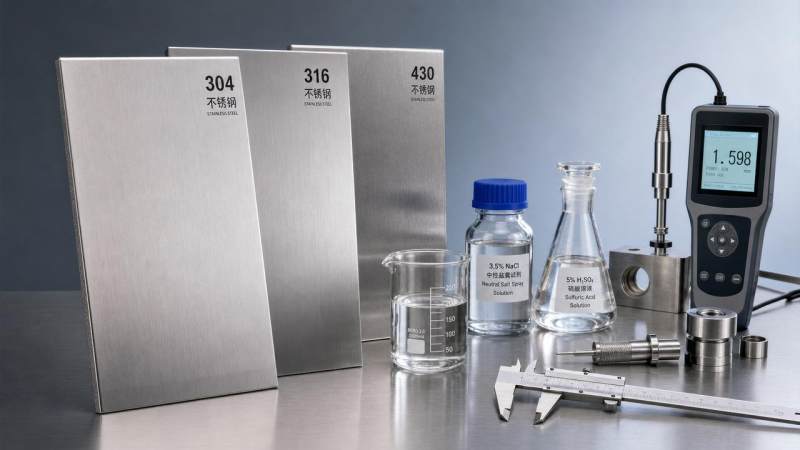
The core search intent behind “304 steel plate vs other grades in corrosive environments” is practical, not academic. Buyers and inspectors want to know whether 304 steel plate is safe enough, durable enough, and economical enough for a specific exposure condition.
For quality control personnel and safety managers, the main concern is not simply which stainless grade is “better.” The real question is which grade reduces corrosion failure risk while still meeting project budget, maintenance, and compliance requirements.
In most mild indoor, atmospheric, and general industrial applications, 304 steel plate remains a reliable choice. It offers good all-around corrosion resistance, strong availability, and relatively favorable cost compared with higher alloy stainless steel grades.
However, if the environment includes chlorides, salt spray, aggressive chemicals, crevice conditions, or repeated wet-dry cycles, 304 may become vulnerable to pitting, crevice corrosion, tea staining, or stress-related damage over time.
That is why material selection should be based on exposure severity, contamination level, cleaning frequency, fabrication details, and expected design life. A wrong grade may pass incoming inspection yet still fail prematurely in service.
Why 304 steel plate is widely used in the first place
304 steel plate is one of the most common austenitic stainless steels in global supply chains. Its popularity comes from a practical balance of corrosion resistance, formability, weldability, hygiene performance, and cost control.
In many construction, fabrication, food handling, equipment housing, and light industrial uses, 304 performs well because it resists ordinary moisture, many cleaning agents, and moderate chemical contact better than carbon steel or lower alloy alternatives.
Its chromium and nickel content helps create a passive oxide layer on the surface. When the environment is not excessively aggressive, that passive film protects the steel from widespread rusting and gives users dependable service life.
Another reason quality teams often prefer 304 steel plate is specification familiarity. It is widely referenced under ASTM, EN, JIS, and other standards, making procurement, inspection, and supplier qualification easier across international projects.
For manufacturers and exporters serving multiple regions, this matters. Stable sourcing, consistent mill documentation, and routine processing knowledge can reduce nonconformance risks, simplify audits, and improve delivery reliability for large-scale orders.
Where 304 steel plate performs well and where it starts to struggle
304 steel plate performs well in clean indoor environments, urban outdoor exposure with low chloride contamination, food processing zones with controlled washdown chemistry, and equipment surfaces that are regularly cleaned and allowed to dry.
It is also suitable for many structural or fabricated components where corrosion resistance is important but not extreme. Examples include architectural trim, tanks, covers, enclosures, work surfaces, and general-purpose industrial components.
Problems begin when corrosive factors become more concentrated. Marine air, deicing salts, bleach-containing cleaners, stagnant moisture, chemical splashing, or narrow crevices can all challenge the passive film on 304 stainless steel.
In these cases, quality managers often observe early warning signs such as localized brown staining, pin-point pitting, corrosion around welds, fastener attack, or hidden damage in joints where drainage and cleaning are poor.
From a safety perspective, localized corrosion is especially important because components may look acceptable in general inspection while actually losing thickness or crack resistance in very specific high-risk areas.
How 304 compares with 316 in chloride-rich environments
The most common comparison is 304 versus 316 stainless steel. For corrosive environments containing chlorides, 316 is usually the more reliable option because its molybdenum content significantly improves resistance to pitting and crevice corrosion.
If a project involves coastal exposure, seawater splash zones, salt-laden processing areas, or repeated contact with chloride-based cleaners, 316 often provides a safer margin than 304 steel plate, especially for long design-life applications.
For quality control teams, this difference matters because corrosion failures in chloride service often do not develop uniformly. Damage can remain highly localized until it becomes severe enough to threaten hygiene, strength, sealing, or safety performance.
That said, 316 is not automatically required for every damp environment. If the application is sheltered, contamination is limited, surfaces are accessible for cleaning, and there is no standing salt residue, 304 may still be justified.
The right decision depends on actual exposure data, not assumptions. A realistic service review should include salt concentration, cleaning chemicals, temperature, moisture retention, and whether fabrication creates crevices that trap contaminants.
How 304 compares with 430, duplex, and carbon steel options
Compared with 430 stainless steel, 304 steel plate generally offers better corrosion resistance and better toughness in many fabrication and service conditions. Grade 430 can be lower cost, but its performance in aggressive moisture is more limited.
For applications where surface appearance, hygiene, and predictable corrosion resistance are important, 304 usually provides a more dependable balance than 430. This is especially true where welded fabrication or variable humidity is involved.
Compared with duplex stainless steels, 304 is usually less resistant to severe chloride attack and may offer lower strength. Duplex grades can be excellent for harsh process, offshore, and structural applications, but they increase material and fabrication complexity.
Compared with coated carbon steel, 304 may deliver better long-term corrosion performance when the stainless surface remains intact and suitable for the environment. But cost comparisons should include maintenance, coating repair, contamination risk, and service accessibility.
In some projects, a combination strategy is more economical. For example, stainless may be used only in critical corrosion zones, while protected carbon steel or galvanized components serve elsewhere under controlled exposure conditions.
What inspection teams should evaluate before approving 304 steel plate
Approving 304 steel plate for corrosive service should never rely only on a material name listed in a purchase order. Quality teams should verify actual grade certification, applicable standard, heat traceability, thickness tolerance, and surface condition.
Surface finish matters because rougher finishes retain contaminants more easily. Weld quality also matters because heat tint, incomplete cleaning, and poor passivation can reduce corrosion resistance and create initiation points for localized attack.
Safety managers should also review design details. Sharp corners, overlapping joints, poorly drained supports, and inaccessible cleaning areas can make even a corrosion-resistant grade underperform in real operating environments.
Another critical issue is contamination control during fabrication and installation. Contact with ordinary carbon steel tools, grinding dust, or iron particles can lead to surface contamination that later appears as rust, misleading users about true material performance.
Inspection plans should therefore include incoming material verification, fabrication process control, weld cleaning checks, and post-installation environmental review. This broader approach is more effective than relying on grade selection alone.
How to judge lifecycle cost instead of only initial material price
Many specification mistakes happen when teams compare stainless grades only by purchase price per ton or per sheet. For quality and safety roles, the better question is total cost of ownership under expected service conditions.
If 304 steel plate is used in a chloride-heavy environment and develops pitting after a short period, the resulting costs may include downtime, product contamination, warranty claims, replacement labor, and safety-related investigations.
On the other hand, automatically upgrading every application to premium grades can also waste budget where corrosion severity is moderate and maintenance conditions are good. Over-specification is a cost issue just as under-specification is a risk issue.
A sound evaluation should include expected service life, accessibility for inspection, cleaning frequency, failure consequence, replacement difficulty, and whether corrosion would create structural, hygienic, or regulatory problems.
When these factors are considered together, 304 often remains an efficient choice for moderate conditions, while 316 or higher-performance materials become justified where failure consequences or chloride intensity are significantly higher.
Related corrosion-control options in broader project planning
Not every corrosive environment requires stainless steel plate in every component. In mixed-material systems, teams may combine stainless sheet or plate for critical contact areas with other protected steel products in supporting or transport functions.
For example, in utility lines, low-pressure fluid systems, agricultural facilities, or industrial structures, Galvanized Pipe can be considered where zinc protection, broad dimensional flexibility, and cost efficiency are appropriate to the service conditions.
Available in galvanized steel with standards such as ASTM, EN, JIS, and GB, this type of product is used across construction, machinery, chemical industry, electric power, bridges, storage, and general low-pressure water, gas, and oil transport.
Its protective galvanized layer is designed to increase corrosion resistance and prolong service life, with size ranges such as length from 1 to 12 meters and thickness from 0.1 millimeters to 300 millimeters depending on project requirements.
For quality managers, the lesson is clear: corrosion control should be system-based. The best answer may involve matching each component type to its actual exposure rather than applying one material rule to the entire project.
Practical decision rules for selecting the right grade
If the environment is clean, moderately humid, and free from strong chlorides or aggressive chemicals, 304 steel plate is usually a sound and economical choice. This is often true for indoor industrial use and many controlled processing areas.
If chlorides are frequent, cleaning chemicals are harsh, or water can remain trapped in joints, 316 should be strongly considered. If structural loads and severe chlorides combine, duplex stainless may deserve technical review despite higher complexity.
If appearance and hygiene are not critical and exposure is less aggressive, coated or galvanized steel systems may offer sufficient performance at lower cost, provided maintenance expectations and coating damage risks are realistically assessed.
Quality and safety managers should also ask whether failure would be merely cosmetic or functionally serious. The more severe the consequence of leakage, contamination, strength loss, or shutdown, the stronger the case for higher corrosion resistance.
Finally, always validate assumptions with samples, field history, or corrosion data from similar operating conditions. Real-world evidence is often more valuable than generic material rankings taken out of service context.
Conclusion: Is 304 steel plate the right choice?
304 steel plate is neither a universal solution nor a risky default. It is a proven, versatile stainless steel grade that performs very well in many moderate corrosive environments and offers strong value when selected correctly.
For quality control and safety professionals, the best decision comes from matching grade capability to actual exposure, fabrication quality, maintenance practice, and failure consequence. In that process, 304 often remains highly competitive.
But when chlorides, crevices, stagnant moisture, or aggressive chemicals are present, comparing 304 carefully against 316, duplex, or protected carbon steel alternatives becomes essential. Better material selection at the start is often the cheapest risk reduction available.
In short, use 304 steel plate where its balance of corrosion resistance and cost aligns with the environment. Upgrade only when the exposure justifies it, and always evaluate the whole corrosion-control system, not the material label alone.
Please give us a message


Please enter what you want to find