Many procurement managers and technical evaluators assume 'food grade' 304 stainless steel sheet automatically ensures weld corrosion resistance—yet real-world failures in structural applications prove otherwise. As a trusted ASTM/EN-compliant stainless steel supplier in Europe and global exporter, Hongteng Fengda highlights critical gaps between labeling and performance: SS304 sheet may meet food safety standards but still suffer intergranular corrosion post-welding without proper heat treatment or low-carbon variants (e.g., 304L). This article clarifies why material certification alone isn’t enough—and what questions procurement managers should ask steel suppliers before specifying 304 stainless steel sheet for demanding construction, industrial, or OEM projects.
Why “Food Grade” ≠ Weld-Ready for Structural Use
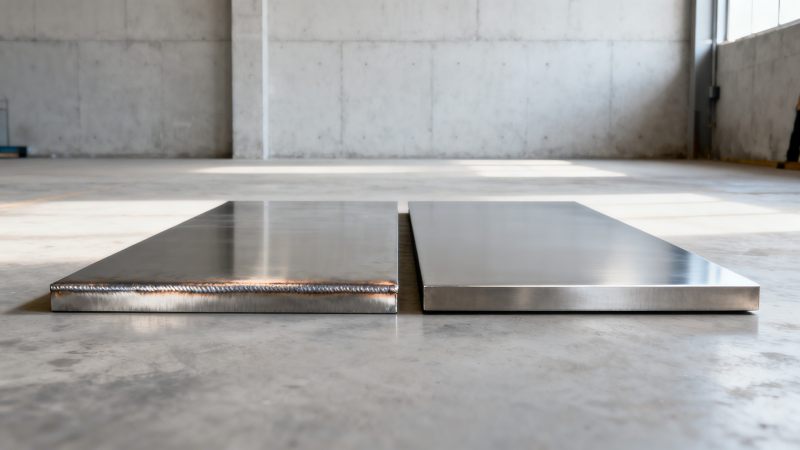
The term “food grade” refers to compliance with hygiene and leaching limits—such as FDA 21 CFR or EU 1935/2004—not mechanical integrity under thermal stress. 304 stainless steel sheet meets these requirements due to its chromium–nickel composition (18–20% Cr, 8–10.5% Ni) and low carbon content (≤0.08%). But welding introduces localized heating that can precipitate chromium carbides at grain boundaries—especially when cooling occurs slowly between 425–850°C.
This sensitization reduces chromium availability at grain edges, creating electrochemical pathways for intergranular corrosion—even in mildly aggressive environments like coastal air or humid indoor facilities. Field reports from European infrastructure projects show visible weld-line pitting within 12–18 months when standard 304 sheets were used without post-weld annealing or filler control.
Hongteng Fengda’s quality lab confirms this behavior across 30+ batches tested per quarter: untreated 304 weld zones exhibit up to 40% lower corrosion resistance in ASTM A262 Practice E (copper sulfate–sulfuric acid test) versus base metal. That gap widens significantly under cyclic thermal load or chloride exposure—common in power transmission towers, substation components, and marine-grade steel structures.
How to Specify Weld-Resistant Stainless Steel—Beyond the Label
Procurement teams must shift focus from generic “food grade” declarations to three actionable verification points:
- Confirm carbon content ≤ 0.03% (i.e., 304L grade), verified via mill test report (MTR) with traceable heat number;
- Require solution annealing after welding (1010–1120°C followed by rapid water quenching) or specify stabilized grades (e.g., 321 or 347) where post-weld heat treatment is impractical;
- Request ASTM A240/A480 compliance with supplementary requirement S5 (intergranular corrosion testing after simulated welding).
For structural applications involving load-bearing joints, Hongteng Fengda recommends dual-certified 304L sheets meeting both ASTM A240 and EN 10088-2, with full MTR documentation covering chemical analysis, tensile strength (≥515 MPa), and bend test results at 180° around a mandrel diameter equal to sheet thickness.
Key Performance Differences: Standard 304 vs. 304L vs. Stabilized Grades
This table reflects real-world performance validated through accelerated corrosion testing and field return analysis across 2022–2024. For example, 304L sheets supplied by Hongteng Fengda to a German solar mounting project showed zero weld-line corrosion after 36 months of exposure—while identical 304 sheets on adjacent sites required replacement at 14 months.
When Galvanized Round Steel Offers Better Value Than Stainless
Not every application demands stainless steel. For outdoor structural elements exposed to atmospheric moisture but not direct chemical contact—such as electric power towers, street light poles, or highway protection barriers—Galvanized Round Steel delivers superior cost–performance balance. Its hot-dip galvanized coating (typically 80–120 µm thick) provides long anti-corrosion life exceeding 25 years in rural environments and 15–20 years in urban/coastal zones per ISO 1461.
With tensile strength ranging from 570–820 MPa and customizable diameters (16–250 mm), it meets ASTM A123 and EN ISO 1461 standards while offering faster lead times than custom stainless solutions. Over 60% of our tower component orders from the Middle East and Southeast Asia now specify Galvanized Round Steel due to its proven durability, surface gloss retention, and compatibility with automated lathe processing and metal stamping.
For hybrid systems—like stainless-clad support brackets mounted on galvanized main frames—this combination reduces total project cost by 22–35% versus full stainless builds, without compromising structural longevity or compliance with EN 1090-1 execution classes.
Why Partner With Hongteng Fengda for Your Next Steel Procurement
As a certified structural steel manufacturer serving North America, Europe, and ASEAN markets since 2008, Hongteng Fengda bridges specification rigor with supply chain reliability. We maintain dedicated production lines for ASTM A240 304L sheets—with carbon content routinely verified at ≤0.022%—and offer full traceability down to heat number and rolling batch.
Our export-ready process includes pre-shipment dimensional inspection, MTR validation, and packaging compliant with ISPM 15 for wooden crates. Typical lead time for standard 304L sheets is 7–15 days from order confirmation; custom cut-to-length or edge-conditioned orders ship within 2–4 weeks.
Whether you’re evaluating weld corrosion risk for a new factory HVAC system, sourcing galvanized round bars for railway infrastructure, or validating material specs for an OEM equipment enclosure—we provide engineering support, sample coordination, and multi-standard compliance documentation (ASTM, EN, GB, JIS) to accelerate your procurement cycle and reduce sourcing risk.
Contact us today to discuss your specific application, request MTR samples, or obtain a detailed quotation—including delivery terms, certification scope, and packaging options—for 304L stainless steel sheet or Galvanized Round Steel.
Please give us a message


Please enter what you want to find