For HVAC project execution, 304 stainless steel coil tubing must match the system, not just the specification sheet. Fit checks determine installation speed, leak risk, corrosion life, and future maintenance cost.
When teams source 304 stainless steel coil tubing, small mismatches in wall thickness, bend radius, or connection size can delay work. Careful verification improves reliability and keeps steel-based systems performing as planned.
Why fit checks matter across HVAC installation scenarios
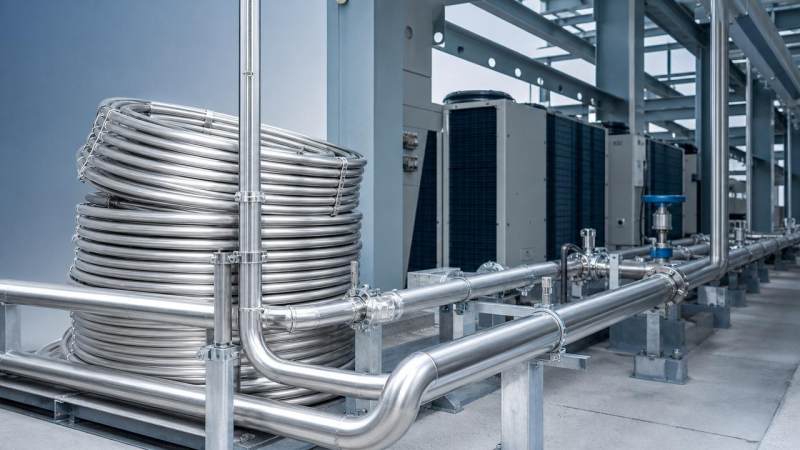
HVAC systems do not use tubing under one identical condition. Chilled water lines, refrigerant routes, rooftop units, and humid environments place different demands on 304 stainless steel coil tubing.
A good fit check reviews pressure, media, temperature change, vibration, and available installation space. In steel-related construction, these decisions also affect support framing, brackets, and anchoring details.
This matters especially in projects using structural steel platforms, equipment rooms, and prefabricated modules. Tubing selection should align with surrounding steel components, routing constraints, and corrosion exposure.
Scenario 1: Tight mechanical rooms need precise coil tubing flexibility
In compact indoor plant rooms, 304 stainless steel coil tubing is often chosen for clean routing and corrosion resistance. The key check here is bendability without flattening or cracking.
Verify the minimum bend radius before purchase. A tube that meets chemical requirements but fails bending tolerance can create rework, connection stress, and space conflicts around pumps or air handling units.
Wall thickness must also support the routing method. Thinner walls may ease bending, but they can reduce mechanical safety if vibration or repeated thermal movement is present.
Core checks for confined routing
- Outside diameter matches fittings and support clips.
- Wall thickness balances pressure rating and flexibility.
- Coil length reduces joint count in narrow spaces.
- Surface finish supports easy cleaning and insulation fit.
Scenario 2: Rooftop and outdoor systems face corrosion and movement
Outdoor HVAC installations add weather, UV exposure, and thermal cycling. Here, 304 stainless steel coil tubing must be checked for actual atmospheric suitability, not assumed universal resistance.
304 grade performs well in many environments, but chloride-heavy coastal conditions may require closer evaluation. Nearby dissimilar metals can also accelerate corrosion at contact points and fasteners.
Expansion and contraction must be reviewed with supports. Stainless tubing routed over steel frames should have adequate allowance for movement, especially near rooftop equipment with frequent temperature swings.
Where supporting members are needed, projects often integrate cold formed steel profiles or purlin systems. In such assemblies, Z-beam supports can help create lightweight framing for brackets or equipment bases.
Scenario 3: Refrigeration and higher-pressure lines require stricter verification
Not every HVAC line carries the same load. Refrigerant circuits and certain process cooling sections can place higher demands on 304 stainless steel coil tubing than standard condensate or low-pressure service.
Pressure compatibility should be confirmed from actual tube dimensions, manufacturing tolerance, and test data. Do not rely on nominal size alone when checking system safety.
Review seam quality, hardness condition, and compatibility with the selected connection method. Compression fittings, orbital welding, and brazed transitions each require different dimensional consistency.
Questions that prevent pressure-related errors
- What is the design pressure and test pressure?
- Is the tubing annealed or work-hardened?
- Are tolerances suitable for the selected fittings?
- Does the supplier provide mill test documentation?
Scenario 4: Clean indoor applications focus on finish and compatibility
Hospitals, food processing zones, laboratories, and electronics facilities often prioritize cleanliness. In these settings, 304 stainless steel coil tubing should be checked for internal cleanliness and external finish consistency.
Rough surfaces can trap contaminants or complicate insulation sealing. Protective packaging quality also matters because handling damage before installation can affect appearance and performance.
Compatibility with nearby steel supports remains important. Stainless tubing should be isolated where needed to reduce galvanic issues and preserve long-term surface condition.
How HVAC needs differ by application scenario
Practical fit-check list before ordering 304 stainless steel coil tubing
A reliable order process turns technical needs into measurable checkpoints. For 304 stainless steel coil tubing, the most useful approach is to confirm size, standard, condition, and installation method together.
- Confirm outside diameter, wall thickness, and coil length.
- Check ASTM, EN, JIS, or other required standards.
- Match pressure rating with operating and test conditions.
- Review bend performance for the intended route.
- Verify compatibility with fittings, clamps, and insulation.
- Ask for mill test certificates and tolerance data.
- Check packaging for export handling and site protection.
In modular steel projects, tubing supports should be checked at the same time. A coordinated support plan reduces field cutting and keeps installation aligned with structural steel framing.
For auxiliary framing, profiles with CE, SGS, BV, or ISO-backed production can support broader project quality goals. Some projects use perforated or non-perforated support members depending on bracket and roof load needs.
Frequent mistakes when evaluating 304 stainless steel coil tubing
One common mistake is treating 304 stainless steel coil tubing as automatically suitable for every corrosive setting. Real conditions, especially chloride exposure, should guide the final decision.
Another mistake is specifying only material grade. Without dimensional tolerance, hardness condition, and connection requirements, the delivered tubing may meet grade yet fail installation needs.
Teams also overlook support interaction. Stainless tubing installed on steel framing without isolation, spacing control, or thermal allowance can suffer wear, noise, or corrosion over time.
A final issue is separating tubing procurement from surrounding steel solutions. In many equipment platforms, lightweight roof structures, brackets, and wall beams influence route access and fixing points.
That is why integrated steel supply can simplify execution. Structural members such as Z-beam sections, available in galvanized coated options and 6-25mm thickness, can support coordinated installation planning.
A better next step for smoother HVAC sourcing
The best results come from matching 304 stainless steel coil tubing to the actual HVAC scenario. Review environment, pressure, routing space, support structure, and connection details before finalizing the order.
When steel framing, brackets, and tubing supports are planned together, installation becomes faster and more predictable. This also reduces sourcing gaps between tubing performance and structural compatibility.
Hongteng Fengda supplies structural steel products and customized steel solutions for global industrial and construction projects. With controlled manufacturing and international standard compliance, the company helps reduce sourcing risk and improve delivery confidence.
If your project includes 304 stainless steel coil tubing alongside steel supports or custom framing, prepare a fit-check sheet first. That single step often prevents the costliest installation errors later.
Please give us a message


Please enter what you want to find