For maintenance teams, selecting the right 2 stainless pipe supports service life, safety, and easier upgrades across steel-related systems.
From fluid transfer to structural assistance, correct material, fittings, and dimensions help reduce leaks, corrosion failures, and unplanned shutdowns.
This guide explains where 2 stainless pipe is commonly used, how fitting compatibility works, and what to review before replacement or expansion.
Basic Understanding of 2 Stainless Pipe
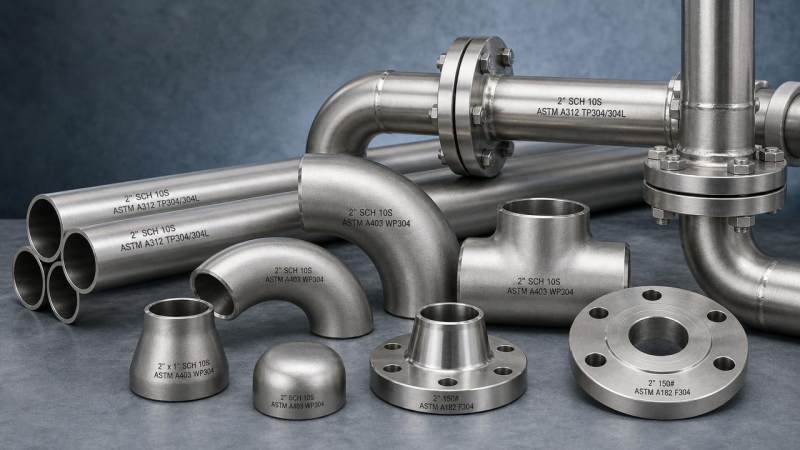
A 2 stainless pipe usually refers to stainless steel pipe with a nominal 2-inch size.
Actual outside diameter and wall thickness depend on the schedule, applicable standard, and project requirement.
In steel and industrial environments, this size is common because it balances flow capacity, strength, and manageable installation weight.
It appears in process lines, drainage systems, support frames, washdown areas, and utility connections.
When specifying 2 stainless pipe, three points matter first: grade, schedule, and end connection type.
- Grade affects corrosion resistance and temperature suitability.
- Schedule affects pressure rating, rigidity, and weight.
- End type affects fitting compatibility and maintenance speed.
Stainless steel is preferred where moisture, chemicals, cleaning agents, or outdoor exposure can shorten carbon steel service life.
Industry Context and Current Selection Priorities
Across construction, manufacturing, and utilities, pipe selection now focuses on lifecycle performance rather than only initial price.
A wrong 2 stainless pipe specification can create recurring maintenance costs through premature corrosion, poor fit-up, and difficult replacement planning.
For export-oriented projects, compatibility with ASTM, EN, JIS, and GB dimensions is especially important.
This is where experienced structural steel suppliers add value through stable production, documentation, and dependable tolerances.
Why 2 Stainless Pipe Delivers Practical Value
The main advantage of 2 stainless pipe is reliable performance under variable operating conditions.
It can carry water, air, light chemicals, and process fluids while also serving selected structural or protective roles.
Compared with coated carbon steel, stainless options often reduce repainting, rust treatment, and contamination risks.
They also support cleaner finishes for visible installations in public, food, and medical spaces.
A widely used option in this category is 304 Stainless steel pipe.
It is used in residential decoration, food and medical sectors, and industrial piping systems.
Available series include 200, 300, 400, 500, 600, 904, 904L, Duplex 2205, and Duplex 2507.
Typical dimensions include length from 3000mm to 12000mm, outside diameter from 6mm to 2500mm, and thickness from 0.6mm to 30mm.
Surface finishes such as No.1, 2B, BA, 2K, and 8K support both industrial and decorative requirements.
For many general-purpose systems, this stainless solution offers corrosion resistance, workability, sound mechanical properties, and strong cost performance.
Common Applications of 2 Stainless Pipe
The most common use of 2 stainless pipe is industrial fluid transport.
It is often selected for water treatment lines, compressed air sections, low-corrosive chemical transfer, and cleaning systems.
In steel plants and fabrication workshops, it may support utility networks exposed to humidity, heat, and frequent washdown.
Another use is architectural or semi-structural installation where appearance and corrosion resistance are both required.
- Handrail posts and protective barriers
- Equipment guarding and service frames
- Drainage and wastewater branches
- Food-grade process connections
- Outdoor utility pipe runs
- Medical and sanitary transport lines
In marine-adjacent or coastal settings, 2 stainless pipe is also chosen to resist salt-laden air better than ordinary steel.
However, grade selection must still match chloride exposure and cleaning chemistry.
Fitting Compatibility and Connection Methods
Fitting compatibility determines whether a 2 stainless pipe system can be installed, repaired, and expanded without unnecessary rework.
Even when the nominal size matches, end preparation and standard differences may cause problems.
Common fitting types
- Threaded fittings for smaller or lower-pressure service
- Butt weld fittings for stronger permanent joints
- Socket weld fittings for compact process lines
- Flanged connections for easier disassembly
- Grooved couplings for quicker maintenance work
Key compatibility checks
For hygienic systems, crevice control and internal smoothness are often as important as nominal size.
For heavy-duty service, weld quality and heat-affected zone management become higher priorities.
Typical Selection by Service Environment
Choosing 2 stainless pipe should always start with the service environment rather than price alone.
This approach helps avoid over-specification and under-specification at the same time.
Practical Maintenance and Installation Considerations
A high-quality 2 stainless pipe still needs correct installation and maintenance to perform well.
- Confirm actual dimensions before ordering fittings or replacement spools.
- Separate stainless from carbon steel contamination during storage and fabrication.
- Use appropriate cutting, welding, and passivation procedures.
- Check support intervals to prevent vibration and sagging.
- Inspect gaskets, flange faces, and thread sealants for chemical suitability.
- Document grade, schedule, finish, and standard for future maintenance.
It is also wise to keep a small record of approved fitting types used with each 2 stainless pipe line.
This reduces confusion when repairs happen during shutdown windows or urgent field replacement.
Next-Step Guidance for Reliable System Planning
A successful 2 stainless pipe specification combines application knowledge, dimensional accuracy, and fitting compatibility review.
Before final selection, compare service media, pressure class, joint method, finish, and project standard requirements.
If the pipe will connect with mixed-source valves or fittings, verify interchangeability using drawings and product data.
For long-term projects, choose supply support that offers stable quality control, standard compliance, and consistent delivery.
That approach helps 2 stainless pipe systems stay efficient, maintainable, and dependable across industrial and structural steel applications.
Please give us a message


Please enter what you want to find