The 12mm steel wire rope weight per meter is a useful starting point for estimating dead loads, transport requirements, and material quantities, but diameter alone does not determine mass.
Strand arrangement, wire size, core material, and manufacturing tolerances can all affect the actual weight. For technical evaluators, understanding these construction differences is essential when comparing specifications and checking whether a rope is suitable for its intended application.
This guide explains the factors behind weight variations and how to assess manufacturer data with confidence. It also shows how to use mass figures in practical project calculations.
What Is the Typical 12 mm Steel Wire Rope Weight per Meter?
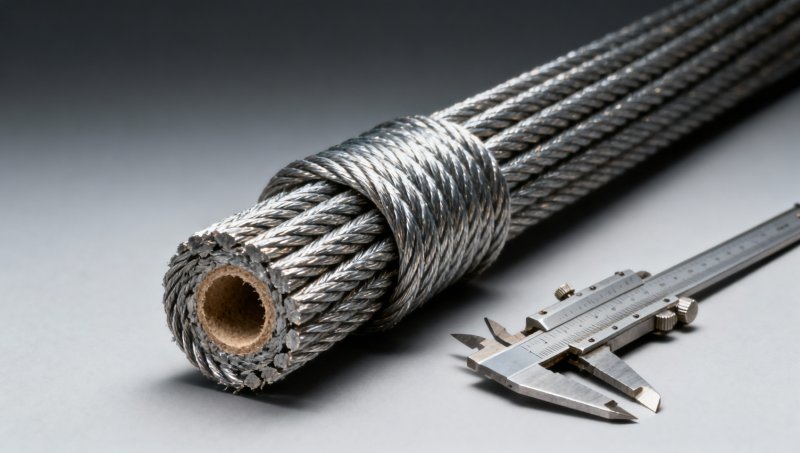
A useful preliminary estimate is approximately 0.5 to 0.7 kg/m, although some constructions fall outside this range. Confirm the actual value with the rope manufacturer.
For example, a nominal mass of 0.55 kg/m gives a bare rope mass of 55 kg over 100 m. At 0.65 kg/m, the same length weighs 65 kg.
That difference can affect handling equipment, transport planning, and suspended dead-load calculations. It does not, by itself, establish which rope is stronger or better suited to lifting.
Manufacturer tables may report nominal mass in kilograms per 100 m or kilograms per kilometer. Convert these figures to kilograms per meter before comparing equivalent products.
- 55 kg per 100 m = 0.55 kg/m.
- 650 kg per 1,000 m = 0.65 kg/m.
- Estimated rope mass = rope length in meters × nominal mass in kg/m.
These figures describe the rope itself unless the supplier states otherwise. Reels, packaging, end fittings, lubricants, and coatings may be excluded or treated differently.
Why Can Two 12 mm Ropes Have Different Weights?
Nominal diameter describes the overall rope size, not the exact quantity of steel inside it. Wire geometry and the spaces between wires change the metallic cross-sectional area.
Steel has a density of approximately 7,850 kg/m³. A solid 12 mm steel cylinder would weigh about 0.89 kg/m before accounting for dimensional tolerances.
Wire rope normally weighs less because its cross-section contains gaps and may include a nonmetallic core. The amount of steel varies with the construction and manufacturing process.
A simplified way to understand this difference is to compare metallic area with the area of the nominal rope circle. A greater metallic fill generally increases mass.
This comparison is only a conceptual aid. Wire helical paths, core composition, surface treatments, and actual dimensions also matter, so it should not replace manufacturer mass data.
Strand arrangement and wire size
A rope designation such as 6×19 describes a six-strand family with approximately 19 wires per strand. Specific designs and wire arrangements can vary within that family.
Similarly, a 6×36 rope generally has more wires per strand. Differences in wire diameter, strand geometry, and packing can change the amount of steel per meter.
More wires do not automatically mean a heavier rope. Compare complete construction details and published mass values rather than ranking products by wire count alone.
These design choices also influence flexibility, fatigue behavior, and resistance to external wear. The most appropriate balance depends on sheave sizes, operating conditions, and inspection requirements.
Core material and construction
A fiber core generally contributes less mass than an independent wire rope core, often abbreviated IWRC, when other design features are comparable. Actual differences remain product-specific.
An IWRC provides a steel support structure within the rope. Fiber cores have different support and operating characteristics, so the choice should follow the application specification.
Do not substitute one core type solely to reduce dead weight. Verify compatibility with operating temperatures, crushing conditions, sheave pressures, and the equipment manufacturer’s requirements.
Compaction, coating, and tolerances
Compacted strands or ropes can contain more steel within a comparable nominal diameter. This often changes both mass and performance, but the effect depends on the design.
Galvanizing adds a protective zinc layer, while polymer coatings or impregnations can add nonmetallic material. Check whether the listed diameter and mass include those treatments.
Manufacturing tolerances also matter. A nominal 12 mm rope is not necessarily exactly 12.00 mm across every measurement point or along its entire length.
Because cross-sectional area changes approximately with the square of diameter, small diameter differences can affect mass. Actual variation must be assessed against the applicable specification.
How Should You Compare Manufacturer Weight Data?
Start by confirming that each supplier is quoting the same product configuration. A diameter match alone is insufficient for a meaningful technical or commercial comparison.
Ask for the complete construction designation, core type, nominal diameter, tensile grade, surface finish, and applicable manufacturing standard. Include lay direction and type where relevant.
Then check whether the stated mass is nominal, calculated, or measured. Nominal values are useful for planning, but they are not guaranteed shipment weights unless specified.
For coated products, establish whether the quoted diameter refers to the underlying rope or the finished coated assembly. Record whether the mass includes the coating.
Also identify the supplied length basis. A supplier may quote rope cut length, usable length between fittings, or a finished assembly length measured between defined points.
Finally, request breaking force, dimensional tolerances, and inspection documentation separately. A mass figure does not replace any of those properties or demonstrate conformity on its own.
- Construction: strand and wire arrangement, core, compaction, and lay.
- Dimensions: nominal diameter, measurement basis, and permitted tolerance.
- Mass: unit, nominal or measured basis, and included components.
- Mechanical data: tensile grade and specified minimum breaking force.
- Documentation: applicable standard, certificate requirements, and traceability details.
Where figures differ, ask suppliers to explain the basis before treating the difference as a defect. Their products may simply have different constructions or reporting conventions.
How Do You Calculate Total Rope and Shipment Weight?
For preliminary estimates, multiply the manufacturer’s nominal mass per meter by the total rope length. Include all rope required on drums and reeving paths, where applicable.
Suppose a project requires 240 m of rope with a published nominal mass of 0.60 kg/m. The estimated bare rope mass is 240 × 0.60 = 144 kg.
If two ropes of that length are required, the combined nominal rope mass is 288 kg. Add fittings, reels, and packaging separately when estimating shipment weight.
For example, if the reel and packaging together weigh 38 kg, one packed reel would have an estimated gross mass of 182 kg before adding any fittings.
Use the supplier’s actual packing details for final transport arrangements. Reel material, size, and construction can materially change gross mass and handling requirements.
For critical lift planning, determine which lengths are actually suspended in each operating position. Rope stored on a drum does not necessarily contribute to suspended load.
Account for the geometry and movement of all relevant rope parts. Depending on the equipment arrangement, rope self-weight can also affect line tensions and support reactions.
Apply the equipment designer’s method and governing requirements for dynamic effects, load cases, and allowable limits. A simple mass calculation is not a complete engineering assessment.
Does a Heavier Rope Have a Higher Breaking Force?
Not necessarily. Greater metallic area may contribute to breaking force, but wire tensile grade, construction, manufacturing quality, and termination efficiency also influence assembly performance.
Compare the manufacturer’s specified minimum breaking force for each exact rope. Do not infer it from kilograms per meter or from the mass of a solid steel bar.
Breaking force is also not the same as a permitted working load. Applicable design factors, reeving arrangements, termination details, and regulations determine the allowable application conditions.
For lifting equipment, follow the equipment manufacturer’s specifications and relevant rules. A qualified engineer should evaluate substitutions, including changes to diameter, core, construction, or tensile grade.
Check fatigue and wear requirements as well as static strength. A rope that meets a breaking-force requirement may still be unsuitable for the sheaves or duty cycle.
Corrosion, abrasion, broken wires, deformation, and poor lubrication can reduce service performance over time. Inspection and discard decisions should follow the applicable equipment and rope guidance.
What Should Technical Evaluators Request Before Purchasing?
A clear inquiry reduces the risk of receiving technically different quotations. Provide the intended service, required length, operating environment, equipment details, and any mandatory project standard.
For bending applications, include sheave and drum diameters, groove details, and expected duty cycle. These details help establish whether the proposed construction is appropriate.
State whether the rope needs corrosion protection, a particular lubrication condition, or a coating. Confirm how those requirements affect diameter, compatibility, mass, and inspection.
Specify required end terminations and their installation method. Obtain assembly dimensions and ratings from the responsible supplier rather than assuming the bare rope rating applies unchanged.
Request a technical data sheet identifying nominal mass and minimum breaking force for the exact ordered configuration. Where necessary, agree on inspection and certification requirements before purchase.
For shipment planning, ask for cut lengths, reel dimensions, estimated gross weight, and packing method. Confirm whether offcuts or spare lengths are included in the quotation.
If the project also involves reinforced concrete, evaluate reinforcement separately from the rope specification. The two products perform different structural functions and require different design checks.
For example, HRB600 Rebar is a hot-rolled ribbed reinforcing bar with a stated 600 MPa yield strength, intended for construction reinforcement rather than lifting.
Its listed diameters include 12 mm, but matching a rope’s nominal diameter does not make the products interchangeable. Confirm the applicable standard and grade requirements for each purchase.
Higher-strength reinforcement can reduce required steel quantities in some designs, subject to code provisions, detailing, and engineer approval. It should never be treated as an automatic substitution.
Final Assessment
Use 0.5 to 0.7 kg/m only as an initial planning range for a 12 mm steel wire rope. Obtain the exact construction’s published mass before finalizing calculations.
Compare core type, strand design, finish, diameter basis, and mass reporting conventions alongside breaking force and application requirements. Those details explain differences that diameter alone cannot.
For procurement and engineering decisions, retain the manufacturer’s data sheet and verify the complete assembly and operating conditions. Weight is an important input, not a standalone suitability test.
Please give us a message


Please enter what you want to find