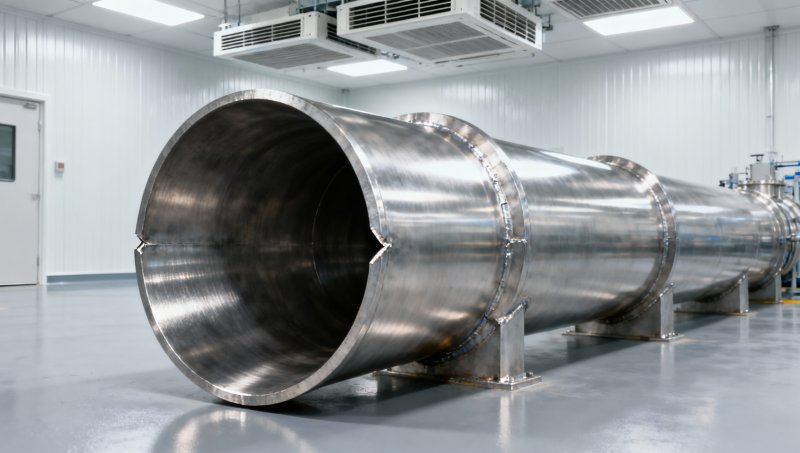
For quality control and safety professionals overseeing pharmaceutical cleanroom installations, selecting the right 1 stainless steel pipe is not a matter of preference—it’s a prerequisite for maintaining sterile integrity, preventing microbial harborage, and passing regulatory audits. Surface roughness (Ra), passivation efficacy, and FDA-aligned documentation are not optional add-ons; they are measurable, verifiable criteria embedded in cGMP and ASTM A967/A380 requirements. If your piping system shows visible micro-pitting after cleaning validation, fails extractable testing, or triggers non-conformance during FDA pre-approval review, the root cause often traces back to one or more of these three technical checkpoints—before installation, not after.
Ra Value: Why ≤0.4 μm Isn’t Just a Number
Surface roughness—expressed as arithmetic average deviation (Ra)—directly governs biofilm adhesion risk in fluid-contact surfaces. In pharmaceutical water systems, an Ra above 0.4 μm creates microscopic valleys where bacteria, endotoxins, and process residues accumulate beyond routine CIP/SIP reach. ASTM F2524-22 specifies that for Class A/B cleanroom piping, electropolished stainless steel tubing must demonstrate Ra ≤0.4 μm across full-length sampling—not just at a single test point. This isn’t about polishing aesthetics; it’s about eliminating topographic niches where bioburden persists despite validated sterilization cycles. Ra values measured post-fabrication (e.g., after welding or bending) often increase by 0.1–0.3 μm due to heat-affected zone disruption. That means raw material certification alone is insufficient—you need post-fabrication Ra verification on finished pipe segments, with traceable profilometer reports tied to lot numbers.
Passivation: Beyond Nitric Acid Dips
Passivation removes free iron and enhances chromium oxide layer formation—but compliance hinges on method selection, dwell time, temperature control, and post-treatment rinsing. ASTM A967 outlines six approved methods (A–F), yet only Methods A (nitric acid) and B (citric acid) are widely accepted for pharmaceutical applications due to their compatibility with 316L stainless steel and low residue profiles. Critical oversight occurs when passivation is applied before final surface finishing: if electropolishing follows passivation, the oxide layer is stripped away. The correct sequence is always: fabrication → electropolishing → passivation → final rinse → drying under controlled humidity. Any deviation invalidates the protective layer’s continuity. Also, passivation effectiveness isn’t confirmed by visual inspection—it requires copper sulfate spot testing per ASTM A967 Annex A1 or, preferably, ferroxyl test per ASTM A380 Section 7.2. Absence of blue staining indicates adequate oxide coverage; localized discoloration signals incomplete coverage at weld seams or mechanical joints.
FDA Compliance: Documentation, Not Just Material Grade
Using 316L stainless steel doesn’t automatically satisfy FDA expectations. The U.S. Code of Federal Regulations (21 CFR Part 211.65) mandates that equipment surfaces “be constructed so that they can be thoroughly cleaned and sterilized.” That places legal responsibility on the buyer—not the supplier—to verify and retain evidence of three interdependent elements: (1) certified Ra ≤0.4 μm on all interior and exterior contact surfaces, (2) documented passivation protocol aligned with ASTM A967 Method A or B—including bath concentration, temperature, duration, and post-rinse conductivity ≤1.0 µS/cm, and (3) full material traceability: heat number, mill test report (MTR) per ASTM A276/A484, and certificate of conformance listing compliance with ASTM A312 for seamless pipe or ASTM A778 for welded pipe. Missing any one element renders the entire piping system non-auditable—even if installed flawlessly.
Where Structural Steel Experience Adds Technical Rigor
While pharmaceutical-grade stainless tubing demands precision tolerances, structural integrity remains foundational—especially at support points, anchor zones, and seismic bracing interfaces. Pipe supports, hangers, and load-bearing frames must resist thermal expansion stress without transferring vibration or deformation into the process line. For projects requiring dual-specification components—such as high-strength structural brackets paired with ultra-smooth sanitary piping—material consistency matters. High Carbon Steel Plate offers predictable yield behavior under sustained load, with hardness verified via Heat Treatment Code HRBS HV10 and carbon content strictly capped at C≤0.15% to prevent intergranular corrosion sensitization during welding. Its uniform grain structure and deep-drawing performance also enable consistent flange reinforcement rings and custom mounting plates—critical where ISO Class 5 cleanroom piping intersects with structural steel frameworks.
Verification Steps Before Installation
Do not rely solely on supplier-provided certificates. Conduct these four checks on-site before cutting or welding:
- Ra spot check: Use a portable stylus profilometer on three random locations per pipe segment (start/mid/end), avoiding weld zones. Reject any reading >0.42 μm.
- Passivation validation: Perform copper sulfate test on weld seams and mechanical joint faces. Blue deposits indicate free iron exposure—requiring re-passivation and re-testing.
- MTR cross-reference: Match heat number on pipe marking to MTR’s tensile strength (min. 485 MPa for 316L), sulfur content (≤0.030%), and ferrite content (if applicable).
- Surface defect scan: Examine under 600-lux white light at 30° angle for scratches, gouges, or grinding marks deeper than 0.05 mm—these exceed acceptable Ra thresholds even if average value passes.
When to Escalate Technical Review
If Ra readings fluctuate across a single pipe length, or if passivation tests fail only at weld junctions, the issue likely lies in inconsistent post-weld treatment—not base material. Similarly, if MTRs list ASTM A240 but omit ASTM A312 compliance language, the pipe was manufactured to plate specification, not tubing standard—making it unsuitable for pressurized cleanroom distribution. These aren’t supplier errors to negotiate; they’re technical disqualifiers requiring replacement before commissioning. No audit waiver compensates for non-compliant surface topology or undocumented passivation.
Final acceptance rests on reproducible measurement—not vendor assurance. Every 1 stainless steel pipe installed in a regulated pharmaceutical environment must carry demonstrable, test-backed evidence of Ra control, passivation fidelity, and FDA-aligned documentation—not just nominal grade conformity. That evidence starts with specification clarity, continues through fabrication verification, and ends only after on-site validation confirms what the paper claims.
Please give us a message


Please enter what you want to find