Structural steel standards vary from project to project because design codes, load requirements, regional regulations, and end-use environments are rarely the same. For buyers, engineers, and contractors, understanding these differences is essential to selecting compliant materials, controlling costs, and avoiding sourcing risks. This article explains why structural steel standards matter and how they affect global procurement decisions.
In global steel sourcing, the same beam size may be acceptable in one market and rejected in another. A warehouse in Southeast Asia, a bridge in North America, and a plant expansion in Europe can all require different grades, tolerances, test documents, and coating expectations.
For information-driven buyers, the issue is not only technical compliance. It also affects lead time, mill selection, fabrication feasibility, inspection scope, and total landed cost. When structural steel standards are understood early, procurement decisions become faster and project risk becomes easier to control.
Why structural steel standards differ across projects
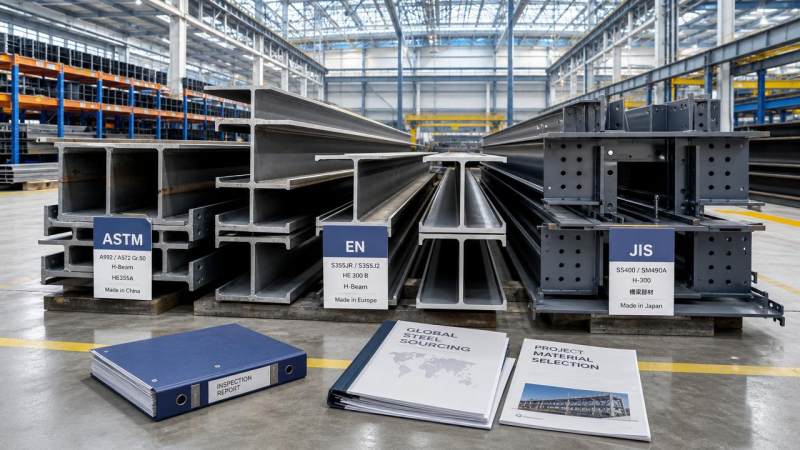
Structural steel standards are shaped by at least 4 major variables: design code, mechanical requirement, service environment, and local approval practice. Even where section dimensions look similar, the accepted yield strength, chemical composition, impact performance, and inspection method may differ significantly.
1. Design codes define the baseline
A project designed under ASTM-based practice does not always translate directly into EN, JIS, or GB specifications. Engineers may require A36, A572, or A992 in one project, while another may call for S275JR, S355JR, or SS400. These are not just different labels; they reflect different code systems and performance expectations.
In practical sourcing, this means buyers must verify 3 things before placing an order: grade equivalency, dimensional standard, and document acceptance. Assuming one grade can automatically substitute for another is one of the most common causes of approval delays.
2. Load conditions change material requirements
Projects with higher live loads, longer spans, dynamic vibration, or seismic demands often require stronger or tougher material. A low-rise workshop may accept a standard carbon steel beam, while a high-load industrial platform may need higher yield grades such as Q460C or A572.
The difference can be substantial. A project team may compare 235 MPa, 345 MPa, and 460 MPa class materials during design optimization. Higher strength may reduce section weight, but it can also affect welding procedure, fabrication cost, and availability.
3. Regional regulations and approval habits matter
Many countries accept multiple international standards, but local authorities, consultants, or EPC contractors often have preferred systems. In North America, ASTM references are common. In Europe, EN10025 is widely recognized. In Japan and parts of Asia, JIS-based specifications may dominate.
For exporters, this creates a documentation challenge. Mill test certificates, heat numbers, dimensional reports, coating records, and third-party inspections may be required in 2 to 5 separate document sets depending on project complexity.
4. End-use environment affects standard selection
A dry indoor structure and a marine-facing facility do not face the same risks. Corrosion exposure, low temperature, humidity, and fatigue cycles all influence what standard is suitable. In outdoor or coastal use, the steel grade may be acceptable only when paired with galvanizing, surface treatment, or stricter toughness requirements.
This is why structural steel standards are often linked to project environment rather than only section shape. A beam that performs well at 20°C in a warehouse may not be the right choice for a cold-region infrastructure job exposed to sub-zero conditions.
The table below shows how common project variables influence standard selection in real procurement discussions.
The key takeaway is simple: standards vary because projects vary. Procurement becomes smoother when the buyer treats steel grade, section standard, and quality documents as one combined package rather than separate items.
How these differences affect steel sourcing and cost control
Different structural steel standards directly affect quotation speed, production planning, and shipping accuracy. If the inquiry only lists a section size without the required standard, suppliers may need 2 to 3 clarification rounds before they can issue a reliable offer.
Specification mismatch creates hidden cost
A mismatch can appear in grade, dimensions, surface condition, or certification. For example, a buyer may request an H-beam based on EN dimensions but expect ASTM A992 mechanical performance. That combination may be possible in some cases, but not as a standard stock item, which can extend mill scheduling by 2–6 weeks.
Hidden cost also appears in rework. If hole punching, cutting, or welding preparation is based on the wrong section tolerance, the fabrication shop may lose time and material. On large projects, even a 1–2% material error can become a meaningful budget issue.
Documentation requirements influence supplier choice
For many international buyers, the material itself is only part of the purchase. The supplier must also deliver heat traceability, dimensional inspection records, packing lists, and sometimes third-party verification. Some projects accept standard mill certificates, while others require additional review before shipment.
A capable exporter should understand ASTM, EN, JIS, and GB references and be able to align production with customer drawings. This reduces the risk of cargo arriving at site but failing consultant review, which is one of the most expensive sourcing failures in steel procurement.
Product selection should match both standard and application
In many projects, section type matters as much as material grade. For buyers sourcing beams for steel structures, machinery frames, bridges, or ship-related fabrication, choosing a product available in multiple standard systems can improve flexibility and shorten lead time.
A practical example is Hot Rolled H Beam, which can be supplied in common grades such as Q235, Q345B, Q460C, SS400, S275JR, S355JR, A572, and A992. Typical dimensional ranges include flange thickness of 8–64mm, web thickness of 5–36.5mm, flange width of 50–400mm, web width of 100–900mm, and lengths from 1m to 12m or cut-to-size.
For buyers comparing options, this kind of product is useful because it supports applications in mechanical manufacture, steel structure, shipbuilding, bridging, and automobile chassis. It also allows value-added processing such as bending, welding, punching, cutting, and decoiling depending on downstream fabrication needs.
Why flexibility matters in international procurement
If one supplier can support standard grades across ASTM, EN10025, and JIS G3101 references, buyers save time during technical alignment. This is especially valuable when a project contains 3 or more beam sizes, multiple end users, or mixed regional specifications.
The following table compares common procurement factors affected by structural steel standards.
When structural steel standards are defined early, suppliers can quote more accurately and buyers can compare offers on a like-for-like basis. This improves both technical clarity and commercial transparency.
How buyers can evaluate standards before placing an order
For information researchers and procurement teams, a structured review process can prevent most sourcing problems. In many B2B steel orders, 5 checkpoints are enough to identify whether the requested material is likely to meet project expectations.
Five practical checkpoints
- Confirm the exact standard name, not only the steel grade.
- Check required mechanical properties, including yield and tensile range where specified.
- Verify section dimensions, tolerance basis, and cut length, such as 6m, 9m, or 12m.
- Review service environment, including indoor, marine, humid, or low-temperature exposure.
- Ask which certificates and inspections are mandatory before shipment.
Common buyer mistakes
- Assuming equivalent grades are always interchangeable without engineer approval.
- Ordering by drawing section only and omitting material standard.
- Ignoring fabrication needs such as punching, welding, or galvanizing compatibility.
- Not checking whether the supplier can issue the required MTC format.
When customized support becomes important
If a project includes mixed standards, non-stock sizes, or OEM structural components, the supplier should be able to coordinate manufacturing, quality control, and export documentation together. This is where an experienced structural steel manufacturer and exporter can reduce risk more effectively than a simple trading source.
Companies serving multiple regions often need familiarity with North America, Europe, the Middle East, and Southeast Asia. In practice, this means understanding how global buyers compare ASTM, EN, JIS, and GB references while still expecting stable lead times and consistent quality.
What to look for in a structural steel supply partner
Choosing the right partner is not only about price per ton. Buyers should evaluate production capability, standards coverage, customization support, and responsiveness during technical clarification. These factors often determine whether delivery will stay on schedule over a 4–12 week project cycle.
Four supplier capabilities that matter
First, the supplier should support mainstream structural steel standards and be transparent about available grades and dimensions. Second, it should maintain quality control from raw material to final inspection. Third, it should handle customized cutting or processing when required. Fourth, it should provide dependable communication during export and shipment planning.
For global projects, these capabilities reduce sourcing risk more than small price differences do. A lower unit price loses value quickly if the steel fails document review or misses the fabrication schedule.
Why manufacturers with export experience are valuable
An export-oriented manufacturer can usually align product selection, production scheduling, and inspection records more effectively than a supplier without international project experience. This is especially important for beams, channels, angle steel, cold formed profiles, and custom structural components used across different code environments.
Hongteng Fengda, as a structural steel manufacturer and exporter from China, focuses on reliable steel products and customized solutions for construction, industrial, and manufacturing projects. With modern manufacturing facilities and quality control aligned to major international standards, the company supports buyers who need stable supply, consistent quality, and practical cost control.
Structural steel standards vary because each project combines its own code system, load demand, environmental condition, and approval requirement. Buyers who clarify standards early can reduce technical disputes, avoid costly delays, and compare offers with greater accuracy. For projects involving standard sections or customized structural steel components, working with a supplier that understands ASTM, EN, JIS, and GB requirements makes procurement more predictable.
If you are evaluating material options, reviewing grade equivalency, or sourcing beams and structural profiles for an international project, contact us to discuss your specifications, get a tailored solution, and learn more about dependable structural steel supply.
Please give us a message


Please enter what you want to find