When evaluating stainless steel angle price, the surface finish is more than a visual detail—it directly affects processing cost, corrosion performance, inspection requirements, and final project value.
Comparing mill finish, brushed finish, polished finish, or customized treatments helps prevent misleading quotations and improves sourcing decisions for structural steel projects.
This trend matters as construction, industrial fabrication, and architectural applications demand cleaner appearance, tighter tolerances, and more transparent cost structures.
Finish Requirements Are Becoming a Bigger Stainless Steel Angle Price Signal
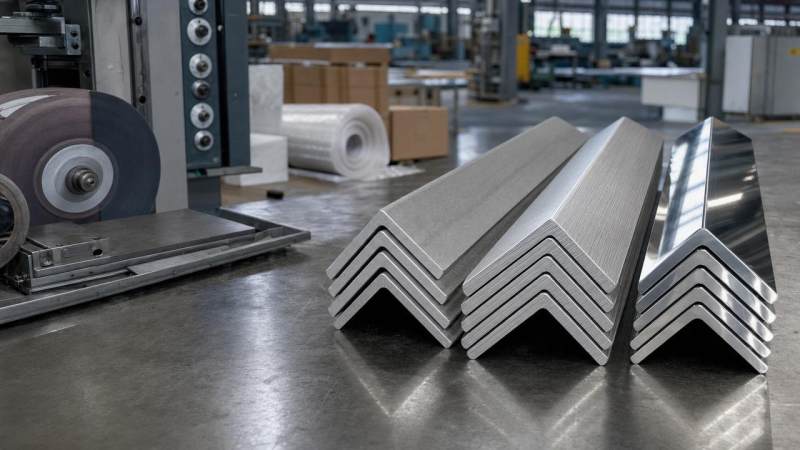
The market no longer treats stainless angle as only a structural section.
In many projects, the same profile must provide load support, visible appearance, and long-term corrosion resistance.
This shift explains why stainless steel angle price varies even when grade, size, and weight look similar.
A mill finish angle may suit hidden bracing, equipment frames, or general industrial use.
A brushed or polished angle may be required for handrails, facades, elevators, clean rooms, or retail interiors.
The cost difference reflects extra operations, surface control, packaging protection, and defect rejection risk.
Therefore, stainless steel angle price should be read as a combination of material, processing, inspection, and application risk.
Current Market Changes Behind Finish-Based Price Gaps
Several market signals are making finish quality more important in stainless angle sourcing.
First, visible steel structures are expanding in commercial buildings, infrastructure, and public facilities.
Second, overseas projects increasingly request consistent appearance across batches and delivery lots.
Third, cost pressure is pushing companies to compare quotations more carefully instead of accepting broad descriptions.
These changes make stainless steel angle price more sensitive to finish definitions, tolerance expectations, and surface defect limits.
A quotation saying “polished” is not enough.
The actual grit level, direction, gloss consistency, edge condition, and protective film all influence stainless steel angle price.
Main Drivers That Make Finish Change the Final Cost
Finish-related cost is created across the full production chain, not only during the final surface operation.
This is why two suppliers may offer different stainless steel angle price levels for the same nominal grade.
The lower offer may exclude finish protection, strict inspection, or consistent batch appearance.
Mill Finish: Lower Cost, Practical for Hidden Structures
Mill finish is usually the most economical option for stainless angle.
It keeps the natural surface from rolling or forming, with limited cosmetic treatment.
For concealed supports, industrial frames, or machinery bases, mill finish often provides adequate function.
Because processing is limited, stainless steel angle price is less affected by labor and abrasive consumption.
However, mill finish may show rolling marks, minor scratches, or color variation.
If the angle remains visible, later rework may cost more than ordering a better finish initially.
Brushed Finish: A Balance Between Appearance and Cost
Brushed stainless angle is widely used where appearance matters but mirror reflection is unnecessary.
The linear texture hides light scratches and gives a uniform architectural look.
This finish adds processing cost, so stainless steel angle price rises compared with mill finish.
The increase depends on grit specification, brushing direction, profile size, and required consistency.
For railings, decorative frames, balcony edges, and interior metalwork, brushed finish often delivers strong value.
Polished Finish: Higher Value, Higher Control Requirements
Polished stainless angle requires more careful surface preparation and finishing control.
As brightness increases, small scratches, waves, or edge marks become easier to notice.
For this reason, stainless steel angle price often includes higher rejection allowances and stricter handling.
Mirror-like surfaces may need several polishing stages, protective film, and dedicated packaging.
The result can be worthwhile for premium decoration, elevator trims, signage structures, and visible architectural details.
Application Changes Are Reshaping How Price Is Judged
The same stainless angle may be evaluated differently across construction, machinery, and decorative applications.
In structural work, strength, grade compliance, and dimensional accuracy usually dominate.
In visible installations, surface uniformity can become as important as mechanical performance.
This creates a practical shift in stainless steel angle price comparison.
The lowest unit price may not deliver the lowest installed cost.
- Hidden frames can usually prioritize mill finish and stable dimensional tolerances.
- Public-facing metalwork should define finish level before comparing quotations.
- Marine or chemical environments may require both corrosion resistance and surface smoothness.
- Export shipments need packing that protects the selected finish during transport.
A reliable stainless steel angle price should therefore match the real use environment, not only the drawing size.
Material Grade and Finish Must Be Considered Together
Finish is important, but it cannot replace correct material selection.
Common stainless grades differ in corrosion resistance, formability, weldability, and raw material cost.
A polished lower-grade angle may still underperform in aggressive environments.
Meanwhile, a higher-grade stainless angle with simple finish may be more suitable for industrial exposure.
This relationship is a key reason stainless steel angle price should be checked against grade, finish, and service conditions together.
Hongteng Fengda supplies structural steel products for construction, industrial, and manufacturing projects worldwide.
Alongside angle steel, channel steel, steel beams, and cold formed profiles, the product range also includes 45# Carbon Steel Round Bar.
This carbon steel bar supports applications requiring excellent strength, wear resistance, hot rolled or cold rolled supply, and standards such as ASTM, EN, JIS, and GB.
Such portfolio depth helps projects align stainless, carbon steel, and customized structural components under consistent quality control.
Inspection Expectations Are Raising the Cost of Premium Finishes
Finish quality is increasingly verified before shipment, especially for export orders.
Surface inspection may include visual checks, roughness review, gloss comparison, edge evaluation, and packaging confirmation.
Each requirement can influence stainless steel angle price because it adds labor and documentation.
Clear inspection criteria reduce disputes and prevent inconsistent delivery expectations.
For polished or brushed angles, sample approval can be more valuable than a simple written description.
Photos, finish codes, and reference samples help define acceptable color, texture, and surface marks.
Without these controls, stainless steel angle price comparisons can become inaccurate and risky.
What Should Be Checked Before Accepting a Quotation
A useful quotation should make the finish scope visible and measurable.
When these details are missing, stainless steel angle price may appear attractive but remain incomplete.
- Confirm stainless grade, standard, size, thickness, and length tolerance.
- Define finish type, grit level, polishing direction, or sample reference.
- Check whether edge finishing is included or separately charged.
- Clarify inspection method, acceptance criteria, and document requirements.
- Confirm packing method, protective film, bundle weight, and moisture control.
- Ask whether surface defects found before shipment are repaired or replaced.
These checks make stainless steel angle price easier to compare across suppliers and production routes.
Practical Response Strategy for Changing Finish Demands
The best response is not always choosing the highest finish.
The smarter approach is matching finish level to performance needs, visibility, and lifecycle cost.
This method supports better cost control because unnecessary finishing is avoided.
It also reduces rework caused by unclear surface expectations.
Why Supplier Capability Matters as Finish Standards Rise
Finish-sensitive orders require more than basic steel trading capacity.
Stable production, controlled handling, documented inspection, and export packing all affect final performance.
Hongteng Fengda operates as a structural steel manufacturer and exporter from China.
The company supplies angle steel, channel steel, steel beams, cold formed profiles, and customized structural steel components.
Products are supported by modern manufacturing facilities and quality control aligned with ASTM, EN, JIS, and GB requirements.
For stainless angle projects, this capability helps align finish selection, cost control, and dependable lead times.
It also makes stainless steel angle price more transparent because production and inspection factors can be defined early.
Final Outlook: Price Differences Will Become More Specification-Driven
Finish-based price variation will likely remain important as steel applications become more visible and performance-focused.
The key trend is greater specification clarity.
Rather than asking only for stainless steel angle price, projects should define finish, grade, inspection, and packing together.
This creates more accurate quotations and fewer disputes after delivery.
For the next sourcing step, prepare drawings, finish references, quantity, standard, and delivery destination before requesting an offer.
Hongteng Fengda can support specification review, customized structural steel supply, and practical guidance for finish-based cost comparison.
A well-defined stainless steel angle price is not just cheaper or higher; it is clearer, safer, and better matched to project value.
Please give us a message


Please enter what you want to find