The ss 304 pipe price per meter can change frequently due to shifts in raw material costs, global demand, production standards, and order specifications. For buyers comparing suppliers, understanding these price drivers is essential to avoid hidden costs and make smarter sourcing decisions. This article explains what affects pricing and how to evaluate quotations more accurately in today’s steel market.
When people search for ss 304 pipe price per meter, they usually do not want a number alone. They want to know why quotes vary, what a fair price looks like, and how to compare suppliers without making costly mistakes.
For information-focused buyers, the biggest concern is often uncertainty. One supplier offers a low rate, another gives a much higher quotation, and both claim to sell 304 stainless steel. The difference usually comes from factors hidden behind the unit price.
The most useful way to evaluate the market is to look beyond the headline figure. Material grade, thickness tolerance, finish, quantity, certification, production route, and shipping terms all influence the final cost per meter in practical sourcing situations.
Why the ss 304 pipe price per meter rarely stays stable
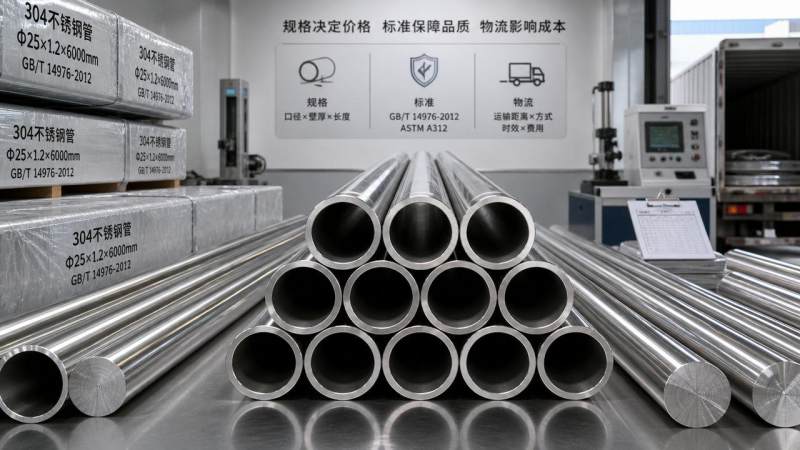
The ss 304 pipe price per meter is linked to a supply chain that changes constantly. Stainless steel pricing depends heavily on raw materials, especially nickel and chromium, both of which can move quickly in global commodity markets.
Even if the pipe specification remains the same, mill-side production costs may rise within weeks. Energy prices, labor expenses, packaging costs, and inland transport charges can all affect what exporters and distributors are able to offer.
Exchange rate movements also matter. Many international steel transactions are quoted in US dollars, while production inputs may be purchased in local currency. A currency swing can change export pricing without any visible change in the physical product.
On top of that, regional demand cycles create additional volatility. When construction, industrial fabrication, or energy projects increase purchases, mills may prioritize larger contracts, reducing spot availability and pushing up pipe prices per meter.
In slower periods, prices may soften, but not always equally across all specifications. Common sizes may become more competitive, while non-standard diameters, wall thicknesses, or special finishes remain relatively expensive due to lower production efficiency.
What exactly is included in a per-meter pipe price
Many buyers assume that a per-meter price is a complete and comparable number. In reality, one quotation may include material only, while another covers polishing, testing, packaging, documentation, and export preparation.
That is why two suppliers can quote very different prices for what appears to be the same item. If one uses theoretical weight and another uses actual weight, the cost basis may already differ before freight or inspection is added.
Some quotations are based on ex-works terms, meaning the buyer takes responsibility for local transport, customs handling, and ocean freight. Others may be FOB, CFR, or CIF, each changing the practical landed cost significantly.
For this reason, buyers should always ask what the unit rate includes. A lower ss 304 pipe price per meter may end up being more expensive overall if hidden processing charges or compliance fees appear later in the order cycle.
The biggest cost drivers behind 304 stainless steel pipe pricing
Raw material cost is usually the first driver, but not the only one. The chemical composition of 304 stainless steel, especially nickel content, has a direct effect on base pricing and explains many month-to-month fluctuations.
Wall thickness is another major factor. A thicker pipe uses more material per meter, so the total cost naturally rises. However, buyers should also check whether the supplier follows strict thickness tolerance or a lower-cost production range.
Pipe diameter affects pricing as well. Larger diameters may require different forming and welding methods, while very small or special dimensions can reduce production efficiency. In both cases, the price per meter may increase compared with standard sizes.
Surface finish matters more than some buyers expect. Pickled, polished, mirror, brushed, or BA finishes all involve different processing steps. If visual appearance or corrosion resistance in end use is important, finishing costs should not be ignored.
Testing and certification can also raise the unit quote. Requirements such as mill test certificates, third-party inspections, PMI testing, or compliance with ASTM, EN, JIS, or GB standards add value, but they also add cost.
Finally, order quantity strongly influences the result. Small trial orders often carry higher per-meter prices because setup, packaging, and documentation are spread over fewer units. Larger repeat orders usually receive more competitive pricing.
Why one supplier’s low quote may not actually be cheaper
In stainless steel sourcing, the cheapest visible quote is not always the best commercial decision. Some offers look attractive because they use thinner actual walls, looser tolerance control, or substitute specifications that are not clearly stated upfront.
Another common issue is unclear grade identification. Buyers searching for ss 304 pipe price per meter should confirm whether the supplier is quoting genuine 304 stainless steel and not a lower-grade alternative designed to meet only a price target.
Packaging quality also influences downstream cost. Poor export packing can lead to scratches, deformation, or corrosion contamination during transit. A slightly higher initial quotation may prevent claims, replacement delays, and project disruption later.
Lead time reliability is equally important. A supplier that quotes low but cannot deliver on schedule may create a much bigger indirect cost, especially for construction or manufacturing projects that depend on synchronized material arrival.
Documentation quality should not be underestimated either. In cross-border purchases, incomplete test reports, missing export files, or inconsistent labeling can trigger customs issues and delay site use, effectively increasing the real cost per meter.
How buyers should compare ss 304 pipe price per meter correctly
The best comparison method is to standardize every quotation. Ask each supplier to quote the same grade, diameter, wall thickness, length, finish, standard, tolerance, and trade term. Only then does the unit price become meaningful.
It is also wise to request both theoretical and actual weight basis when relevant. This helps buyers understand whether the pipe quantity is calculated by standard formula or by measurable physical weight after production and finishing.
Always confirm whether the quoted material is seamless or welded. The manufacturing method affects both price and application suitability. A welded pipe may be fully acceptable in many uses, but it should not be compared blindly with seamless pricing.
Ask for the applicable production standard as well. ASTM, EN, JIS, and GB requirements may differ in tolerances, testing, and documentation. When the standard changes, the ss 304 pipe price per meter can change for valid technical reasons.
One practical sourcing habit is to compare at least three complete quotations, then eliminate offers that lack technical transparency. The goal is not simply to find the lowest number, but to identify the best balance of quality, risk, and total cost.
How market conditions in China can influence export quotations
China remains a major source for stainless steel and structural steel products, so domestic production conditions there often affect global buyer quotations. Steel mill scheduling, environmental controls, and regional logistics can all influence export pricing.
When mills face strong domestic demand, export offers may harden. When domestic activity slows, overseas buyers may find more flexible negotiation space. This pattern is common, but it still depends on product type, specification, and mill availability.
Export buyers should also monitor freight markets. Ocean shipping rates, container availability, and port handling efficiency can change landed cost quickly, even if the stainless steel pipe factory price itself remains relatively stable.
Experienced manufacturers often help buyers manage this uncertainty by offering stable lead times, specification guidance, and realistic quotation windows. That is especially useful for procurement teams planning projects several weeks or months in advance.
Companies with broader steel manufacturing capabilities may also support sourcing efficiency across related categories. For example, some buyers who purchase pipe also review bars or structural materials for other project needs during the same procurement cycle.
In some industrial applications, buyers evaluating stainless products may also consider items such as 316L Stainless Square steel rod for complementary use. Such products are typically available with standards like ASTM, AISI, JIS, GB, DIN, and EN, depending on project requirements.
Questions buyers should ask before accepting a quote
Before confirming any order, ask the supplier to state the exact grade, standard, size range, tolerance, finish, production method, and certificate package in writing. Verbal assumptions are a frequent source of disputes in steel purchasing.
Buyers should also ask whether the quotation is fixed for a specific time period. Since stainless raw material markets can move quickly, a price valid today may not remain available next week, especially for larger or customized orders.
Clarify packaging details and loading method as well. Pipes may be bundled, capped, wrapped, or palletized differently depending on destination and handling conditions. Better packing can reduce damage and preserve usable value after arrival.
Do not forget to confirm minimum order quantity and production lead time. A supplier may offer an excellent ss 304 pipe price per meter, but if the MOQ is too high or the delivery window is too long, it may not fit the project plan.
Finally, ask for sample documents if compliance matters. Reviewing a mill test certificate, inspection report, or previous export paperwork in advance can reveal whether the supplier is prepared for your market’s regulatory and quality expectations.
How to make a smarter sourcing decision in a changing price environment
The smartest buyers treat stainless steel pricing as a technical and commercial evaluation, not just a shopping exercise. They compare offers on a like-for-like basis and calculate the total delivered value instead of focusing on one visible metric.
That means balancing price with consistency, standards compliance, production capacity, communication quality, and delivery reliability. For information researchers, building this understanding early makes future supplier discussions far more efficient and productive.
If a quotation seems unusually high, ask what technical or commercial factors are increasing the cost. If it seems unusually low, investigate what may be missing. In both cases, transparent dialogue is the fastest route to a sound buying decision.
For international buyers, working with a manufacturer or exporter that understands global standards and customized requirements can reduce sourcing risk. Clear specifications, stable production, and honest quoting practices often matter more than the lowest opening number.
In short, the ss 304 pipe price per meter keeps changing because the market behind it is dynamic. Raw materials, processing details, standards, quantities, logistics, and supplier practices all shape the final quotation buyers receive.
Understanding these drivers helps buyers judge whether a quote is reasonable, avoid hidden cost traps, and compare offers more accurately. Instead of asking only “what is today’s price,” the better question is “what exactly am I paying for, and what risk does it remove?”
Please give us a message


Please enter what you want to find