In 2026, more global buyers are turning to an H-beam manufacturer China can reliably offer—not just for lower costs, but for stable quality, wider specification options, and faster export support.
As construction and industrial projects demand both efficiency and compliance, Chinese suppliers are becoming a strategic sourcing choice for dependable structural steel solutions.
This shift is not driven by price alone. It reflects deeper changes in lead-time expectations, project risk control, quality verification, and specification flexibility across steel sourcing.
Why 2026 looks different for H-beam sourcing
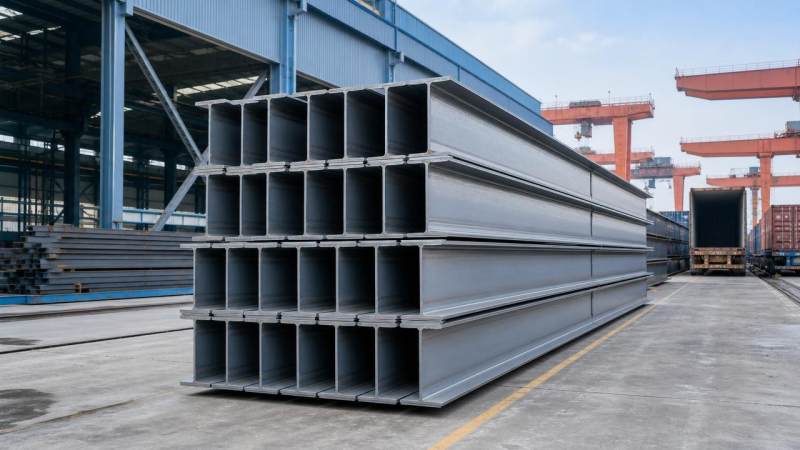
The steel market in 2026 is more disciplined, data-driven, and schedule-sensitive than before. Delays now carry higher costs across construction, fabrication, and cross-border logistics.
That is why the search for an H-beam manufacturer China has become more strategic. Buyers want consistency across production, paperwork, standards, and shipment execution.
Chinese structural steel suppliers have strengthened their export systems. Many now support ASTM, EN, JIS, and GB requirements with better mill traceability and specification matching.
At the same time, manufacturing clusters in China help shorten coordination cycles. Raw material access, forming capacity, finishing, testing, and container loading are often closely connected.
The strongest signals behind rising demand
Several market signals explain why more importers now prefer an H-beam manufacturer China can provide with reliable export experience.
These signals favor suppliers with stable production and export discipline. That is one reason the H-beam manufacturer China market continues gaining international attention.
What makes Chinese H-beam supply more competitive now
The most important advantage is not simply lower production cost. It is the combination of capacity, process control, specification coverage, and responsive communication.
1. Stable production capacity supports scheduling
Large and medium structural steel factories in China can plan rolling, cutting, and dispatch with better rhythm. This supports repeat orders and phased project deliveries.
2. Wider size and grade availability reduces sourcing gaps
Global projects rarely rely on one size only. Chinese suppliers often handle multiple beam sizes, related sections, and custom steel fabrication within one supply network.
3. Export documentation has improved significantly
Mill test certificates, packing lists, origin files, inspection reports, and labeling standards are now handled more systematically by experienced exporters.
4. Quality consistency now drives repeat business
A capable H-beam manufacturer China partner must control chemistry, dimensions, straightness, surface condition, and loading protection, not only quote a competitive number.
Many projects also require adjacent steel items. In some cases, anti-corrosion round sections are sourced together with beams for supporting applications.
A useful example is Galvanized Round Steel, often used in towers, highway protection, street light poles, marine parts, and structural components.
With DC01 material, tensile strength of 570–820 MPa, and standards including ASTM, EN, JIS, and GB, it fits projects needing corrosion resistance and customized dimensions.
How this trend affects project execution and steel planning
The growing preference for an H-beam manufacturer China source is changing how steel procurement is evaluated across planning, engineering, and site delivery stages.
- Specification review starts earlier to avoid late revision costs.
- Material substitutions are checked more strictly against required standards.
- Packaging and loading plans matter more for long-distance transport protection.
- Mixed-product shipments are used to reduce fragmentation and handling delays.
- Supplier communication speed becomes part of total procurement performance.
This trend also reduces dependence on local spot markets with limited dimensions. Direct factory sourcing improves predictability when exact sections or repeat volumes are required.
For industrial steel users, the benefit is stronger coordination between design intent and delivered material. That can reduce cutting losses, mismatch problems, and installation delays.
What to examine before choosing an H-beam manufacturer China partner
Not every supplier delivers the same level of reliability. In 2026, selection should focus on execution strength rather than broad promises.
Key checkpoints
- Can the supplier match ASTM, EN, JIS, or GB specifications clearly?
- Are dimension tolerances and theoretical weights confirmed before production?
- Is there evidence of stable export packing and container loading practice?
- Can inspection documents be provided without delays or inconsistency?
- Does the factory support customized processing or related structural steel items?
- Is communication direct, technical, and responsive during quotation changes?
A reliable H-beam manufacturer China source should also help identify practical risks. These include unavailable sizes, unrealistic lead times, and over-simplified freight assumptions.
Why integrated structural steel exporters are gaining trust
Integrated suppliers are gaining advantage because projects increasingly combine standard beams with channels, angles, cold formed profiles, and custom steel components.
Hongteng Fengda reflects this direction. As a structural steel manufacturer and exporter from China, it supplies standard and OEM solutions for global construction and industry.
Its product range includes angle steel, channel steel, steel beams, cold formed steel profiles, and customized structural steel components with quality control aligned to major standards.
This matters because buyers increasingly prefer one dependable source for multiple steel needs. Fewer handoffs often mean fewer errors, better timing, and clearer accountability.
Practical sourcing moves for 2026 and beyond
The best response is not rushed switching. It is a structured comparison of total supply performance, especially for repeat or specification-sensitive steel projects.
If sourcing plans involve recurring beam demand, custom fabrication, or multi-standard requirements, a tested H-beam manufacturer China partner can deliver measurable operational value.
The 2026 market favors suppliers that combine quality stability, export readiness, and practical communication. That is why this sourcing shift is likely to continue.
The next step is simple: compare suppliers by execution evidence, not marketing claims, and build a steel sourcing plan around consistency, compliance, and delivery confidence.
Please give us a message


Please enter what you want to find