When sourcing from galvanized steel pipe manufacturers, buyers often see meaningful lead time differences. These gaps usually reflect deeper supply chain realities rather than simple scheduling choices.
Raw material availability, coating capacity, order customization, inspection standards, and export coordination all shape delivery speed. Understanding these variables supports better supplier evaluation and steadier project planning.
In steel procurement, lead time is now a strategic indicator. It often reveals operational discipline, capacity stability, and a supplier’s ability to manage changing market conditions.
Lead time differences are becoming a stronger signal in the steel supply market
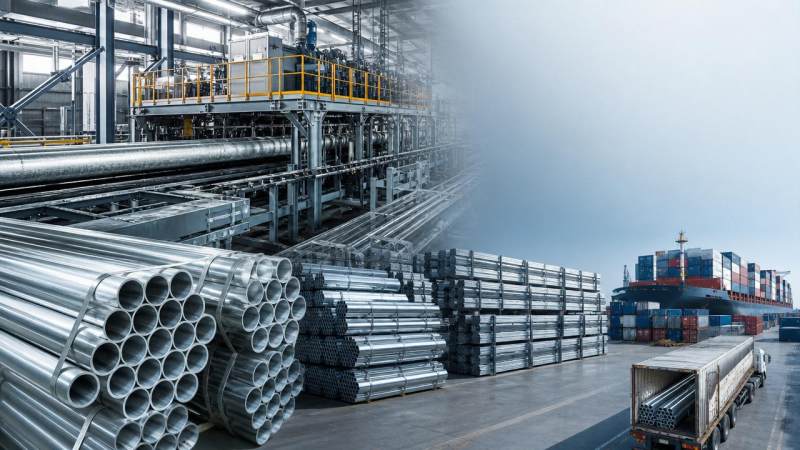
Across global steel trade, delivery expectations have changed. Shorter planning cycles and tighter construction schedules have increased attention on the response speed of galvanized steel pipe manufacturers.
This change is especially visible in export-oriented steel business. Shipping disruptions, zinc price swings, and energy cost changes now affect production calendars more directly than before.
As a result, two suppliers offering similar pipe specifications may provide very different lead times. The difference often comes from internal control, not only plant size.
Why galvanized steel pipe manufacturers do not move at the same pace
Lead time variation usually comes from several linked factors. Each factor can either shorten delivery windows or create hidden waiting periods during production and export.
Raw materials often decide the first part of the schedule
Many galvanized steel pipe manufacturers depend on continuous hot rolled steel supply. If coil arrivals slip, the whole production sequence shifts immediately.
Zinc procurement also matters. Hot-dip galvanizing needs stable material planning. Sudden zinc shortages or cost spikes may force line adjustments and selective order prioritization.
Capacity is not just machine quantity
A large factory may still deliver slowly if its lines are overloaded. Real lead time depends on queue length, maintenance frequency, labor organization, and dispatch efficiency.
Some galvanized steel pipe manufacturers keep flexible scheduling systems. Others run fixed batches, which can increase waiting time for non-standard orders.
Technical complexity changes release timing
Orders with uncommon diameters, wall thicknesses, cut lengths, or coating requirements usually move slower. Every added parameter creates another inspection or setup checkpoint.
This pattern applies across steel products. For example, projects using Structural Steel Channel often require exact lengths, grade matching, and corrosion protection coordination.
That product is available in models such as 5-40# and 6.5-30#, with grades including A36, Q235B, Q345B, S235JR, and S355JR. It is used in building structures, machinery, vehicles, ship beams, and furnaces.
With tensile strength at or above 520MPa, common lengths of 6m, 9m, and 12m, plus galvanized or painted finishes, the same planning logic applies: specification complexity affects delivery reliability.
Quality standards and export control are shaping delivery expectations
International buyers increasingly request ASTM, EN, JIS, or GB compliance. That means galvanized steel pipe manufacturers must align chemical composition, coating quality, dimensional tolerance, and documentation accuracy.
Third-party inspections add confidence, but they can also add time. Testing appointments, sampling, report review, and correction handling may extend shipment release.
- Hydrostatic or mechanical testing may require extra batching time.
- Coating thickness verification can delay packaging approval.
- Export documents must match invoices, packing lists, and certificates exactly.
- Port and vessel booking windows can override completed production dates.
In practice, the fastest production line does not always mean the fastest arrival. End-to-end coordination matters as much as mill speed.
These lead time differences influence cost, risk, and project continuity
Long or unstable lead times can create more than schedule pressure. They often affect freight planning, working capital, safety stock, and downstream installation sequencing.
Reliable galvanized steel pipe manufacturers help reduce hidden costs. Predictable supply lowers expediting expenses, emergency sourcing, and mismatch risk between materials and project milestones.
The most useful signals to watch before selecting galvanized steel pipe manufacturers
Instead of judging only by quoted days, it is better to verify operational indicators. Stronger suppliers usually provide evidence behind their promised schedules.
- Ask whether raw steel and zinc are stocked or purchased after order confirmation.
- Check whether galvanizing is in-house or outsourced.
- Review average on-time shipment records, not only best-case examples.
- Confirm quality standards, certificate flow, and inspection turnaround time.
- Examine packaging ability for export, including bundling, marking, and container loading.
- Clarify how schedule changes are communicated when market conditions move suddenly.
These points help distinguish between optimistic promises and process-backed reliability. That distinction is increasingly important in global steel sourcing.
A practical way to respond to changing lead time conditions
The best response is not only to demand faster delivery. It is to build a sourcing model that balances speed, quality, and schedule transparency.
- Separate urgent orders from specification-heavy orders.
- Pre-confirm standards, coating requirements, and document templates.
- Use milestone checks for raw material readiness, production start, inspection, and shipment booking.
- Keep an alternate supply plan for peak-demand periods.
- Evaluate suppliers by delivery consistency across several orders.
For global structural steel supply, stable capacity and disciplined quality control matter. Hongteng Fengda supports international projects with dependable production, recognized standards compliance, and customized steel solutions.
If lead time reliability is becoming a selection priority, compare galvanized steel pipe manufacturers through real production factors, not price alone. A clearer evaluation today reduces sourcing risk tomorrow.
Review current project specifications, identify timing-sensitive items, and confirm manufacturing and export checkpoints early. That step can improve delivery confidence before procurement pressure increases.
Please give us a message


Please enter what you want to find