For buyers and evaluators, understanding why hot rolled coil HRC pricing changes by grade and mill is essential to making accurate sourcing decisions.
Different steel grades, mill capabilities, quality standards, and production costs shape every quotation in the steel market.
In practice, hot rolled coil hrc prices do not move for one reason alone.
They reflect chemistry, rolling technology, order size, certification needs, logistics exposure, and regional supply pressure.
This article explains the most important pricing drivers and shows how to compare supply options with better cost control and lower sourcing risk.
Basic pricing logic behind hot rolled coil HRC
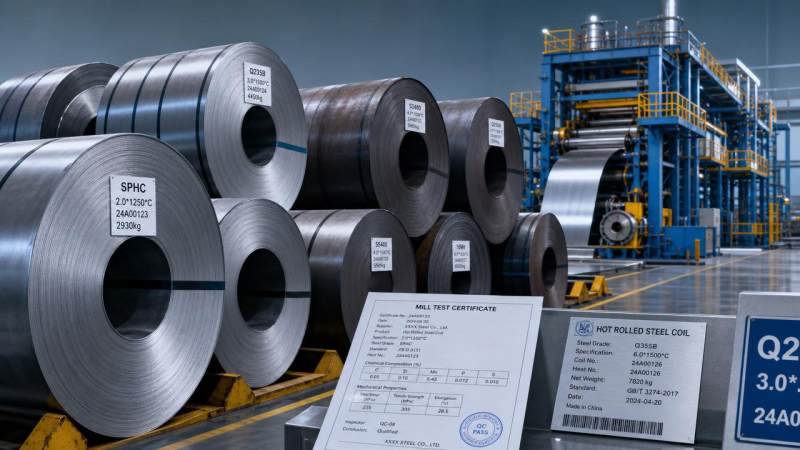
Hot rolled coil hrc is a foundational flat steel product used across construction, machinery, automotive, energy, and fabrication.
It is produced by rolling heated slabs into coils with target thickness, width, and mechanical properties.
Although market indexes publish reference prices, actual transaction values often differ significantly.
The reason is simple.
Not all coils are equal in composition, dimensional tolerance, surface condition, or downstream suitability.
A base commercial grade may be priced close to market averages.
A higher strength, cleaner surface, or tighter tolerance coil usually carries a premium.
Mill origin also matters because production route, reputation, inspection systems, and consistency directly affect usable value.
Core elements included in a quotation
- Steel grade and mechanical property level
- Thickness, width, coil weight, and edge condition
- Applicable standard such as ASTM, EN, JIS, or GB
- Mill source and production schedule
- Testing, certification, and traceability requirements
- Packing method, port terms, and freight exposure
Why grade creates clear price differences
Grade is one of the strongest variables in hot rolled coil hrc pricing.
Different grades require different alloy design, rolling control, and testing discipline.
These changes raise production complexity and cost.
For example, carbon structural grades are generally more affordable than high-strength low-alloy grades.
Grades for forming, welding, or load-bearing use may need stricter control of carbon, manganese, sulfur, and phosphorus.
That means more stable raw materials and more careful process windows.
Grade-related cost factors
- Alloy additions for strength or corrosion performance
- Controlled rolling for improved structure and toughness
- Additional laboratory testing and mechanical verification
- Lower rejection tolerance for chemistry deviations
- Special end-use requirements such as forming or welding stability
Even when thickness looks identical, two coils can differ in practical value.
A lower-priced coil may fit general fabrication.
A higher-priced coil may reduce cracking, distortion, or rework in demanding applications.
How mill capability affects hot rolled coil HRC prices
Mill differences are another major reason hot rolled coil hrc quotations vary.
A mill with advanced reheating control, precise rolling stands, and better cooling systems can deliver more consistent output.
That consistency often supports a premium.
Higher-performing mills usually manage tighter tolerances, flatter profiles, more stable coil weight, and cleaner surfaces.
For export orders, these points matter because downstream processing costs can exceed the initial price gap.
Typical mill-related pricing signals
Mill reputation also affects resale confidence and project acceptance.
In many tenders, accepted mill lists create visible price separation in the same regional market.
Industry conditions and current market attention points
Beyond grade and mill, hot rolled coil hrc pricing responds to broader steel market conditions.
Raw material costs, energy prices, environmental controls, and freight changes all influence the final number.
Lead time pressure can also create sudden differences between mills.
Common market signals to monitor
- Iron ore, scrap, and coking coal movements
- Seasonal construction demand and industrial output
- Plant maintenance, output restrictions, or power controls
- Export policy changes, duties, and trade barriers
- Ocean freight rates and inland logistics congestion
- Currency fluctuations in cross-border settlements
When supply is tight, standard grades may rise quickly.
When demand weakens, premium grades can remain relatively firm if only a few mills can produce them reliably.
Related steel products and downstream value comparison
Hot rolled coil hrc often serves as an upstream material for structural and formed steel products.
That is why pricing analysis should also consider the downstream conversion value.
In many projects, flat steel cost influences the economics of channels, profiles, and fabricated assemblies.
A useful reference is Metal Channel, widely used in construction, automobile manufacture, wall beams, brackets, columns, and lightweight roofing systems.
It is available in grades such as Q195, Q235, Q235B, Q345B, Duplex, and 201, 202, 304, 316 stainless options.
Typical specifications include thickness from 1.5mm to 25mm, height from 80mm to 160mm, and length from 6m to 12m.
Products meeting AISI, ASTM, DIN, JIS, BS, and GB/T standards usually offer strong welding performance, high strength, and anti-corrosion options.
For structural sourcing, comparing coil costs with finished profile performance helps determine whether buying raw flat steel or finished sections delivers better total value.
Practical application value in sourcing decisions
Understanding hot rolled coil hrc price variation improves more than budgeting.
It supports technical matching, claim prevention, and long-term supply stability.
A lower headline price may increase total cost if the coil causes yield loss, welding issues, or delayed processing.
A slightly higher price may reduce scrap, improve fabrication speed, and protect delivery schedules.
Evaluation points with direct business impact
- Check whether the quoted grade exactly matches the required standard.
- Confirm thickness tolerance, width tolerance, and coil weight range.
- Review mill test certificate format and heat traceability.
- Ask about surface quality and suitability for forming or welding.
- Compare delivery lead time with project schedule risk.
- Measure freight, duties, and inland transport within total landed cost.
Typical supply scenarios and price interpretation
Practice recommendations for stable cost control
Effective comparison of hot rolled coil hrc offers requires a structured approach.
Price should be reviewed together with technical fit and supply reliability.
- Build one specification sheet for all suppliers before asking for offers.
- Separate base material price from freight, packing, and inspection fees.
- Request equivalent comparisons by standard, grade, and tolerance.
- Track repeat performance from each mill, not only one-time quotations.
- Use sample orders when a new mill offers unusually low pricing.
- Keep alternative origins ready during volatile market cycles.
A disciplined review process turns hot rolled coil hrc pricing into a manageable decision instead of a market guess.
For steel supply planning, the next step is to compare required grades, standards, and processing expectations against mill capability and total landed cost.
With that method, quotations become clearer, technical risk becomes lower, and sourcing outcomes become more predictable.
Please give us a message


Please enter what you want to find