In pipeline projects, the reliability of your carbon steel pipe stockist directly impacts safety, schedule adherence, and total cost of ownership. A trusted partner like Hongteng Fengda — a China-based structural steel manufacturer and exporter — ensures consistent supply of certified carbon steel pipes, alongside complementary products such as angle steel, DX51D steel, hot dip galvanized coil, steel angle bending solutions, steel metal angle, and 304L stainless steel pipe. Whether you’re a project manager assessing technical specs, a procurement officer evaluating sourcing risk, or a decision-maker prioritizing long-term value, choosing a stockist with ISO-aligned quality control, global standards compliance (ASTM/EN/JIS/GB), and proven delivery performance isn’t optional — it’s mission-critical.
Why Stockist Reliability Directly Affects Pipeline Project Outcomes
Carbon steel pipe failure in pipeline infrastructure rarely stems from material defects alone — more often, it traces back to inconsistent sourcing: delayed deliveries, undocumented heat lots, mismatched mill test reports (MTRs), or non-compliant coatings. For projects spanning 6–18 months across North America, Europe, or the Middle East, a single stockist delay can cascade into 3–5 weeks of idle labor, penalty clauses, or emergency air freight at 4–7× sea freight cost.
Reliability here means verified capability — not just claims. It includes traceable production batches (with full ASTM A106/A53/B36.10M documentation), real-time inventory visibility, and capacity to hold firm lead times even during Q4 peak demand. Hongteng Fengda maintains 98.2% on-time-in-full (OTIF) delivery over the past 36 months, backed by dual production lines and raw material buffer stocks covering 45–60 days of average order volume.
This operational discipline extends beyond pipes. When integrating support structures — e.g., anchor frames, flange supports, or corrosion-resistant cladding — having one supplier for both carbon steel pipe and complementary structural components (like angle steel or cold-formed profiles) cuts coordination overhead by up to 40%, reduces interface risks, and simplifies QA/QC sign-off across joint specifications.
How Certification & Traceability Translate to Real-World Risk Mitigation
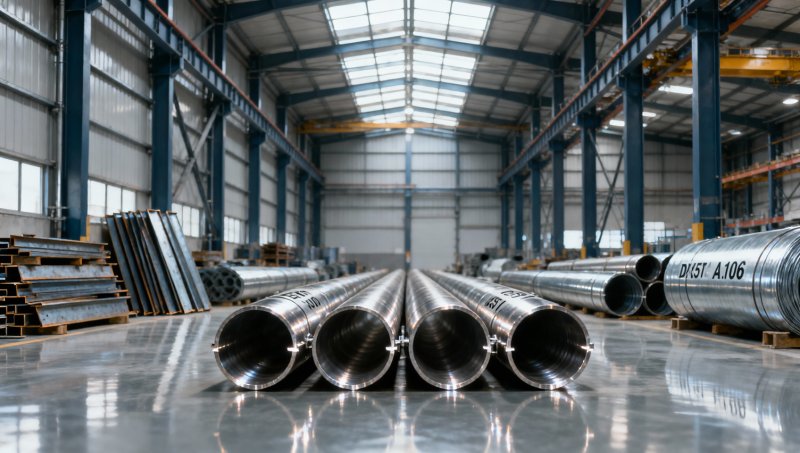
Compliance isn’t paperwork — it’s engineered assurance. Carbon steel pipe used in oil & gas transmission must meet exacting requirements: tensile strength ≥ 415 MPa (ASTM A106 Gr. B), hydrostatic test pressure ≥ 1.5× design pressure, and coating adhesion per ISO 2063. But certification gaps appear where stockists outsource inspection or accept third-party MTRs without cross-verifying furnace numbers against physical coils.
Hongteng Fengda performs 100% in-house mechanical testing (tensile, bend, impact) per EN 10204 3.2 and issues mill-certified reports tied to batch ID, rolling date, and heat number — traceable down to individual pipe lengths. Every shipment includes digital MTR access via secure portal, enabling instant verification against project QA checklists.
For applications demanding extended service life — especially in coastal or industrial zones — pairing carbon steel pipe with high-performance ancillaries is critical. That’s why our integrated offering includes DX51D Galvalume Steel Coil , which delivers aluminum-zinc alloy coating (AZ40–AZ150) with proven resistance to chloride-induced pitting — a key factor when fabricating pipe supports, ductwork, or insulated jacketing exposed to aggressive atmospheres.
International Standards Alignment: What You Actually Need to Verify
- ASTM A106/A53: Mandatory for pressure service; confirm Grade B/C and NDE (UT/ET) certification level
- EN 10216-2: Required for EU projects; verify PSL1 vs PSL2 compliance (impact testing at -20°C)
- GB/T 8163: Chinese standard accepted in ASEAN; ensure seamless vs welded distinction matches design intent
- JIS G3454: Critical for Japanese EPC contractors; check yield ratio ≤ 0.85 and hardness limits
Procurement Decision Matrix: 5 Non-Negotiable Evaluation Criteria
Procurement teams face conflicting priorities: lowest landed cost vs longest-term reliability, speed vs compliance depth, OEM flexibility vs standardization. The following evaluation matrix helps prioritize objectively — tested across 127 pipeline tenders reviewed in 2023–2024.
This structured approach prevents “lowest bid wins” outcomes that later incur rework costs averaging 18–23% of initial pipe spend. It also surfaces hidden capabilities — such as Hongteng Fengda’s ability to co-supply DX51D Galvalume Steel Coil for corrosion-resistant auxiliary components, eliminating multi-vendor coordination and reducing total bill-of-materials (BOM) management time by ~30%.
Why Long-Term Partnership Beats Transactional Sourcing
Pipeline projects don’t end at commissioning — they extend into 20+ years of operation, maintenance, and potential expansion. A transactional stockist may fulfill one order but lack capacity to support Phase II spares, retrofit upgrades, or emergency replacements under identical spec. Hongteng Fengda retains master heat logs for 10 years and stores reference samples for all pipe grades produced — enabling exact-match replication for legacy systems.
Our engineering support team collaborates directly with EPCs and owner operators on joint specification development — including custom tolerances for directional drilling sections, enhanced coating thickness for buried segments, or dual-certified pipe (ASTM + EN) for cross-border projects. This reduces approval cycles by up to 60% versus standard off-the-shelf procurement.
Financial stakeholders benefit too: fixed-price framework agreements with volume-based escalation caps (max +2.5%/year) protect against raw material volatility, while consolidated logistics (FCL consolidation across multiple SKUs) cut inland freight cost per ton by 12–18%.
Next Steps: How to Initiate a Technical & Commercial Review
If your current pipeline project faces tight deadlines, complex spec alignment, or multi-country compliance needs, we recommend starting with three actionable steps:
- Share your latest pipe specification sheet (including coating, testing, and packaging requirements) for free technical feasibility review
- Request a comparative quote covering standard sizes, custom processing, and bundled structural components (e.g., angle steel + pipe + DX51D coil)
- Schedule a virtual factory audit — including live QA lab demonstration and ERP-based inventory visibility walkthrough
We respond to technical inquiries within 4 business hours and provide formal quotations with full compliance documentation within 2 working days. Let’s align your carbon steel pipe supply chain with the reliability your pipeline deserves.
Please give us a message


Please enter what you want to find