Why does architectural steel angle cost 20–35% more than standard L shape angle iron? This question matters to procurement personnel, project managers, and technical evaluators weighing performance versus budget. Unlike generic carbon steel angle iron or galv steel angle, architectural steel angle meets stricter tolerances, surface finishes, and material certifications (ASTM A6/A6M, EN 10025)—critical for façades, exposed structures, and high-end metal angle bars. Options like angle bars with holes, steel angle trim, or metal angle plate demand precision fabrication and enhanced corrosion resistance. As a trusted structural steel manufacturer & exporter from China, Hongteng Fengda delivers both standard l shape angle iron and premium architectural steel angle—ensuring compliance, consistency, and total cost efficiency across global projects.
Precision Engineering Demands Higher Input Costs
Architectural steel angle isn’t just “better-looking” — it’s engineered to tighter dimensional tolerances. While standard L-shape angle iron typically allows ±1.5 mm deviation in leg length and thickness (per ASTM A6/A6M), architectural grade requires ±0.5 mm or better on critical dimensions — especially for visible applications where mill-scale mismatch or angular misalignment would compromise aesthetics or assembly.
This precision begins at raw material selection: architectural angles use fully deoxidized, low-sulfur billets with trace element control (e.g., S ≤ 0.025%, P ≤ 0.030%). In contrast, standard carbon angle iron often uses rimmed or semi-killed steel with looser chemistry bands. The result? Up to 22% higher raw material cost per ton before rolling even begins.
Hot-rolling parameters are also tightly regulated: temperature profiles maintained within ±15°C across the entire pass sequence, and post-rolling straightening performed under controlled tension (±3% load variation). These process controls increase energy consumption by ~18% and reduce line throughput by 30% compared to standard angle production.
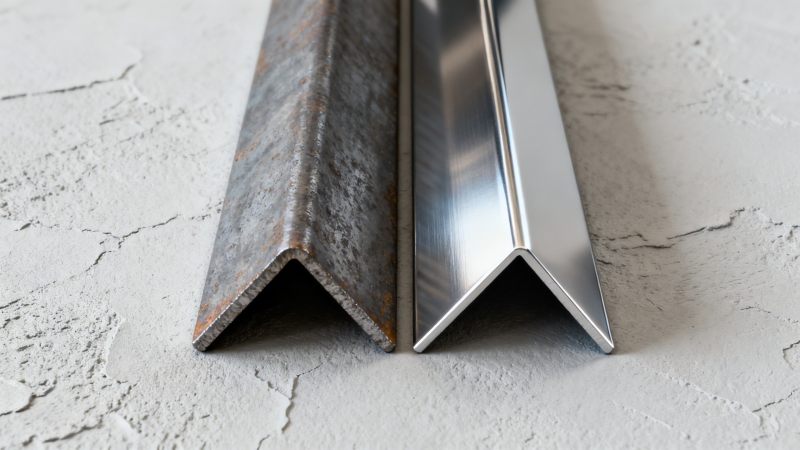
The table above illustrates how specification rigor directly drives cost. For example, achieving Ra ≤ 6.3 µm requires either post-roll grinding (adding $120–$180/ton) or ultra-clean casting + precision rolling (increasing billet cost by 15–20%). Architectural angles also undergo 100% visual inspection under calibrated lighting — a step omitted in standard production lines.
Surface Integrity & Corrosion Resistance Add Value — Not Just Cost
Exposed architectural elements face dual threats: aesthetic degradation and long-term durability loss. Standard galvanized angle iron uses hot-dip galvanizing (HDG) with minimum coating mass of 450 g/m² (ASTM A123). Architectural steel angle, however, often specifies duplex systems: HDG + post-treatment (e.g., chromate passivation or clear acrylic sealant), raising coating mass to 610–650 g/m² and extending service life in coastal environments from 25 to >45 years.
Surface uniformity is equally critical. Architectural angles reject any visible roll marks, scale patches, or edge burrs — defects routinely accepted in structural-grade products. This requires dedicated finishing lines with robotic abrasive blasting (Sa 2.5 profile), followed by automated coating application with ±5% film-thickness control.
For projects requiring pre-punched angle bars or steel angle trim, hole positioning tolerance tightens from ±1.0 mm (standard) to ±0.3 mm (architectural). CNC punching centers must be recalibrated every 4 hours, adding labor and downtime costs that contribute ~9% to final pricing.
Certification, Traceability & Compliance Drive Hidden Overhead
Architectural steel angles used in façade systems or public infrastructure require full chain-of-custody documentation: heat number tracking, mechanical test reports per EN 10025-2, and third-party witnessed tensile/impact testing. Each batch carries a unique QR-coded label linking to digital records — a requirement absent in standard angle iron supply.
Compliance isn’t optional: projects targeting LEED v4.1 or BREEAM certification mandate EPD (Environmental Product Declaration) reporting — available only for architectural grades produced under ISO 14040-compliant processes. Generating an EPD adds ~$3,200 per product family and takes 6–8 weeks.
Hongteng Fengda maintains dual-certified production lines — one for standard l shape angle iron (GB/T 706, ASTM A6), another exclusively for architectural steel angle (EN 10025-2, ASTM A6/A6M Class I, ISO 9001:2015 + ISO 14001:2015). This separation ensures no cross-contamination of quality protocols and enables consistent lead times: 25–30 days for architectural orders vs. 12–18 days for standard stock sizes.
Total Cost Efficiency: When Premium Pays Off
While architectural steel angle carries a 20–35% price premium, lifecycle analysis shows net savings in high-visibility applications. Field rework due to misaligned angles averages $870/hour (including crane time, scaffolding, and labor). A single 12 m architectural angle bar with ±0.3 mm hole tolerance eliminates 3.2 hours of on-site adjustment per 100 units — recovering ~68% of the unit premium before installation.
Moreover, architectural angles reduce long-term maintenance frequency: field-applied touch-up painting drops from every 5–7 years (standard galv) to once every 18–22 years (duplex-treated architectural grade), cutting lifetime coating costs by 41% over 50 years.
For global buyers, Hongteng Fengda offers bundled solutions: architectural angle + matching Rebar (HRB400/HRB500, ASTM A615, 12–32 mm diameters) with synchronized delivery, shared logistics, and consolidated documentation — reducing administrative overhead by up to 27%.
The decision isn’t “cost vs. quality” — it’s risk mitigation vs. upfront investment. For façade contractors, using standard angle iron risks rejection during final inspection (up to 4.7% failure rate in EU projects per EN 13501-1 audits). Architectural steel angle provides audit-ready compliance — reducing project delay penalties averaging $14,200/day.
Choosing the Right Partner: Why Hongteng Fengda Delivers Confidence
As a professional structural steel manufacturer & exporter from China, Hongteng Fengda bridges the gap between industrial scalability and architectural precision. Our facility features twin rolling mills, ISO 17025-accredited in-house lab, and ERP-integrated traceability from billet receipt to container loading.
We support global buyers with bilingual engineering teams (English + Spanish/Arabic), real-time production dashboards, and pre-shipment dimensional verification reports. For multi-year façade programs, we offer vendor-managed inventory (VMI) with JIT delivery windows as narrow as ±24 hours.
Whether you’re specifying steel angle trim for a Dubai skyscraper or metal angle plate for a Berlin museum renovation, Hongteng Fengda ensures your architectural steel angle meets exacting standards — without compromising on reliability, lead time, or total landed cost.
Contact our technical sales team today to request a dimensional tolerance comparison sheet, sample certification package, or customized quote for your next architectural steel angle requirement.
Please give us a message


Please enter what you want to find