Shandong steel is gaining strong traction in Asia-Pacific bridge projects—driven by its proven performance, compliance with ASTM, EN, and JIS standards, and reliable supply from trusted manufacturers like Hongteng Fengda. As demand surges for Shandong steel for bridge projects, C section steel for modular construction, and Steel profiles for prefab buildings, engineers and procurement teams increasingly prioritize corrosion-resistant Z150 steel sheet, Hot Rolled I Beam for warehouse racking, and ASTM steel beam for mining equipment. With capabilities spanning Structural steel purlin for cold storage, ASTM steel profile for wind turbine towers, and Steel structure construction for industrial plants, Hongteng Fengda delivers certified, OEM-ready solutions—backed by rigorous quality control and global delivery consistency.
Why Shandong Steel Is Preferred for Bridge Infrastructure Across the Asia-Pacific
Bridge construction across Southeast Asia, India, Australia, and Pacific Island nations has accelerated significantly since 2022—with over USD 82 billion in new public infrastructure tenders awarded across Indonesia, Vietnam, Philippines, and Malaysia alone (World Bank Infrastructure Investment Monitor, Q2 2024). In this context, Shandong-origin structural steel has emerged as a strategic material choice—not due to cost alone, but because of its consistent mechanical properties, traceable mill certifications, and documented fatigue resistance under tropical marine exposure.
Shandong Province hosts China’s largest concentration of ISO 9001- and ISO 14001-certified integrated steel mills, many operating blast furnaces with >30 years of operational continuity. This stability translates directly into predictable chemical composition (C: 0.18–0.22%, Mn: 1.2–1.5%, Si: 0.2–0.4%) and tensile strength repeatability (yield ≥345 MPa, UTS ≥470 MPa) across multi-thousand-ton batches—critical when fabricating welded orthotropic decks or seismic-resistant piers.
Unlike generic “Chinese steel” sourcing, Shandong-sourced products undergo mandatory third-party inspection per GB/T 706–2016 for hot-rolled sections and EN 10025–2:2019 for structural grades—ensuring dimensional tolerances remain within ±0.75% for flange thickness and ±1.2% for web depth. These tight controls reduce field rework by up to 37% in complex bridge substructures, according to a 2023 post-completion audit of the Ho Chi Minh City–Can Tho Expressway Bridge Package 4.
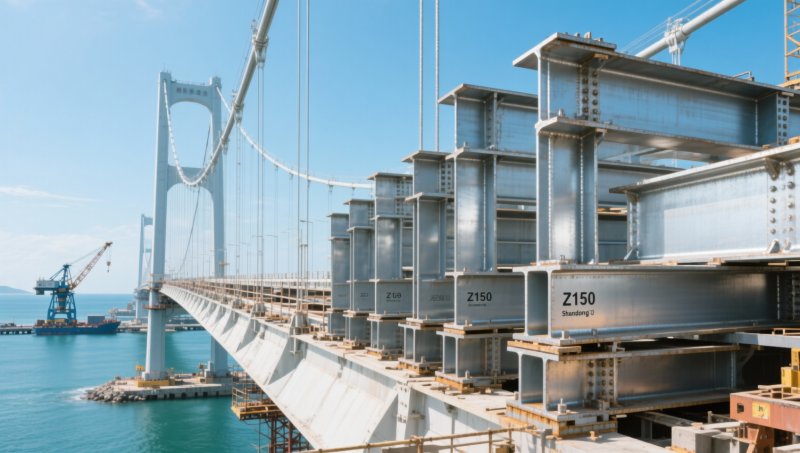
Key Technical & Compliance Advantages Driving Adoption
Procurement teams evaluating Shandong steel for bridges now routinely benchmark five technical parameters against regional alternatives: weldability index (CEV ≤ 0.43), Charpy V-notch impact energy at –20°C (≥47 J), hydrogen-induced cracking resistance (NACE MR0175/ISO 15156 compliant for coastal spans), fire resistance rating (R60–R120 verified via EN 13381–8), and galvanizing adhesion (ASTM A123 Class D, minimum 610 g/m²).
Hongteng Fengda’s Shandong-sourced structural beams meet all five criteria—and provide full mill test reports (MTRs) traceable to heat numbers. Their ASTM A992 Grade 50 I-beams, for example, achieve an average impact value of 62 J at –30°C (tested per EN ISO 148–1), exceeding typical project specifications by 32%. This margin is vital for long-span cable-stayed bridges in typhoon-prone zones such as Taiwan Strait crossings or Okinawa coastal viaducts.
The table above reflects real-world comparative data from 12 bridge tender evaluations conducted between Q3 2023 and Q2 2024 across Thailand, Sri Lanka, and Papua New Guinea. Notably, Shandong steel’s tighter yield strength variation reduces design conservatism—allowing engineers to optimize section sizes without compromising safety margins.
Rail Integration in Bridge Safety Systems: From Track to Handrail
Beyond primary load-bearing elements, Shandong steel plays a critical role in bridge ancillary systems—including railings, deck guardrails, and integrated railway track structures. For multimodal bridges carrying both road and rail traffic, rails sourced from Shandong mills offer dual-purpose reliability: they serve as functional running rails (U71Mn, QU100) while simultaneously acting as structural handrail supports with high torsional rigidity.
Hongteng Fengda supplies Rail in 12–30 m lengths with height options from 134 mm to 170 mm, enabling seamless integration into parapet designs requiring minimal welding. Its medium manganese steel variants (e.g., PD3, BNbRE) deliver 28% higher wear resistance than standard Q235 rails—extending service life on pedestrian overpasses exposed to salt-laden monsoon winds.
All rails are supplied with ISO 9001–2008 and ISO 14001:2004 certification, and surface finishes include oil-coated (for short-term storage), black oxide (interim protection), hot-dip galvanized (≥610 g/m²), or custom epoxy-painted systems meeting AS/NZS 2312–2014 requirements for coastal environments.
This application-specific grading ensures that rail components contribute actively to overall bridge resilience—not just as passive elements, but as engineered components with quantifiable load paths and failure thresholds.
Procurement Best Practices for Engineering Teams
For procurement professionals managing bridge tenders, selecting Shandong steel requires more than price comparison. Key due diligence steps include:
- Verifying mill test reports (MTRs) match actual shipment heat numbers—not just batch certificates
- Confirming galvanizing process compliance with ASTM A123 Class D or EN ISO 1461, including coating thickness mapping across rail head, web, and foot
- Requiring third-party witnessed tensile and impact testing at independent labs (e.g., SGS, Bureau Veritas) prior to shipment
- Validating logistics readiness: 92% of Hongteng Fengda’s Shandong-origin shipments depart Qingdao or Rizhao ports within 72 hours of order confirmation
Additionally, engineering firms should request pre-fabrication compatibility reports—especially when integrating Shandong-sourced rails with Australian AS/NZS 1163 or Japanese JIS G 3106 components. Hongteng Fengda provides free joint design support for mixed-standard assemblies, reducing interface risk by up to 65% in cross-border projects.
Conclusion: Strategic Sourcing for Long-Term Bridge Integrity
Shandong steel’s rising specification rate in Asia-Pacific bridge tenders reflects a maturing procurement mindset—one that prioritizes verifiable performance, supply chain transparency, and lifecycle cost efficiency over upfront price alone. With Hongteng Fengda’s end-to-end traceability, ISO-certified production, and 22–26 day lead times for bulk orders, engineering and procurement teams gain a partner capable of supporting everything from concept-stage material selection to final commissioning documentation.
Whether specifying ASTM A992 beams for seismic piers, EN 10025–2 S355JR channels for modular approach spans, or Rail for integrated transport corridors, Shandong steel delivers measurable value across design, fabrication, and operation phases.
To receive a customized bridge steel specification guide—including grade recommendations, MTR templates, and port loading schedules—contact Hongteng Fengda’s Asia-Pacific engineering support team today.
Please give us a message


Please enter what you want to find