The quoted ss steel plate price is rarely a simple reflection of the nickel market, a mill’s list price, or a supplier’s stated price per tonne. Two quotations that appear to cover the same plate can differ substantially because they are based on different grades, melt sources, document packages, dimensions, finishing routes, shipment terms, and delivery commitments. A lower figure may represent a genuinely efficient supply route, but it may also exclude requirements that later become mandatory for fabrication, customs clearance, inspection, or end-use compliance.
The practical comparison is therefore not “Which supplier offers the lowest plate price?” It is “Which quotation provides the specified material, evidence, logistics position, and delivery certainty at the lowest comparable landed cost?” This distinction matters particularly where stainless plate is being evaluated for pressure equipment, food-processing components, architectural cladding, chemical handling, marine environments, or fabricated assemblies with defined material traceability requirements.
Grade is the largest technical source of price variation
“Stainless steel plate” is a product category, not a single commodity. The chemical composition and corrosion-performance requirements behind the grade establish a major part of the price floor.
Common austenitic grades such as 304 and 304L are widely specified because they offer a practical balance of corrosion resistance, formability, weldability, and availability. Their cost is strongly influenced by alloy inputs, particularly nickel and chromium. Grade 316 and 316L contain molybdenum, which improves resistance to chloride-containing environments and certain chemical exposures. That additional alloy content normally places 316/316L at a premium to 304/304L, even when plate thickness and surface finish are identical.
The difference is not merely a commercial label. Substituting 304 for 316 in a chloride-rich setting can create a lifecycle risk that is far greater than the initial material saving. Conversely, specifying 316 where 304 is adequate can raise project cost without delivering proportionate value. Price evaluation should begin with the exposure conditions, fabrication requirements, relevant project specification, and required service life—not with the grade that happens to have the lowest current quotation.
Other stainless families create further variation:
- Ferritic grades generally use little or no nickel and may be economically attractive for applications with moderate corrosion requirements. Their forming and welding behavior must still be assessed for the intended use.
- Martensitic grades are selected where hardness or wear resistance is important, rather than for general corrosion resistance alone.
- Duplex stainless steels combine austenitic and ferritic structures and are often considered for higher strength and demanding corrosion environments. Their alloy design, processing control, and more limited supply base can affect both plate price and lead time.
- Heat-resistant or high-alloy grades may be priced less like general stainless plate and more like engineered material, particularly where low-volume rolling, special testing, or non-standard dimensions are involved.
Grade naming also deserves close attention. A quotation referring only to “304 equivalent,” “316 quality,” or a local grade designation may not demonstrate compliance with the exact ASTM, EN, JIS, or GB grade required by the purchase specification. Equivalent designations can be useful, but composition limits, mechanical property requirements, delivery condition, and test-document expectations must be aligned before the prices are treated as comparable.
Origin affects more than the mill gate price
Material origin is often discussed as a pricing issue, but it is equally a risk and compliance issue. Stainless steel plate may be quoted from integrated mills, rerolling producers, service centers, stockholders, or traders. Those supply channels can offer different advantages, yet they do not provide the same level of control over origin, traceability, rolling route, or production scheduling.
A mill-origin offer may carry a different base price from an offer based on existing warehouse stock. Stock can shorten delivery time and avoid a minimum rolling quantity, but it may be limited to available dimensions, heat numbers, finishes, or document formats. A mill order can better match a project’s exact thickness, width, length, and certification requirements, while introducing production-slot dependence and a longer planning horizon.
Country of origin can also influence the economic result through import duties, trade-remedy measures, customs documentation, rules of origin, port costs, and local customer approval rules. These factors are destination-specific. A quotation that is attractive on an FOB basis can lose its advantage after freight, insurance, import charges, inland transport, inspection, and financing costs are included.
For this reason, a commercial assessment should distinguish clearly between:
- the stated steel price;
- the manufacturing or warehouse origin;
- the shipping origin;
- the declared customs origin;
- the delivery term under the agreed Incoterms rule; and
- the costs and responsibilities excluded from the quotation.
These details are especially important when a buyer has approved-source requirements or when an end customer needs documentation linking the supplied plates to identifiable heats and mills. Origin declared on an invoice is not the same thing as a complete material-traceability package.
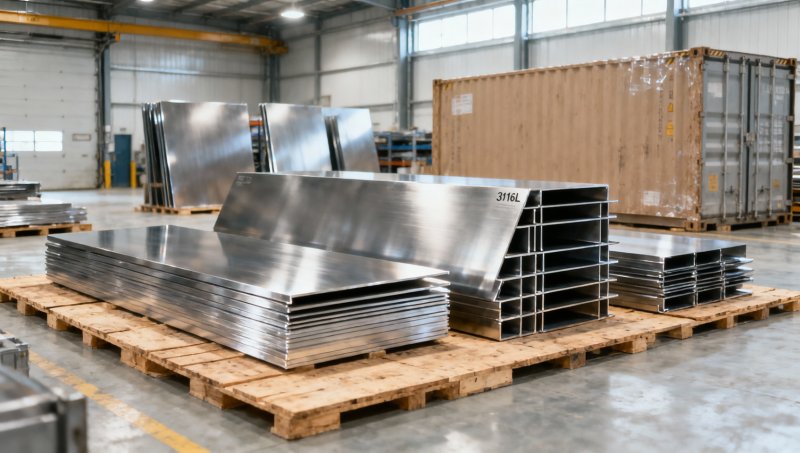
Plate dimensions and finishing routes can change the economics unexpectedly
Plate price is commonly communicated per tonne, which is useful for a first comparison but insufficient for a purchasing decision. A plate ordered in a non-standard thickness, extra-wide width, unusual length, tight flatness requirement, or low individual piece weight may require different production planning, trimming, leveling, cutting, or handling. The premium may appear as a higher unit price, a minimum-order condition, a cutting charge, increased scrap allowance, or a longer lead time.
Thickness is particularly important. Thin stainless material may be supplied as sheet or coil-derived cut lengths rather than true heavy plate, depending on the producer’s terminology and capability. Thick plate involves different rolling and heat-treatment considerations. A quotation should identify nominal thickness, permitted tolerance standard, width and length tolerances, edge condition, flatness requirement, and whether the material is supplied in as-rolled, annealed and pickled, polished, or another specified condition.
Surface finish is not cosmetic in many applications. No. 1 finish, 2B finish, BA finish, brushed finishes, and polished finishes involve different processing routes and acceptance expectations. Where plate will be exposed architecturally, used for food-contact equipment, or fabricated into visible enclosures, surface defects, protective film requirements, coil-break marks, scratch limits, and weld discoloration after fabrication may become commercial acceptance issues. A lower quotation with an undefined finish can become costly if the finished part requires re-polishing or is rejected for appearance.
Yield should be evaluated alongside the per-tonne figure. If a standard plate format produces excessive offcut, a seemingly lower price can result in a higher cost per usable component. Nested cutting plans, fabrication layout, and available plate sizes can therefore be more relevant than a small difference in nominal steel price.
Certification is a purchasable deliverable, not a paperwork afterthought
Certification requirements frequently explain why two technically similar offers are not priced alike. A basic commercial certificate may be adequate for general fabrication, while a controlled project may require inspection certificates under EN 10204, complete chemical and mechanical test results, heat-number traceability, ultrasonic testing, positive material identification, third-party inspection, or customer-specific marking and release procedures.
EN 10204 3.1 documentation, for example, is commonly requested where material properties must be traceable to the manufacturer’s test results. It should not be assumed that every certificate labeled “MTC” or “mill certificate” carries the same evidential status. The buyer should define who issues the certificate, whether the data relates to the supplied heat, what standard governs testing, and how plate markings connect the physical goods to the documents.
The financial impact is not limited to the certificate fee. Enhanced documentation can require segregated stock, additional inspection coordination, retained traceability through cutting, and more controlled packing. If an independent inspection agency is required, costs may include attendance, testing, reporting, scheduling delays, and reinspection risk where material identification is incomplete.
The same logic applies across fabricated steel purchasing. A supplier offering carbon-steel structural components, such as an Angle Steel Supplier, may quote standard grades under ASTM, EN, JIS, DIN, or GB references, but the commercial comparison still depends on whether dimensions, heat documentation, coating condition, tolerance requirements, and delivery evidence match the project requirement. Material category changes; the discipline of comparing like with like does not.
Order volume changes both bargaining power and supply feasibility
Large-volume orders can reduce certain costs because production, packing, inspection, and freight can be spread over more tonnes. That does not mean every high-volume order will receive the same discount. The practical value of volume depends on whether the order matches a mill’s preferred rolling program, standard slab route, stock dimensions, and export packaging process.
A mixed order of several grades, thicknesses, and small cut lengths may consume more administrative and handling effort than a single-grade full-plate order of equal total tonnage. Similarly, an order below a producer’s economic minimum may be priced from stock rather than mill production, or it may attract a small-lot surcharge. Evaluators should not judge an offer solely by total tonnes when the order contains a complex product mix.
Price validity is another issue. Stainless inputs can move while a project is still finalizing drawings, approvals, and shipping instructions. A quotation may be fixed for a defined period, subject to raw-material adjustment, or valid only against immediate order confirmation. Commercial review should identify the price basis and the point at which the supplier is contractually committed. A low indicative quote with no clear validity or adjustment mechanism is not necessarily a low procurement cost.
Delivery requirements can outweigh a modest difference in steel price
Delivery conditions are often the hidden separator between quotations. The gap between EXW, FCA, FOB, CFR, CIF, DAP, and DDP is not simply a freight calculation; each term allocates transport tasks, export procedures, insurance responsibilities, and risk transfer differently. The applicable Incoterms rule should always be stated with the named place or port and the relevant edition agreed by the parties.
For stainless plate, packaging requirements matter because surface damage, moisture exposure, edge damage, and plate movement during transit can compromise acceptance. Export seaworthy packing, protective film, wooden supports where permitted, corrosion-prevention measures, bundle marking, and container loading plans can all affect the delivered condition and cost. A plate that arrives with significant scratching or mixed heat identification may create disruption well beyond the value of a freight saving.
Delivery timing should be evaluated as a range of dependencies rather than a single promised date. Production lead time, testing release, inspection availability, export documentation, port congestion, vessel schedule, transshipment risk, and destination clearance each sit outside the simple phrase “delivery in X days.” When plates are needed for a fabrication sequence, the cost of delay may be tied to labor, equipment, site access, or contractual milestones. In that setting, the most economical offer is often the one with a credible delivery path and transparent exceptions, rather than the shortest unqualified lead-time statement.
How to make quotations comparable
A reliable comparison starts by converting each offer into the same commercial and technical basis. The comparison sheet should capture the exact grade and governing standard; plate dimensions and tolerances; finish and edge condition; quantity by item; manufacturing origin; mill or stock source; certificate level; inspection scope; packaging; Incoterms rule and named location; lead-time definition; payment terms; quote validity; and exclusions.
It is useful to separate the result into three values: material price, delivered logistics cost, and risk-adjusted cost. The last category does not require speculative financial modeling. It means identifying foreseeable exposures: uncertain origin, missing certification, unpriced inspection, ambiguous tolerance, unconfirmed production allocation, or delivery terms that leave a critical responsibility unassigned.
The central market trend is not that one universal stainless plate price is becoming more important. It is the opposite: price transparency increasingly depends on specification transparency. As supply chains involve more cross-border compliance checks, differing origin routes, and project-specific documentation, an apparently simple per-tonne comparison reveals less than it once did. The strongest commercial decision is built on a quotation that is complete enough to be tested—not merely low enough to attract attention.
Please give us a message


Please enter what you want to find