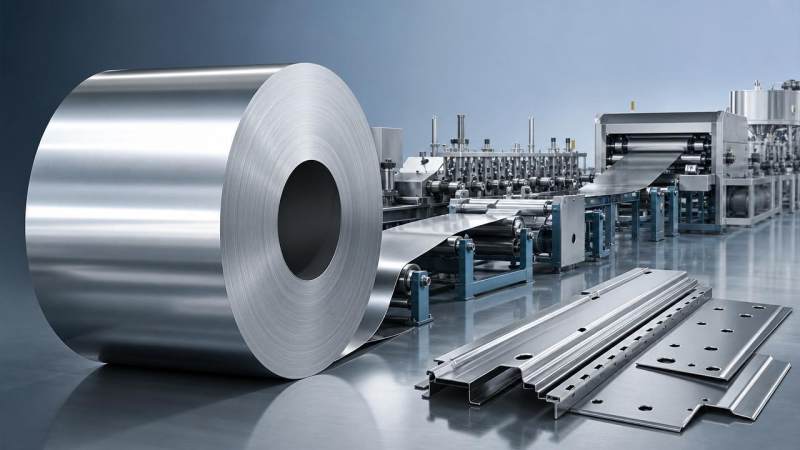
For many industrial buyers, ss coil 304 remains the practical standard when balancing corrosion resistance, formability, cost control, and supply reliability. From processing equipment to structural applications, its consistent performance helps plants reduce maintenance risks and keep production stable. Understanding why this grade still leads the market can support smarter sourcing and longer-term operational value.
Why does ss coil 304 remain the safe default for so many plants?
The core search intent behind this topic is practical, not academic. Buyers want to know why 304 still wins in real purchasing decisions.
They are usually comparing materials, controlling project risk, or reviewing whether a lower-cost or higher-grade alternative makes better business sense.
For enterprise decision-makers, the answer is straightforward. SS coil 304 remains the default because it offers the most balanced mix of corrosion resistance, forming performance, availability, and cost.
It is not always the cheapest grade, and it is not the most corrosion-resistant option. But in many plant environments, it is the lowest-risk commercial choice.
That matters because most industrial procurement decisions are not made around a single technical property. They are made around lifecycle reliability and supply confidence.
When a material performs consistently across fabrication, installation, maintenance, and replacement cycles, it becomes the standard buyers return to again and again.
What are plant buyers actually trying to avoid when they choose 304?
Most industrial buyers are not simply looking for “good stainless steel.” They are trying to avoid expensive operational problems that start with wrong material selection.
These problems include early corrosion, welding failures, poor forming results, unstable lead times, inconsistent surface finish, and hidden replacement costs after commissioning.
In many plants, downtime costs far more than the price difference between two stainless grades. That changes how buyers evaluate material value.
If a cheaper alternative causes rework, maintenance intervention, or sanitation problems, the initial savings disappear quickly. Decision-makers know this from experience.
That is why ss coil 304 remains trusted. It reduces uncertainty across multiple stages, from sourcing and fabrication to operation and maintenance.
For global buyers, another key concern is standardization. 304 is widely recognized under ASTM, EN, JIS, and other systems, making cross-border procurement easier.
This broad acceptance simplifies communication between engineering teams, contractors, fabricators, and quality control departments in different regions.
Where does 304 perform well enough to justify its market position?
SS coil 304 performs reliably in a wide range of mild to moderately corrosive industrial environments. That is one reason it remains so widely specified.
It is commonly used for food processing equipment, tanks, ducting, kitchen systems, architectural trims, enclosures, machine covers, and light structural components.
In these applications, buyers usually need a material that can resist moisture, many cleaning chemicals, and ordinary atmospheric exposure without demanding premium-grade cost.
304 delivers that baseline extremely well. Its chromium and nickel composition provides stable corrosion resistance for many indoor and sheltered industrial uses.
It also performs well where appearance matters. For visible surfaces, decorative metalwork, and exposed equipment panels, 304 offers a clean and professional finish.
In fabrication environments, its formability is another major advantage. It can be rolled, bent, stamped, and shaped with good consistency under normal processing conditions.
This makes it attractive for manufacturers that want one stainless grade suitable for multiple product lines rather than managing complex multi-grade inventory.
Why do cost-conscious buyers still choose 304 instead of lower-priced alternatives?
At first glance, some lower-cost materials may look attractive. Carbon steel, coated steel, or lower-grade stainless may offer a cheaper purchase price per ton.
But enterprise buyers rarely evaluate material cost in isolation. They assess installation efficiency, expected service life, maintenance frequency, and replacement exposure.
SS coil 304 often proves more economical over time because it lowers total ownership cost, especially in applications exposed to humidity, cleaning cycles, or visual wear.
Carbon steel may require painting, coating repair, or more frequent inspection. In demanding environments, those additional tasks increase labor and operational burden.
Lower stainless grades may also create quality inconsistency if they cannot maintain corrosion resistance or mechanical performance across the intended service conditions.
304 therefore occupies an important commercial middle ground. It avoids unnecessary over-specification while providing stronger reliability than many budget-driven substitutes.
For procurement managers, this balance is often the deciding factor. A material that protects operating continuity is usually worth more than its initial purchase discount.
When should buyers consider alternatives to ss coil 304?
Although 304 is the default choice in many plants, it is not the right answer for every environment. Good sourcing decisions depend on application-specific risk.
If the plant operates in chloride-heavy conditions, such as coastal facilities, marine settings, or aggressive chemical washdown areas, 316 may be more appropriate.
If the application emphasizes heat resistance, mechanical strength, or price sensitivity under less corrosive exposure, other stainless or coated steel solutions may fit better.
The key is not to assume that “default” means universal. It means broadly practical across many common industrial use cases.
Buyers should evaluate media exposure, temperature, cleaning chemistry, fabrication method, finish requirements, and expected maintenance interval before finalizing specifications.
This is where experienced suppliers add value. They help customers avoid both under-specification and over-specification, which can each create unnecessary cost.
For example, in building envelope and roofing applications, stainless may not always be the first material considered. Coated steel solutions can be highly practical.
In such cases, products like Color Coated Galvanized Steel Sheet PPGI may serve commercial, residential, agricultural, or public building projects efficiently.
With options including high corrosion resistant coatings, custom colors, and lightweight installation advantages, these materials solve different project priorities than stainless coil.
What makes 304 easier to source and manage across global supply chains?
One major reason ss coil 304 remains dominant is supply chain maturity. It is one of the most commonly produced and traded stainless grades worldwide.
That means buyers typically have more sourcing channels, more processing options, and more benchmark pricing data than they would for niche grades.
For international procurement teams, this reduces dependence on a narrow supplier base. Broader supply improves flexibility during price swings or logistics disruption.
Availability also matters for downstream planning. When a grade is easy to source in standard widths, thicknesses, and finishes, projects move faster.
Fabricators can schedule production more confidently, and inventory managers can maintain practical stock levels without excessive customization risk.
Standardization is equally important. 304 is familiar to engineering consultants, inspection teams, and end users, which reduces approval friction and technical confusion.
This market familiarity lowers transaction costs in a way many buyers underestimate. A common grade is easier to quote, compare, test, and replace.
How should decision-makers judge whether 304 offers real value for their plant?
For business leaders, the right question is not “Is 304 good?” The better question is “Does 304 reduce commercial and operational risk in this application?”
To answer that, evaluate five factors: service environment, fabrication needs, maintenance cost, expected lifespan, and replacement consequences if failure occurs.
If the environment is moderate, the fabrication demand is high, and failure would interrupt plant operations, 304 is often a strong business case.
Its value becomes even clearer when maintenance access is difficult or when appearance, hygiene, or product-contact standards matter to the operation.
Decision-makers should also review supplier capability. Material quality is not only about grade name but also about chemistry control, flatness, finish, and consistency.
A reliable manufacturing partner helps ensure that the purchased 304 coil performs as expected after slitting, forming, welding, and installation.
That is especially important for exporters serving global projects. Documentation, international standards compliance, and predictable lead times all affect procurement outcomes.
Companies such as Hongteng Fengda support buyers by combining stable production, quality control, and international supply experience across industrial steel applications.
What does the continued popularity of 304 tell us about industrial buying priorities?
The long-term success of ss coil 304 shows that industrial buyers prioritize proven performance more than theoretical optimization in everyday plant decisions.
Most operations do not need the most advanced alloy. They need a material that works consistently, is easy to process, and is available when schedules are tight.
304 answers that need better than many alternatives. It offers enough corrosion resistance for broad use, enough workability for efficient fabrication, and enough market depth for dependable sourcing.
That combination is difficult to replace. Even when alternatives look attractive in one category, they often lose balance across the full commercial picture.
This is why 304 remains the benchmark against which other materials are measured. It is the reference point for both technical comparison and purchasing strategy.
As plants continue to focus on uptime, compliance, and cost discipline, the demand for balanced materials will remain strong.
Conclusion: Why 304 remains the practical standard
For many plants, the case for ss coil 304 is not about tradition. It is about measurable operational logic.
304 remains the default because it combines corrosion resistance, formability, recognized standards, supply reliability, and lifecycle value in one commercially practical package.
It is not ideal for every environment, and careful application review still matters. But for a large share of industrial uses, it continues to be the smartest low-risk choice.
For enterprise buyers, that is the real takeaway. The best material is often not the cheapest or the highest grade, but the one that delivers dependable performance with manageable cost.
When sourcing decisions affect maintenance budgets, project timelines, and plant continuity, that balance is exactly why 304 still leads the market.
Please give us a message


Please enter what you want to find