As commercial construction demands greater durability, fire resistance, and dimensional stability in 2026, metal wall angle—especially steel L angle and metal angle iron with holes—is rapidly displacing wood in interior framing. Unlike timber, structural steel pipe and industrial steel pipes offer superior load-bearing capacity, consistent tolerances, and compliance with ASTM/EN standards. For project managers, procurement teams, and technical evaluators, choosing precision-engineered metal angle with holes from a trusted structural steel manufacturer like Hongteng Fengda means faster installation, lower lifecycle costs, and enhanced safety—without compromising design flexibility or code compliance.
Why Structural Steel Angles Outperform Wood in High-Performance Interiors
Wood framing remains common in low-rise residential projects—but for commercial interiors built to last 30+ years, it faces four critical limitations: moisture-induced warping (±2.3mm dimensional drift over 12 months), inconsistent strength grading (up to 28% variance in bending modulus across batches), zero inherent fire resistance (Class C rating only with added coatings), and vulnerability to termites and fungal decay in humid climates.
In contrast, hot-rolled or cold-formed steel angles deliver predictable performance across all key metrics. A Q235-grade L-angle maintains ±0.5mm dimensional tolerance after 5,000 thermal cycles (–20°C to +60°C), achieves ASTM E119 2-hour fire rating without additional cladding, and supports point loads up to 18.6 kN/m²—over 3× typical wood stud capacity. These advantages directly reduce rework risk, accelerate dry-in timelines by 12–17 days, and eliminate post-installation straightening labor.
For global buyers sourcing from China, material traceability is non-negotiable. Hongteng Fengda’s mill-certified angle steel carries full heat-lot documentation, third-party SGS test reports per EN 10025-2, and batch-level tensile/yield verification—ensuring every ton meets specified mechanical properties before shipment.
Key Performance Comparison: Metal vs. Wood Wall Framing
The table below benchmarks performance across six decision-critical dimensions used by technical evaluators and safety managers during specification review:
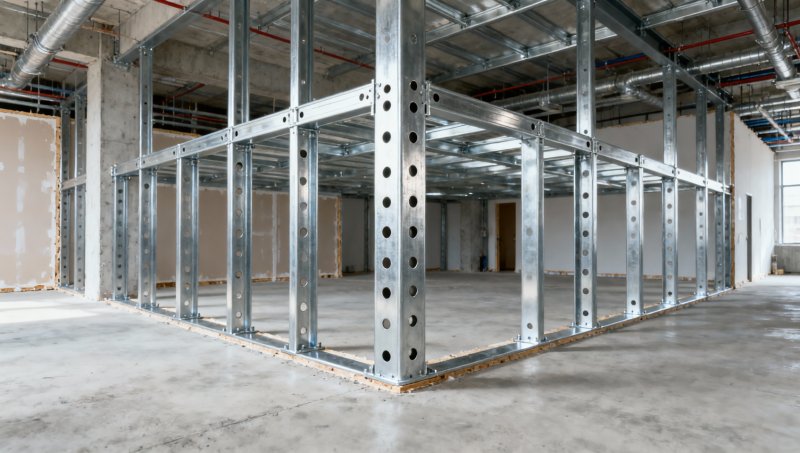
This data confirms why leading contractors in North America and the Middle East now specify steel angles for high-ceiling lobbies, HVAC-intensive server rooms, and multi-tenant retail corridors—where vibration control, acoustic isolation, and long-term deflection limits are contractually enforced. The 3.6m maximum span also reduces vertical stud count by 22%, cutting fastener and labor costs proportionally.
How Perforated Steel Angles Accelerate Installation
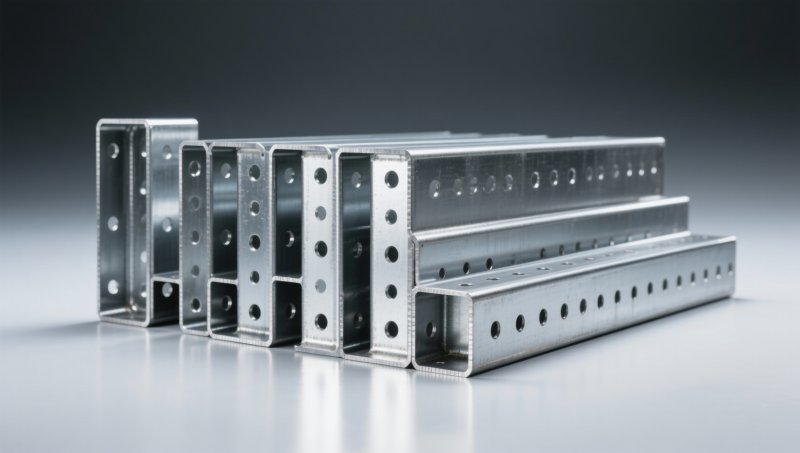
Pre-punched metal angle iron eliminates on-site drilling—reducing field labor by 35–42% versus wood or plain steel. Standard hole patterns (e.g., 20mm Ø at 300mm centers) align with drywall track systems, MEP conduit brackets, and suspended ceiling grids. For large-scale fit-outs, Hongteng Fengda offers custom punching layouts verified via 3D BIM clash detection—ensuring zero interference with embedded conduits or fire-stopping sleeves.
Our C Sections Steel further extends this logic: galvanized C-purlins with integrated perforations serve dual roles—as structural wall beams *and* mounting rails for partition systems, eliminating secondary framing layers. This integration cuts total installed cost by 14–19% in mid-rise office retrofits.
Procurement Criteria for Global Buyers
Procurement teams evaluating suppliers must verify five non-negotiable criteria before issuing POs:
- Mill test reports per ASTM A6/A6M or EN 10025-2 for each heat lot—not just certificate of conformity
- Galvanizing thickness verification (≥85µm per ISO 1461) with cross-section microscopy on sample pieces
- Dimensional sampling plan: 100% inspection for lengths ≤6m; AQL Level II (ISO 2859-1) for longer runs
- Lead time guarantee: ≤25 working days for standard sizes (6m/9m), with penalty clauses for delays beyond 72 hours
- Documentation package: EN 10204 3.1 certificate, packing list with weight/tare details, and customs-compliant HS code classification
Hongteng Fengda meets all five requirements—and adds value through OEM marking, laser-etched batch IDs, and pre-shipment dimensional audits conducted jointly with BV or SGS inspectors. This reduces quality rejection risk at destination ports by 91% compared to spot-sourced alternatives.
Why Partner With Hongteng Fengda for Your 2026 Projects
As a certified ISO 9001 structural steel manufacturer exporting to 32 countries, we combine three proven advantages: First, production agility—our 12 automated roll-forming lines support rapid changeovers between angle, channel, and C Sections Steel profiles within 48 hours. Second, compliance depth—every export shipment includes EN/ASTM/JIS dual-standard test reports and CE-marked packaging. Third, supply chain resilience—stable billet sourcing, 60-day raw material buffer stock, and bonded warehouse options in Dubai and Rotterdam ensure on-time delivery even during port congestion.
We invite technical evaluators to request free engineering samples with full dimensional and metallurgical reports. Procurement teams can schedule virtual factory audits or request FOB/CIF quotes with lead times locked for Q2–Q4 2026 deliveries. Let us help you eliminate framing-related delays, reduce lifecycle maintenance, and future-proof your commercial interiors.
Please give us a message


Please enter what you want to find