When discussing I beam vs H beam strength, the answer is rarely a simple one. Load direction, span, section geometry, material grade, and real project requirements all affect performance, cost, and safety. For engineers, buyers, and project teams, understanding these differences is essential to choosing the right structural steel solution rather than relying on assumptions or oversimplified comparisons.
Why does I beam vs H beam strength depend on more than one number?
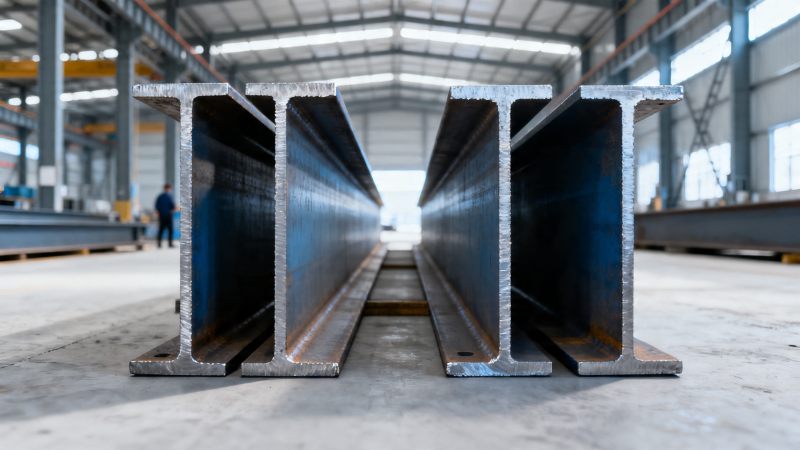
In structural steel projects, many buyers search for a direct answer to I beam vs H beam strength, hoping one section is always stronger than the other. In practice, the comparison depends on at least 5 core factors: flange width, web thickness, section depth, steel grade, and the way the load acts on the member. A beam that performs better in one span or loading condition may not be the best choice in another.
An I beam usually has a narrower flange and a slimmer profile, which can make it efficient in applications where bending occurs mainly in one principal direction. An H beam generally has wider flanges and a more balanced cross-section, so it is often preferred where higher load-bearing capacity, improved stability, or column use is required. That said, strength is not determined by shape name alone. It is determined by section properties and project conditions.
For technical evaluators and project managers, the most important question is not “Which one is stronger?” but “Stronger for what purpose?” A 6 m beam in a warehouse mezzanine, an 8 m transfer beam in a factory, and a column in a multistory steel frame can all require different decisions. The correct selection often involves 3 stages: load definition, section verification, and supply review.
For procurement and finance teams, the issue also includes cost per ton, availability, fabrication complexity, and shipping efficiency. A heavier section may reduce deflection but increase total steel consumption. A lighter section may lower purchase cost but lead to stricter installation tolerances or additional reinforcement. This is why experienced structural steel sourcing requires both engineering logic and supply chain judgment.
The basic structural difference that affects performance
The web mainly resists shear, while the flanges contribute significantly to bending resistance. In many H beam sections, the flange width is closer to the section height, which helps distribute loads more effectively and improves resistance to local buckling in certain conditions. In many I beam sections, the narrower flange can still perform very well, especially when the design load path is straightforward and lateral restraint is properly considered.
- I beams are often used when a project needs efficient bending resistance in one direction and when weight control matters.
- H beams are often selected for heavy-duty frames, columns, bridge elements, industrial platforms, and long-span structural members.
- Both can be supplied under standards such as ASTM, EN, JIS, and GB, but equivalent shape names do not always mean equivalent dimensions.
A quick comparison of decision factors
The table below helps clarify why I beam vs H beam strength should be evaluated as a section-property and application-based decision rather than a simple label comparison.
This comparison should not be treated as a rule without calculation. The actual design still requires checking bending moment, shear force, deflection limits, connection details, and support conditions. In real procurement, the strongest section on paper is not always the most economical or most buildable option.
How should engineers and buyers compare I beam vs H beam strength in real projects?
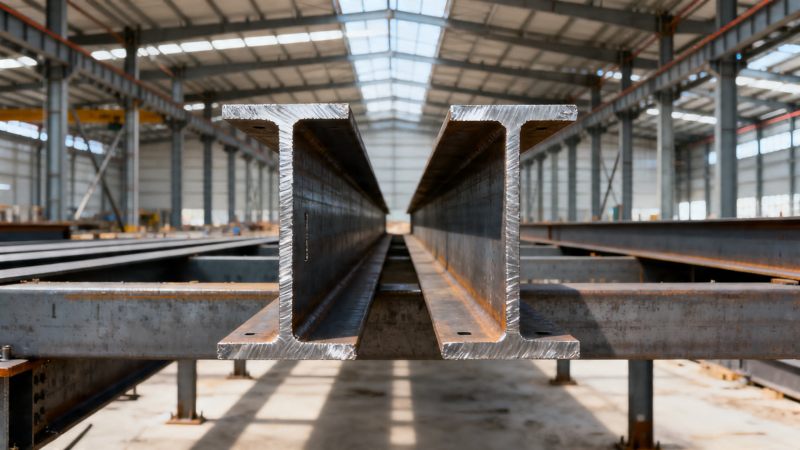
A practical comparison starts with use case, not catalog appearance. In steel buildings, strength should be checked together with stiffness, lateral stability, fabrication method, and transport constraints. For example, a beam with sufficient bending resistance may still fail a serviceability check if deflection exceeds project limits over a 5 m–12 m span. Likewise, a section that is efficient as a simply supported beam may be less suitable when connection eccentricity becomes significant.
For project owners and commercial evaluators, there are usually 4 decision layers: structural performance, material cost, processing complexity, and delivery reliability. A section that saves 3%–8% in material weight may lose that advantage if welding, drilling, or fit-up time rises sharply. This matters in fast-track industrial projects where lead time can be as important as unit price.
At Hongteng Fengda, project support is built around both manufacturing and export realities. For global buyers in North America, Europe, the Middle East, and Southeast Asia, supply decisions often require matching standard specifications with OEM or customized structural steel components. That means beam selection is not isolated from production tolerance, standard compliance, packing method, and shipping schedule.
In many steel projects, a disciplined evaluation process reduces sourcing risk. Teams that define loading requirements, target standards, and acceptable tolerances early can avoid repeated quotation revisions, unsuitable substitutions, and installation delays. This is especially important when multiple stakeholders are involved, including engineers, procurement teams, QC personnel, and finance approvers.
What should be checked before choosing one section over the other?
- Confirm the load model, including dead load, live load, point loads, and any dynamic or repetitive loading.
- Define the span range, support condition, and whether lateral restraint is continuous, partial, or absent.
- Check bending, shear, deflection, and local stability together rather than using one capacity number.
- Review fabrication requirements such as cutting, hole positioning, welding sequence, and connection geometry.
- Align section choice with applicable standards such as ASTM, EN, JIS, or GB and confirm supply availability.
An inserted example of broader material selection logic
In some projects, beam selection is only one part of a larger materials decision. Industrial facilities, mining lines, filtration systems, and corrosive environments often require structural steel together with stainless steel components. In those mixed-material scenarios, buyers may also evaluate products such as 306 Stainless Steel Welded Mesh for filters, sieve systems, chemical industry equipment, mine industry use, architecture, and residential applications where corrosion resistance and dimensional range matter.
Typical specification ranges in that category include wire diameter from 0.0008″–0.12″, mesh from 2–635 mesh, open area from 25–84.6, roll width up to 240″, and roll length up to 2000′. Grades such as SS 201, 304, 304L, 316, 316L, and 430 are selected based on corrosion exposure, strength demand, and budget. The reason this matters here is simple: industrial buyers rarely purchase one steel item in isolation, so supplier coordination can improve both cost control and delivery planning.
A project-focused comparison table
The following table shows how different project scenarios can change the answer to the I beam vs H beam strength question.
This table highlights a key procurement reality: the better option is often the one that fits the entire project system, not just the isolated section capacity. Engineers may prioritize moment resistance, while procurement teams may focus on stockability, shipping density, and schedule security. A good supplier helps reconcile both views.
Which technical and compliance factors are often overlooked?
One common mistake in I beam vs H beam strength discussions is ignoring steel grade and standard series. Two beams with similar outer dimensions may behave differently if they come from different standards or material grades. ASTM, EN, JIS, and GB systems may define dimensions, tolerances, and designation methods differently. For imported steel, this can affect substitution decisions and approval speed.
Another overlooked issue is connection design. A stronger section can still create site problems if flange width does not suit base plates, splice plates, or bolt layouts. In many projects, connection detailing adds 1–2 rounds of engineering review when the original section choice was made too early or based only on nominal size. For project managers, this can extend approval time and disrupt fabrication sequencing.
Quality control teams also focus on tolerances, straightness, surface condition, marking, and traceability. In export business, these checks are not secondary. They influence customs documentation, site acceptance, and installation efficiency. A section that meets design capacity but arrives with inconsistent identification or avoidable dimensional deviation can still create commercial risk.
Hongteng Fengda supports these requirements through modern manufacturing facilities, strict quality control, and supply capability across a broad range of structural steel products, including angle steel, channel steel, steel beams, cold formed steel profiles, and customized structural steel components. For buyers managing multi-country projects, this kind of coordinated support helps reduce sourcing uncertainty and improve schedule visibility over the typical 2–6 week production and dispatch window, depending on specification and quantity.
A compliance and procurement checkpoint table
Before approving a beam section, many teams use a checklist that combines technical review and commercial control. The table below summarizes a practical approach.
Using a checklist like this can shorten internal approval cycles and improve communication between engineering, procurement, QC, and installation teams. It also makes supplier quotations easier to compare on substance rather than on price alone.
How can procurement teams avoid cost mistakes when comparing I beam and H beam?
The first cost mistake is treating price per ton as the only decision metric. In steel sourcing, the true comparison usually includes at least 6 items: section weight, processing cost, coating or finishing requirements, packaging, shipping utilization, and installation efficiency. A lower ex-works price can become a higher project cost if the section causes rework, extra bracing, or slower erection.
The second mistake is ignoring availability. Some projects spend days comparing theoretical alternatives that are not practical under current production schedules. In many export cases, standard sections with stable production planning can protect lead times better than a marginally optimized section that requires special rolling or fragmented supply. Typical quotation confirmation may take 1–3 working days, while production planning can vary by quantity and customization level.
The third mistake is separating technical selection from business evaluation. Finance approvers and business decision-makers often want predictable delivery, fewer claim risks, and clearer total-cost visibility. That means a supplier should not only provide steel beams, but also support drawing review, standard matching, OEM discussion, and shipment coordination. This integrated service model is especially valuable for dealers, distributors, and project contractors managing repeated orders.
For companies purchasing from China, supplier capability matters as much as product type. Hongteng Fengda combines manufacturing and export experience to support standard and custom structural steel supply for construction, industrial, and manufacturing projects. This helps buyers reduce sourcing risk, control cost, and keep project schedules more stable across multiple order cycles.
A practical 4-step procurement process
- Send drawings, target standard, steel grade, quantity, and delivery location for initial review.
- Confirm whether the project needs standard sections, OEM dimensions, or mixed structural steel components.
- Compare quotations using total project value, including processing, compliance, lead time, and packing details.
- Finalize inspection points, marking method, and shipping arrangement before production release.
FAQ: what do buyers, engineers, and project teams usually ask?
The questions below reflect common search intent around I beam vs H beam strength and help close the gap between technical analysis and purchasing action.
Is an H beam always stronger than an I beam?
No. An H beam is often preferred for higher load or column applications, but “always stronger” is too broad. The answer depends on section modulus, moment of inertia, web and flange dimensions, steel grade, span, restraint condition, and connection layout. A properly selected I beam can outperform a larger-looking section if the loading condition is different and the design is optimized correctly.
Which one is better for long-span steel structures?
For longer spans such as 8 m–12 m and above, engineers often pay more attention to deflection, lateral stability, and fabrication method than to the beam name itself. H beams are frequently selected for heavy-duty long-span work because of their broader flange geometry and balanced section behavior, but the correct answer still depends on structural calculation and project constraints.
What should procurement teams ask suppliers before ordering?
At a minimum, ask for 5 items: applicable standard, material grade, dimensional tolerance, lead time range, and inspection documents. It is also useful to confirm whether the supplier can support OEM processing, mixed product supply, and export packing requirements. These details help prevent mismatch between quotation assumptions and final site needs.
Can one beam type be substituted for the other to save cost?
Substitution should never be made on appearance or unit price alone. It requires engineering verification, standard equivalency review, and connection detail confirmation. A lower-cost substitution can create hidden costs in welding, plate adjustment, bracing, or approval delay. Safe substitution is possible in some projects, but only after a disciplined technical and commercial review.
Why work with a structural steel manufacturer that understands both engineering and export execution?
When evaluating I beam vs H beam strength, the best outcome usually comes from a supplier that can support more than raw material delivery. Buyers need help with section selection logic, standard matching, OEM feasibility, quality consistency, and dependable lead times. This is especially important when projects involve multiple stakeholders and cross-border delivery requirements.
Hongteng Fengda provides structural steel products and customized solutions for global construction, industrial, and manufacturing projects. Our supply scope includes angle steel, channel steel, steel beams, cold formed steel profiles, and customized structural steel components. With modern manufacturing facilities and strict quality control, we support buyers seeking compliance with ASTM, EN, JIS, and GB related requirements according to project specifications.
If you are comparing I beam and H beam options for a current project, you can contact us to discuss section parameters, application scenarios, steel grade selection, production lead time, OEM processing, inspection requirements, sample support, and quotation planning. Clear early communication often saves 1–2 rounds of redesign and helps avoid unnecessary cost in purchasing and installation.
For distributors, contractors, project owners, and technical teams, we can support both standard specifications and customized structural steel needs. Share your drawings, load conditions, target market standards, and delivery schedule, and we can help you evaluate the most practical solution for performance, compliance, and supply reliability.
Please give us a message


Please enter what you want to find