Europe’s continued demand for 304 stainless steel coil is driven by strict quality standards, diverse industrial applications, and the need for stable supply. For every 304 stainless steel coil exporter to Europe, understanding these market expectations is essential. With reliable production, international compliance, and export experience, Chinese steel manufacturers are becoming trusted partners for European distributors, agents, and wholesalers seeking consistent quality and competitive sourcing.
Why a checklist matters in the European stainless steel market
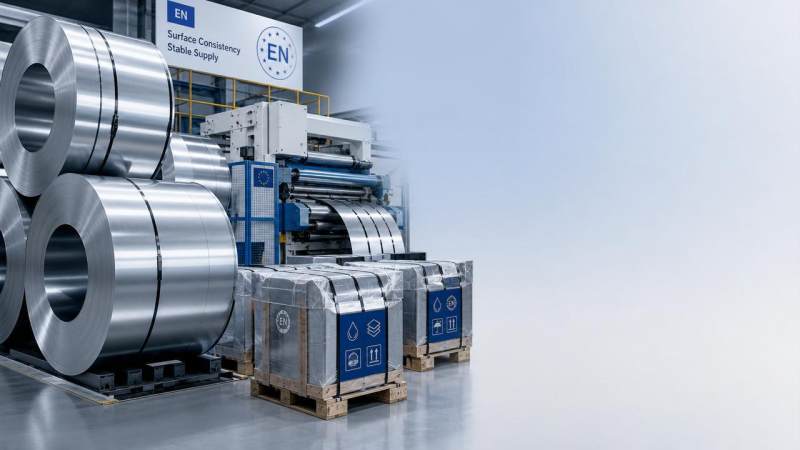
Europe is not only buying steel. It is buying documented quality, predictable processing, and low supply-chain risk. That is why checklist-based evaluation matters before shipment begins.
For a 304 stainless steel coil exporter to Europe, success depends on more than price. Material traceability, EN compliance, surface consistency, and delivery accuracy directly affect acceptance and repeat business.
A practical checklist reduces errors in specification matching, export paperwork, coating or finish confusion, and logistics coordination. It also helps compare suppliers on measurable facts instead of general promises.
Core checklist: what Europe expects from 304 stainless steel coil
- Confirm chemical composition first, especially chromium and nickel balance, because European buyers often require stable corrosion resistance and reliable forming performance across batches.
- Match the standard clearly, such as ASTM, EN, or JIS equivalence, and state it on all documents to avoid customs, testing, or downstream processing disputes.
- Define surface finish precisely, including 2B, BA, No.1, or brushed finishes, since appearance and cleanability strongly influence acceptance in visible or hygienic applications.
- Check thickness tolerance and width tolerance against end-use requirements, because European processors often run automated lines that depend on dimensional consistency.
- Request mechanical property data, including tensile strength, yield strength, and elongation, to ensure the coil performs correctly during bending, stamping, welding, or roll forming.
- Verify coil weight, inner diameter, and outer diameter before loading, since mismatch can interrupt slitting, decoiling, or line feeding at the destination plant.
- Inspect edge condition and flatness carefully, because poor edge quality may create safety issues, waste, or unstable processing during cutting operations.
- Prepare complete mill test certificates and traceability records, as European importers often need batch-level verification for quality systems and project approvals.
- Protect packaging against moisture and salt exposure, especially for sea transport, because stainless steel can still suffer staining, handling damage, or contamination.
- Evaluate delivery reliability, not just unit price, since delayed containers can disrupt construction schedules, fabrication planning, and contract performance in Europe.
Why Europe keeps demanding 304 grade instead of lower-cost alternatives
304 stainless steel coil offers a strong balance of corrosion resistance, formability, weldability, and appearance. That balance fits Europe’s wide mix of industrial and architectural applications.
In many projects, lower-cost materials may reduce initial spending but increase maintenance risk. Europe often values lifecycle performance, regulatory compliance, and processing stability over the cheapest tonnage.
This is why the phrase 304 stainless steel coil exporter to Europe reflects a demanding niche. The market rewards consistency, paperwork discipline, and technical understanding, not only aggressive quotations.
Food, kitchen, and sanitary equipment
304 is widely used where clean surfaces and moderate corrosion resistance are essential. Tanks, counters, panels, and equipment housings all benefit from its stable finish and fabrication flexibility.
In these uses, surface defects, contamination, and inconsistent polish levels matter. A dependable 304 stainless steel coil exporter to Europe must control finish quality from rolling to packing.
Construction and architectural fabrication
European construction uses stainless coil for trim, cladding details, drainage parts, and decorative fabrication. Aesthetic uniformity matters almost as much as corrosion performance in these visible applications.
Many steel projects also combine stainless with carbon steel structures. Companies with wider structural steel experience can better coordinate supply around fabrication, tolerances, and project schedules.
Industrial processing and light manufacturing
From machine covers to duct parts and formed components, 304 stainless steel coil remains a practical material for medium-corrosion environments. Stable stamping and welding behavior is a key buying factor.
Alongside stainless products, some buyers also source auxiliary metal materials for platforms, guards, and industrial partitions. In such mixed projects, Galvanized Expanded Metal Sheet can complement structural or enclosure needs with hot-dip zinc protection, customizable sizes, and compliance with standards such as ASTM, DIN, JIS, GB, and EN.
Available in grades such as DX51D+Z, S250GD+Z, and SGCC, this product supports applications in construction, transportation, agriculture, energy, communications, and light industry, with thickness from 0.12mm to 6.00mm and zinc layers from 60g/m² to 275g/m².
Commonly overlooked issues in European exports
- Ignore protective film compatibility and risk adhesive residue, which can create complaints when coils are stored, recoiled, or exposed to changing temperatures after arrival.
- Assume all 304 requests are identical and miss special demands on hardness, finish, slitting burr control, or application-specific certification.
- Use incomplete export labels and create confusion between heat numbers, coil numbers, and invoice data during customs clearance or warehouse receiving.
- Overlook contamination risks from carbon steel contact, which may affect surface condition and trigger quality disputes despite correct stainless chemistry.
- Focus only on FOB price and underestimate inland transport, port timing, insurance, and destination handling costs that influence final competitiveness.
These details often separate a routine shipment from a long-term supply relationship. Europe tends to reward suppliers that eliminate uncertainty before the material reaches the processing line.
Practical execution steps for stable export performance
- Start with a written specification sheet covering grade, finish, tolerances, coil size, packaging, certification, and destination use.
- Cross-check buyer standards with mill production capability before confirming lead time or offering alternative equivalents.
- Sample and inspect critical surface areas under proper lighting, especially for visible architectural and appliance applications.
- Separate stainless handling areas from carbon steel operations to reduce contamination and preserve surface integrity.
- Issue full pre-shipment documentation early, including MTC, packing list, invoice, and identification mapping for every coil.
- Track shipping milestones closely and communicate delays fast, because downstream European schedules are usually fixed and tightly coordinated.
Why Chinese supply remains competitive
China remains an important source because it combines scale, flexible processing, and broad export experience. For a 304 stainless steel coil exporter to Europe, this means faster response to custom sizes and volume planning.
Hongteng Fengda, as a professional structural steel manufacturer and exporter from China, supports global projects with stable production, strict quality control, and compliance with ASTM, EN, JIS, and GB standards.
Although known for angle steel, channel steel, beams, cold formed profiles, and customized structural components, this export discipline also reflects the wider capabilities expected in steel sourcing: consistency, dependable lead times, and reduced procurement risk.
Conclusion and next action
Europe keeps demanding 304 stainless steel coil because it meets real performance needs across food equipment, construction, and industrial manufacturing while fitting strict compliance expectations.
For any 304 stainless steel coil exporter to Europe, the winning approach is clear: control chemistry, finish, dimensions, documents, packaging, and logistics with checklist precision.
Use the checklist above to review current supply capability, compare mills, and tighten export execution. Better preparation creates smoother clearance, fewer claims, and stronger repeat orders in the European steel market.
Please give us a message


Please enter what you want to find